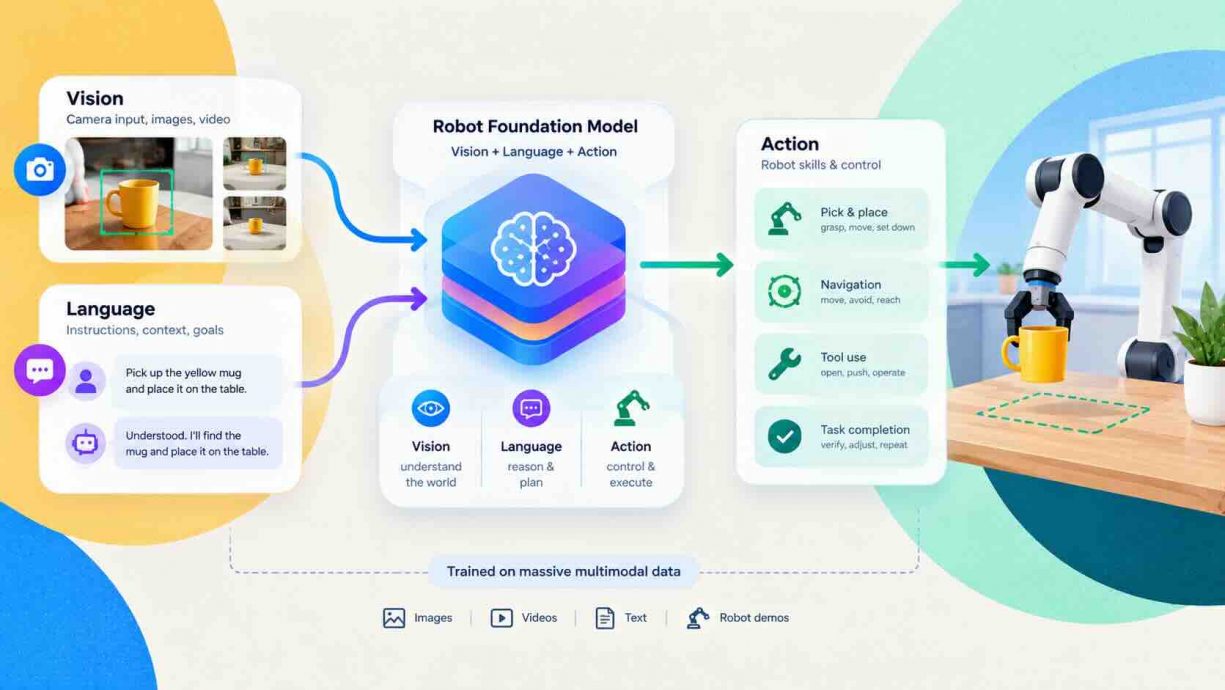

Introduction
Readers who type “What Is Robot Foundation Models Explained Vision Language Action?” into a search box want a plain answer before any jargon. Factories already run on machines at enormous scale, because the International Federation of Robotics counted 542,000 new industrial robot installations in 2024 alone. Almost all of those machines still follow hand-written routines that break the moment a part, a light, or a task changes. Robot foundation models try to fix that brittleness by borrowing the recipe behind large language models: pretrain one big model on diverse data, then adapt it. Vision-language-action models, usually shortened to VLAs, are the most visible version of that recipe because they read camera images and instructions and output motor commands. This guide explains what these systems are, how they work, where they came from, and where they still fall short. It also covers training data, open versus closed models, safety, ethics, economics, and practical steps for getting started.
Quick Answers on What Robot Foundation Models and Vision-Language-Action Systems Do
What is a robot foundation model?
A robot foundation model is a large neural network pretrained on diverse robot and internet data, then adapted to many tasks and machines. It replaces hand-coded routines with one general policy.
What is a vision-language-action model?
A vision-language-action model reads camera images and a language instruction, then outputs robot actions directly. RT-2, OpenVLA, π0, and Gemini Robotics all follow this pattern of turning a vision-language backbone into a control policy.
Why do robots need foundation models?
Classic robots break when objects, lighting, or tasks change. Foundation models bring broad visual and language knowledge, so one policy can generalize to unseen objects and follow new instructions with little extra data.
Key Takeaways
- The short answer to “What Is Robot Foundation Models Explained Vision Language Action?” is that a robot foundation model is one large pretrained network that can control many tasks and robot bodies.
- A vision-language-action model is the version that takes camera images plus a text instruction and returns motor commands in a single learned pipeline.
- Real progress comes from data scale and diversity, including shared datasets such as Open X-Embodiment, teleoperation, human video, and synthetic simulation.
- Brittleness, safety, and cost remain open problems, so these models are best treated as powerful but unfinished tools for supervised deployments.
Table of contents
- Introduction
- Quick Answers on What Robot Foundation Models and Vision-Language-Action Systems Do
- Key Takeaways
- What Is a Robot Foundation Model, and Where Do VLAs Fit?
- Why Robots Needed Foundation Models in the First Place
- How a Vision-Language-Action Model Turns Pixels Into Motion
- Action Tokens, Diffusion, and Flow Matching Explained
- Training Data: Teleoperation, Shared Datasets, and Synthetic Worlds
- The Landmark Models From RT-1 to Gemini Robotics
- Dual-System Designs: Fast Reflexes and Slow Reasoning
- Open Models Versus Closed Models in Robotics
- Hardware Realities: Edge Compute, Latency, and Embodiment Gaps
- Putting Robot Foundation Models to Work in Real Deployments
- Where Vision-Language-Action Models Fall Short Today
- Safety and Risk Management for Embodied AI
- Ethics, Labor, and Privacy in the Age of Generalist Robots
- How Researchers Evaluate Generalist Robot Policies
- The Economics Behind Robot Foundation Models
- Skills and Tools for Getting Started
- The Future of Robot Foundation Models and Embodied Intelligence
- Key Insights
- Open Models Putting Robot Foundation Models Into Practice
- Lessons From Landmark Robot Foundation Model Deployments
- Frequently Asked Questions About Robot Foundation Models and Vision-Language-Action
What Is a Robot Foundation Model, and Where Do VLAs Fit?
The question “What Is Robot Foundation Models Explained Vision Language Action?” has a short answer. A robot foundation model is a large pretrained network that controls many robots, and a vision-language-action model is its version that maps images and instructions straight to actions.
An Interactive From AIplusInfo
Can your task be taught to a VLA?
Set the number of demonstrations you can record, the kind of task, and the action head, then see an illustrative estimate of effort and fit.
200
Pick and place
Action tokens
Teleoperation time
0 hrs
Data coverage
0%
Illustrative fit score
0
This is a planning heuristic, not a measurement. For scale, the Gemini Robotics paper reports learning new short-horizon tasks from as few as 100 demonstrations.
Why Robots Needed Foundation Models in the First Place
For most of the last sixty years, industrial robots have been programmed like machine tools rather than trained like students. An engineer defines waypoints, grip forces, and timing, and the arm repeats the routine thousands of times with remarkable precision. That approach works superbly when the world never changes and fails quickly when anything shifts. A bin of parts that arrives rotated, a glossy surface that confuses a camera, or a new product variant can stop a line until a specialist rewrites the program. Retooling costs time and money, which is why robots cluster in high-volume factories rather than in kitchens, changing warehouses, or homes. The deeper lesson was that perception and planning built by hand do not scale to the messy variety of real environments.
Machine learning offered a first escape from hand-coding, but early learned robots stayed narrow. Reinforcement learning could teach an arm to grasp or a quadruped to walk, yet each skill demanded its own reward design and enormous amounts of trial and error. Researchers studying the role of AI in robots saw one pattern repeat. A policy that excelled in one lab setup collapsed when the table, lighting, or gripper changed. Imitation learning from human demonstrations reduced the trial and error, though every new task still needed fresh demonstrations. The result was a research landscape full of single-purpose policies, each trained from scratch on a small dataset. Nothing resembled the flexible, reusable intelligence that language models had begun to show on text.
The turning point came when researchers asked whether robot learning could follow the path that language and vision had already taken. Models for text and images became general by pretraining on enormous, varied datasets and then adapting with small amounts of task data. Google’s RT-1 tested a version of this idea on real hardware, collecting over 130,000 episodes covering more than 700 tasks with 13 robots across 17 months. It completed 97 percent of the instructions it had seen and 76 percent of instructions it had never seen, a large margin over the baselines compared. Those results showed that the scale and diversity of robot data mattered, but RT-1 still knew nothing about the wider world beyond its own demonstrations. That gap between robot experience and internet knowledge is exactly what vision-language-action models were designed to close.
How a Vision-Language-Action Model Turns Pixels Into Motion
Building on that foundation, it helps to follow a single instruction through a VLA from start to finish. A camera captures the scene and a vision encoder converts the pixels into embeddings. The instruction, such as “put the red cup in the sink,” becomes a sequence of text tokens. A large transformer backbone then fuses both streams, much like the rise of multimodal AI has done for chat assistants that see and read. The backbone is the part that carries the world knowledge, because it was pretrained on billions of images and sentences before it ever saw a robot. A final action component converts the fused representation into numbers the robot can execute, such as joint targets or the motion of a gripper. The whole loop repeats many times per second, so the model sees the effect of each movement and corrects course.
The vision side deserves a closer look because robots depend on spatial detail that web captions rarely describe. OpenVLA, an open 7-billion-parameter model, fuses DINOv2 and SigLIP features from the same image, pairing a feature extractor strong at geometry with one strong at semantics. The geometric features help the model judge where an object sits and how large it is. The semantic features help it recognize that a shape is a mug rather than a bowl. Together they give the language backbone a richer picture than either encoder could supply alone. This pairing explains why some VLAs handle cluttered tables far better than earlier policies that used a single small convolutional network.
The language backbone is where the “foundation” in robot foundation model really lives. RT-2 built its policy on large vision-language models, including the 55-billion-parameter PaLI-X and the 12-billion-parameter PaLM-E, and trained them on both web tasks and robot data at the same time. That co-training lets the model reuse concepts it learned from the internet, such as the meaning of an icon, a number, or a brand of drink. A robot never shown a rock used as a hammer can still reason that a rock is the best available tool. Researchers call this behavior emergent, since the robot data alone never contained those examples. The same effect is why instructions phrased in unfamiliar ways often still work.
Control rate and context make the final piece of the pipeline. Many VLAs take the current image plus a short history of robot state, and some also receive the position of the arm joints, called proprioception. Instead of predicting one motion per step, a number of modern models predict a short chunk of future actions, which smooths movement and reduces the number of expensive model calls. The chunk is executed while the next prediction is computed, so the robot does not freeze while it thinks. Each design choice trades smoothness, reaction speed, and compute against one another. Those trade-offs lead directly to the question of how the action itself should be represented.
Action Tokens, Diffusion, and Flow Matching Explained
Turning to the action head, the simplest idea is to treat motion as another language. RT-2 expresses actions as text tokens, so a robot movement is written as a short string of numbers that the language model generates the same way it generates words. This trick lets the existing vocabulary and training machinery carry over almost unchanged. It also meant that the same model could answer a question about an image and then output the movement needed to act on it. The drawback is that discretizing continuous motion into a limited set of tokens throws away precision, which hurts delicate tasks. Learn more about how tokenization works in LLMs and the same limit becomes easy to see, because every token is a coarse bucket.
Diffusion and flow matching take a different route by generating continuous actions directly. A diffusion model starts from random noise and refines it step by step into a plausible action sequence. Flow matching learns a smooth path from noise to the target in fewer steps. The π0 model from Physical Intelligence starts from a roughly 3-billion-parameter vision-language model. It attaches a flow matching action expert that outputs motor commands up to 50 times per second. That rate is high enough for dexterous work such as folding clothes, where a stiff or jerky controller would crumple the fabric. NVIDIA’s GR00T N1 uses a related idea with a diffusion transformer that generates motor actions in real time. Both designs show that high-frequency, continuous control is compatible with a large language-aware backbone.
Choosing between these approaches depends on the task and the hardware budget. Token-based heads are simple, reuse existing language tooling, and work well when coarse motions suffice. Diffusion and flow heads cost more compute per prediction but deliver the smooth trajectories that contact-rich manipulation requires. Some teams combine them, using a language model to plan at a low rate and a continuous action expert to execute at a high rate. That combination is the direct ancestor of the dual-system designs discussed later in this guide.
Training Data: Teleoperation, Shared Datasets, and Synthetic Worlds
Turning to the fuel behind these models, data is the scarcest ingredient in robot learning. Text and images exist by the trillion on the internet, but a recording of a robot hand turning a valve must be produced by a person operating a real machine. Teleoperation, where a human controls the robot through a leader arm, a headset, or a VR controller, remains the main source of high-quality demonstrations. Figure’s Helix system, for example, was trained on about 500 hours of teleoperated data, which the company says is under 5 percent of the size of earlier VLA datasets. Collecting demonstrations is slow and expensive, so every hour has to teach something new. The scarcity pushes researchers to squeeze value out of every source they can find.
Sharing data across labs is one answer, and the Open X-Embodiment project is the largest effort so far. It pooled data from 22 robots across 21 institutions, covering 527 skills and 160,266 tasks. A single high-capacity model trained on the mix improved several robots by using experience from other platforms. This positive transfer was the first strong evidence that robots with different bodies can learn from one another. The idea mirrors how a language model benefits from text in many domains. Open datasets also let small labs train models that would otherwise require a corporate data-collection program.
Human video and simulation fill the remaining gaps that real teleoperation cannot cover cheaply. Internet videos of people cooking, cleaning, and assembling things show what useful behavior looks like, even though they contain no robot actions. Synthetic data goes further, because NVIDIA describes a synthetic motion generation pipeline that uses imitation learning to expand a small number of human demonstrations into large datasets. Simulation has its own limit, namely the reality gap, where physics and appearance in the simulator differ from the real world. Teams therefore blend real teleoperation, human video, and synthetic trajectories, weighting the expensive real data most heavily where precision matters.
The Landmark Models From RT-1 to Gemini Robotics
Looking at the timeline, the field moved from narrow transformers to general foundation models in barely three years. RT-1 in late 2022 proved that a transformer trained on a large, diverse set of real demonstrations could follow hundreds of instructions. RT-2 arrived in 2023 and gave the idea its name, since Google DeepMind reported that success on unseen scenarios rose from 32 percent for RT-1 to 62 percent. Its tests covered more than 6,000 robotic trials across symbol understanding, reasoning, and human recognition. RT-2 made the central claim of the whole field: web knowledge can be transferred into physical control. That result opened the door to every model that followed.
Open models arrived next and put the technology in the hands of researchers outside the big labs. Octo trained a transformer policy on 800,000 trajectories from the Open X-Embodiment collection and could be fine-tuned to new robots in a few hours. OpenVLA followed with 7 billion parameters and outperformed the far larger RT-2-X by 16.5 points of absolute task success across 29 tasks. SmolVLA later showed that a 450-million-parameter model could run on modest hardware. Each of these releases shifted the bottleneck from model access to data and evaluation.
The next generation of models focused on dexterity and on open-world behavior in unfamiliar places. The π0 model showed laundry folding, table cleaning, and box assembly from a single policy family, trained on data from eight distinct robot platforms. Its successor π0.5 added co-training on heterogeneous data, including web data and semantic subtask prediction, and demonstrated long-horizon cleaning of kitchens and bedrooms in homes it had never seen. That was presented as the first end-to-end learned system to do so, a claim made by its authors. The step from lab tables to unfamiliar houses is the one that matters for real products.
Large model families from the major labs now anchor the field. Gemini Robotics is a VLA built on Gemini 2.0 that directly controls robots. Google DeepMind states that it more than doubles performance on a comprehensive generalization benchmark compared with other VLAs. A companion model, Gemini Robotics-ER, adds spatial reasoning such as pointing, grasp prediction, and 3D bounding boxes. NVIDIA released GR00T N1 as an open foundation model for humanoids, and later versions have continued the line. Together these systems show that robot foundation models are now a product category rather than a research curiosity.
Dual-System Designs: Fast Reflexes and Slow Reasoning
Stepping back from single-model designs, many of the strongest systems split the problem in two. A robot needs slow, deliberate understanding to decide what to do and fast, reactive control to do it without wobbling. Figure’s Helix is the clearest example of this idea in current humanoid robots. It pairs System 2, a 7-billion-parameter vision-language model running at 7 to 9 Hz, with System 1, an 80-million-parameter policy running at 200 Hz. System 2 thinks about the scene and the instruction, while System 1 turns that thinking into smooth joint motion hundreds of times each second. The split resembles how a person decides to pick up a glass and then lets the hand handle the details.
The same logic appears in NVIDIA’s GR00T N1, a dual-system vision-language-action model in which one module interprets the scene and language while a diffusion transformer generates motor actions. The two modules are trained jointly, end to end, so the fast controller learns to use the slow module’s output. This differs from older hierarchical systems that glued a planner and a controller together after separate training. Joint training lets errors in one module be corrected through the other. It also keeps the interface between them a learned latent signal rather than a hand-written command.
The practical benefit is that each half can be sized for its job. A large language-aware model can afford to run slowly because the world changes slowly at the level of intentions. A small action model must be fast and light enough to run on onboard hardware beside the robot. Helix runs its two systems on separate embedded GPUs on each robot, which keeps the whole stack local and avoids cloud latency. Dual-system designs therefore trade architectural complexity for the ability to reason and react at once.
Open Models Versus Closed Models in Robotics
On the open side of the market, researchers can download weights, inspect the code, and fine-tune a model on their own robot. OpenVLA is the clearest example, because its authors released checkpoints, fine-tuning notebooks, and a PyTorch codebase alongside the paper. Octo and SmolVLA follow the same philosophy, and NVIDIA’s robotics AI training models extend it to humanoid platforms. Open weights let a lab adapt a policy to an unusual gripper, keep sensitive footage on its own servers, and audit exactly what changed between versions. The price of that control is that the lab must supply its own data, compute, and safety engineering. Smaller teams often accept the price because the alternative is dependence on a vendor roadmap.
Closed models trade transparency for scale and polish, and that trade appeals to many commercial buyers. RT-2 and Gemini Robotics were built by labs with access to huge compute budgets, large fleets of robots, and teams that curate training data full time. Google DeepMind has described Gemini Robotics-ER as available only to selected trusted testers, which shows how access can be tightly gated. A closed model may lead on raw capability at a given moment, and it usually arrives with a managed interface that hides the plumbing. The downside is that users cannot see the training data, cannot change the weights, and must accept whatever pricing and terms the vendor sets. When a vendor changes or retires a model, every robot that depended on it inherits the disruption.
The line between the camps is blurrier than it first appears. Figure describes the System 2 half of Helix as an open-source, open-weight vision-language model, while keeping the full product closed. Physical Intelligence publishes research papers on π0 and describes it as a prototype rather than a shipped product. Some vendors release smaller models openly to build ecosystems and keep their largest systems proprietary. For a buyer, the practical question is therefore which layers need to be inspectable and which can be rented.
Hardware Realities: Edge Compute, Latency, and Embodiment Gaps
Given the physical demands of manipulation, a VLA cannot behave like a chatbot that waits patiently for a server. A robot arm moving at working speed needs fresh action commands many times per second, and a network round trip can arrive too late to matter. That is why Helix places its two systems on dedicated embedded GPUs inside each robot. Engineers also shrink models through methods such as post-training quantization for edge AI, which stores weights at lower precision to cut memory and latency. OpenVLA’s authors report that quantization allows efficient serving without reducing downstream task success. Compute budgets on a battery-powered robot are always tighter than the specification sheet of the model suggests.
The embodiment gap is the second hardware challenge, and it is subtler. Every robot has its own joint limits, camera positions, and action space, and a policy trained on one body does not automatically move to another. The tool at the end of the arm matters too, because a suction cup and a five-finger hand create different contact physics. This explainer on what an end effector is describes the range of options. Cross-embodiment training, as in Open X-Embodiment and Octo, tries to teach one model the shared structure beneath those differences. Gemini Robotics reports adapting to completely novel robot embodiments with fine-tuning, though the authors give no quantitative benchmark in the abstract. Teams should still budget for calibration, camera placement, and a round of fine-tuning whenever the hardware changes.
Putting Robot Foundation Models to Work in Real Deployments
In practice, a deployment begins with a narrow, measurable task rather than a general ambition. A team might choose to sort returned items into bins, load a dishwasher, or feed parts into a fixture, and then define what counts as success. Clear success criteria matter because VLAs fail in soft ways, such as hesitating, grasping the wrong object, or dropping an item halfway through. The team also decides the safe operating envelope, including speed limits, force limits, and the region where humans may stand. Without that envelope the project has no basis for deciding whether the model is ready for the floor.
The second stage is gathering task-specific demonstrations and fine-tuning a pretrained model rather than training from scratch. Because the base model already understands objects and language, a modest set of demonstrations can be enough to specialize it. The Gemini Robotics authors report that their model can learn new short-horizon tasks from as few as 100 demonstrations with fine-tuning. Parameter-efficient methods such as low-rank adaptation reduce the compute needed, and OpenVLA’s authors note that it can be fine-tuned on consumer GPUs. Demonstration quality matters more than quantity, because a policy copies the hesitations and mistakes of its teacher. Consistent camera placement, steady lighting, and a few deliberate recovery examples all pay off at this stage.
Evaluation comes before any contact with the real production line. Teams run the policy repeatedly on the actual task, count successes and failures, and note the circumstances of each failure. They also test variations on purpose, such as new object positions, different lighting, or a distractor on the table. A model that scores well on the training layout but poorly on small changes is not ready, because production floors change constantly. Logging every trial with video lets engineers see whether failures cluster around a particular object or motion.
The final stage is a supervised rollout with humans in the loop and a monitoring plan. Many early deployments keep a person ready to take over through teleoperation, and they treat each takeover as new training data. Over time the share of tasks the robot completes alone grows, and the team widens the operating envelope step by step. Rollbacks must be easy, because a fine-tuned model can regress on tasks it previously handled well. Treating the policy like any other production software, with versions, tests, and change logs, prevents most surprises.
Where Vision-Language-Action Models Fall Short Today
Despite the progress, the people who build these models are frank about how much remains unsolved. The π0 authors call their model only a small early step and say generalist policies are still in their infancy. They list long-horizon reasoning, self-improvement, robustness, and safety as open problems. Success rates that look impressive in a demo video often hide failures that appear only across many repeated trials. A model that folds laundry well on ten attempts may still jam on the eleventh because a sleeve bunched in an unusual way.
Brittleness shows up in several forms, and each one limits where these models can work. Policies can be thrown off by lighting changes, by objects that look unlike anything in the training mix, or by an instruction phrased in an unexpected way. Language grounding is imperfect, so a model may pick the right color but the wrong object, or confuse left and right. Precision tasks that demand sub-millimeter accuracy, such as inserting a connector, remain much harder than pick-and-place. Researchers also report that models can ignore parts of an instruction when the visual scene strongly suggests a familiar habit.
Security is a newer weakness that deserves far more attention from builders and buyers. A system that follows natural-language instructions can in principle be steered by hostile text, by manipulated images, or by instructions hidden in the environment. Reporting on robots vulnerable to manipulation attacks shows how quickly a language-driven robot can be pushed into unsafe behavior. Because the consequences are physical, these attacks are more serious than a chatbot producing bad text. Defenses such as input filtering, action validators, and hard-coded limits are still maturing.
Safety and Risk Management for Embodied AI
Moving on to safety, the central difficulty is that a learned policy cannot be proven correct the way a hand-written controller sometimes can. Established practice is therefore to wrap the model in layers that do not depend on it, as laid out in this overview of robot safety standards. Low-level controllers enforce joint limits, speed limits, and contact-force limits regardless of what the model asks for. Safety-rated sensors and emergency stops cut power when a person enters a protected zone. The learned model proposes actions, but only a deterministic safety layer is allowed to approve them. That separation keeps a rare model error from becoming a physical injury.
Google DeepMind describes this layered thinking in its Gemini Robotics work, saying that Gemini Robotics-ER can connect to low-level safety controllers that handle collision avoidance, contact-force limits, and dynamic stability. The company also released the ASIMOV dataset to measure semantic safety, which asks whether an action is appropriate in context, such as not handing a knife blade-first to a child. Semantic safety is harder than physical safety because it depends on human norms. Risk managers should therefore combine physical safeguards, semantic checks, staged testing, and clear incident reporting. Each deployment needs a documented hazard analysis before the first trial near a person.
Ethics, Labor, and Privacy in the Age of Generalist Robots
Beyond the engineering questions, generalist robots raise familiar worries about work. If one model can learn many tasks, the range of jobs a robot can plausibly do widens from repetitive factory steps to warehouse picking, cleaning, and elder care. Discussion of how robots affect jobs shows that the effects depend on adoption speed, retraining support, and who captures the savings. Whether foundation models help workers or only replace them is a policy choice, not a technical inevitability. Employers can use robots to take over dangerous or exhausting tasks while keeping people in supervisory and skilled roles. They can also use them to cut headcount, and the same technology serves both ends.
Privacy is a second concern, because a home robot sees, hears, and records the most private spaces people have. A VLA that learns from camera feeds may collect images of children, medical items, and documents. Questions follow about where the footage is stored, who can review it, and whether it is used to train future models. Closed cloud-connected systems make these questions harder to answer, while locally run open models offer more control. Clear consent, data minimization, and the ability to delete recordings should be design requirements rather than afterthoughts.
Fairness and accountability complete the ethical picture for generalist robots. Training data reflects the homes, workplaces, and body types of the people who collected it, so a robot may work better for some users than others. Teleoperators who generate demonstration data are themselves workers whose pay, conditions, and recognition deserve attention. When a robot causes harm, responsibility could fall on the model developer, the integrator, the operator, or the owner, and current law gives incomplete answers. Transparent documentation of training sources, known limitations, and incident histories would help assign responsibility fairly.
How Researchers Evaluate Generalist Robot Policies
From there, the natural question is how anyone knows a robot policy is actually good. The most credible evidence comes from many real trials, because simulation hides the friction, noise, and clutter of real scenes. The RT-2 team reported more than 6,000 robotic evaluation trials, spread across categories such as symbol understanding, reasoning, and human recognition. Each category probes a different part of generalization, so a single average could mislead. Researchers therefore report results separately for new objects, new backgrounds, new instructions, and added distractors. Anyone who asks “What Is Robot Foundation Models Explained Vision Language Action?” should also ask how the answer was measured.
The RT-1 results show why the breakdown matters so much. The model completed 97 percent of seen instructions and 76 percent of unseen ones. Its success was 83 percent on tasks with distractors but only 59 percent on new backgrounds. Simulation benchmarks add speed and repeatability to the picture for researchers who compare methods. On the Language Table benchmark RT-2 reached 90 percent success, ahead of BC-Z at 72 percent, RT-1 at 74 percent, and LAVA at 77 percent. Such numbers are useful for comparing methods, though they do not guarantee the same ordering on a real robot. Reading any claim of a “first” or a “state-of-the-art” result requires checking whether the evaluation is independent, reproducible, and large enough to trust.
The Economics Behind Robot Foundation Models
Turning to money, the business case rests on falling hardware costs and rising software capability. Goldman Sachs Research projects that the total addressable market for humanoid robots could reach $38 billion by 2035, with shipments of about 1.4 million units. Its analysts found that manufacturing cost per unit fell to a range of $30,000 to $150,000 from an earlier $50,000 to $250,000. Costs dropped 40 percent against an expected decline of 15 to 20 percent a year. The firm calls AI progress the biggest surprise, which ties hardware economics directly to the software discussed in this guide.
Software economics differ from hardware economics because a foundation model can be reused. Once a model is pretrained, the marginal cost of adapting it to a new task is a few hundred demonstrations and some compute rather than a new engineering project. Investors have noticed, which is why companies such as Physical Intelligence have drawn major funding, as covered in this story on funding for Physical Intelligence. If one model can serve many robots, the value shifts from selling a single machine to selling the intelligence that runs it. That shift favors firms with data, distribution, and the ability to keep models updated.
Real obstacles remain before the economics of humanoid robots fully close. Goldman notes unresolved bottlenecks in AI software for manipulation, such as grasping, and a shortage of high-precision grinding machines needed for components. Its base case counts more than 250,000 humanoid shipments in 2030, almost all for industrial use rather than homes. Customers will pay only if robots complete tasks reliably enough to beat human labor or existing automation on total cost. Maintenance, insurance, and supervision costs also belong in any honest comparison.
Skills and Tools for Getting Started
For teams ready to experiment, the barrier to entry is lower than it was two years ago. SmolVLA is a compact model with 450 million parameters, and its creators say it can train on a single consumer GPU and even run on a CPU or a MacBook. It was built from 487 community datasets recorded on low-cost arms such as the SO-100, which amounts to roughly 10 million frames. A hobbyist or student can therefore collect a few dozen demonstrations on an inexpensive arm and fine-tune a real policy. The fastest way to learn this field is to collect your own data on a cheap arm and watch exactly where the policy fails. That experience teaches more about data quality than any paper.
The skill set for this field spans several different disciplines. Comfort with Python, PyTorch, and the transformer ecosystem is the base, since nearly every open VLA ships as a PyTorch codebase. Understanding how transfer learning is used helps explain why fine-tuning a pretrained model needs so little new data. Basic robotics knowledge, such as coordinate frames, kinematics, and camera calibration, prevents many mysterious failures. Practitioners should also learn to design experiments, log results, and report uncertainty honestly. Reading the original RT-2, OpenVLA, and π0 papers closes the loop between theory and practice.
The Future of Robot Foundation Models and Embodied Intelligence
Looking ahead, the most likely direction is more data, more diverse embodiments, and better reasoning about long tasks. Researchers expect cross-embodiment pretraining to keep improving as shared datasets grow beyond the 22 robots in Open X-Embodiment. Models will probably learn from their own deployments, using successful runs as new training data and flagging failures for review. Longer planning horizons will come from tighter links between language reasoning models and low-level controllers. The decisive bottleneck is shifting from model design to the supply of high-quality physical experience.
Simulation and world models may ease that bottleneck by letting robots rehearse before they act. NVIDIA’s work on Cosmos and humanoid navigation points toward generated environments that supply varied training scenes at low cost. The challenge is to keep generated data faithful to real physics, so that policies trained on it do not learn false habits. Hybrid recipes that mix real teleoperation, human video, and generated scenes already appear in current models. Expect the balance to move toward synthetic data as simulators improve.
Household and workplace adoption will be gradual rather than sudden. Early products will target structured settings such as warehouses, hospitals, and factories, where tasks are bounded and safety can be engineered. Interest in humanoid robots in the home is high, but reliability, price, and trust will decide how fast the idea spreads. Regulation will likely follow incidents, with standards for learned controllers, data handling, and transparency. Anyone planning around this technology should expect steady capability gains punctuated by hard lessons. Readers who still ask “What Is Robot Foundation Models Explained Vision Language Action?” should expect the answer to keep evolving as new models arrive.
Chart From AIplusInfo
Where early robot transformers generalize, and where they do not
RT-1 success rate by evaluation condition, in percent. Higher is better.
Source: Robotics Transformer 1 project results, as reported by its authors.
Key Insights
- IFR's World Robotics data shows 542,000 industrial robot installations in 2024 and 4.66 million units in use, a vast installed base of mostly inflexible machines.
- Google DeepMind reports that RT-2 raised success on unseen scenarios from 32 percent for RT-1 to 62 percent, showing that web knowledge can transfer into physical control.
- The 7-billion-parameter OpenVLA model beat the 55-billion-parameter RT-2-X by 16.5 points of absolute task success across 29 tasks, so smaller open models can compete with giants.
- The Open X-Embodiment collaboration pooled data from 22 robots at 21 institutions into 527 skills and 160,266 tasks, and cross-robot training improved individual machines.
- Figure says Helix learned from about 500 hours of teleoperated data, under 5 percent of earlier VLA datasets, which suggests that data efficiency is improving quickly.
- Goldman Sachs Research projects a $38 billion humanoid market by 2035 with 1.4 million shipments, as unit costs fell to between $30,000 and $150,000.
- The SmolVLA model has 450 million parameters, trains on a single consumer GPU, and learned from 487 community datasets, which lowers the barrier for small labs and students.
Taken together, these figures describe a field that is moving from proof of concept toward early products. Pretraining on web knowledge and shared robot data has delivered measurable gains in generalization within only a few years. Readers who ask "What Is Robot Foundation Models Explained Vision Language Action?" now have a concrete answer backed by measurable results from many labs. Falling hardware costs and better data efficiency make commercial deployments more plausible each year. Reliability, safety, and honest evaluation still decide whether those deployments earn lasting trust. The sensible reading is cautious optimism backed by careful testing rather than excitement about any single demonstration.
| Dimension | RT-2 | OpenVLA | π0 | GR00T N1 | Gemini Robotics |
|---|---|---|---|---|---|
| Origin | Google DeepMind | Open research release | Physical Intelligence | NVIDIA | Google DeepMind |
| Backbone | PaLI-X 55B or PaLM-E 12B | Llama 2 with DINOv2 and SigLIP vision features | Roughly 3B vision-language model | Vision-language module plus diffusion transformer | Gemini 2.0 |
| Action output | Actions written as text tokens | Action tokens from the language model | Flow matching expert, up to 50 Hz | Diffusion transformer generating motor actions | Direct robot control from the Gemini-based model |
| Openness | Closed research system | Open code and checkpoints, 7B parameters | Research prototype with a published paper | Described as an open foundation model for humanoids | Main model limited; ER model for trusted testers |
| Training data | Web vision-language tasks plus robot trajectories | 970,000 real-world robot demonstrations | Data from 8 distinct robots | Real trajectories, human videos, and synthetic data | Mainly bi-arm ALOHA 2 data |
| Headline result | Unseen-scenario success rose from 32 to 62 percent | 16.5 point gain over RT-2-X across 29 tasks | Laundry folding, table cleaning, box assembly | Beat imitation baselines in simulation; ran on a Fourier GR-1 humanoid | More than doubled a generalization benchmark versus other VLAs |
| Best suited for | Studying web-to-robot knowledge transfer | Labs that need to fine-tune on their own robot | Dexterous, contact-rich manipulation | Humanoid research with open tooling | Teams working inside Google's partner ecosystem |
Open Models Putting Robot Foundation Models Into Practice
OpenVLA Fine-Tuning on Consumer GPUs
A research team trained OpenVLA, a 7-billion-parameter model built on a Llama 2 language model with fused DINOv2 and SigLIP vision features, on 970,000 real-world robot demonstrations. They deployed the model across multiple robot embodiments and compared it with RT-2-X, a model with 55 billion parameters. OpenVLA achieved a 16.5 percent absolute gain in task success across 29 tasks while using about seven times fewer parameters. Low-rank adaptation let other labs fine-tune the model on consumer GPUs, and quantization allowed efficient serving without reducing downstream success. The release turned a frontier-style capability into something a university lab could run. The limitation is that the reported gains cover a specific set of tasks and robots, and results on very new bodies still depend on additional fine-tuning data.
Octo Across Nine Robot Platforms
Octo was built as an open-source starting point for generalist manipulation, trained on 800,000 trajectories drawn from the Open X-Embodiment dataset. Its authors used a transformer policy that accepts either language commands or goal images, and they evaluated it across 9 robotic platforms. Teams can fine-tune Octo to robots with new sensors and action spaces in a few hours on consumer GPUs. That shortens adaptation from a research project of weeks to an afternoon of work for a small lab. The model also served as an open baseline that later systems could be compared against. Its limitation is that it is far smaller than later VLAs with large language backbones, so it carries less web knowledge and still needs task-specific fine-tuning.
SmolVLA on Low-Cost Community Arms
Hugging Face's team trained SmolVLA, a compact model with 450 million parameters, on 487 community datasets recorded mostly on the low-cost SO100 arm, roughly 10 million frames in total. They also built an asynchronous inference stack that separates action prediction from action execution. In their tests the asynchronous mode finished tasks about 30 percent faster, 9.7 seconds against 13.75 seconds, at a similar success rate of about 78 percent. The model can train on a single consumer GPU and run on a CPU or even a laptop. The drawback is that community data is often noisy with vague task labels, and the model uses only a global camera view at runtime. Whether training on these arms transfers to very different robots remains an open question.
Recommended by AIplusInfo
Books to go deeper on robot learning
Three well-regarded titles that map to the policies, language models, and motion control discussed above.
As an Amazon Associate, AIplusInfo earns from qualifying purchases.

Book
Reinforcement Learning: An Introduction (Adaptive Computation and Machine Learning series)
The standard textbook behind the policy, reward, and exploration ideas that robot learning methods still build on today.
Buy on Amazon
Book
Modern Robotics: Mechanics, Planning, and Control
A rigorous grounding in kinematics, dynamics, and motion planning that explains what the learned policies must still respect.
Buy on Amazon
Book
Hands-On Large Language Models: Language Understanding and Generation
A practical tour of the transformer language models that sit inside every vision-language-action stack discussed above.
Buy on AmazonLessons From Landmark Robot Foundation Model Deployments
Case Study: Google DeepMind's RT-2 Language Transfer
Before RT-2, Google's robot team faced a problem with its own earlier model. RT-1 could only act on combinations of objects and tasks seen in robot data, so it lacked knowledge of the wider world. The team's solution was to co-fine-tune large vision-language models, including PaLI-X with 55 billion parameters and PaLM-E with 12 billion, on robot trajectories and web tasks together. Actions were written as text tokens, so the model could output movements the same way it wrote words. In more than 6,000 evaluation trials, success on unseen scenarios rose from 32 percent for RT-1 to 62 percent. The model also showed emergent skills, such as choosing a rock as an improvised hammer, and a chain-of-thought variant added a plan step before the action tokens. A reader should keep the limits in mind, because the headline gains were measured on the team's own benchmark in controlled lab settings. The tokenized action format also constrained motion precision, which later flow-matching models set out to improve.
Case Study: Physical Intelligence and the Laundry Challenge
Physical Intelligence set out to solve a practical problem: robots could not handle long tasks with deformable objects, such as folding laundry, without brittle task-specific programming. The company built π0 by attaching a flow matching action expert to a roughly 3-billion-parameter vision-language model. The policy could then output continuous motor commands up to 50 times per second. It trained the model on data from 8 distinct robots, including single-arm, dual-arm, and mobile manipulators. According to the company's write-up, the same policy family handled laundry folding, table cleaning, and box assembly. The model could also recover when a person interfered with the robot mid-task. The authors describe the training set as the largest robot interaction dataset to date, although they give no total in hours.
The follow-up model, π0.5, extended the approach by co-training on web data, object detections, and semantic subtask predictions along with low-level actions. Its authors present it as the first end-to-end learned robotic system to perform long-horizon, dexterous skills such as cleaning a kitchen or bedroom in entirely new homes. That claim comes from the authors and has not been independently verified in the materials cited here. The π0 team also states plainly that the model is only a small early step, with long-horizon reasoning, self-improvement, robustness, and safety still unsolved. These limits mean that today's laundry demonstrations are best read as evidence of direction rather than a finished product. Still, the move from a lab table to unfamiliar homes marks a major change in what researchers attempt.
Case Study: Figure Helix and Coordinated Humanoids
Humanoid makers faced a bottleneck: a robot that must both understand a household scene and move its fingers smoothly could not run a single large model fast enough. Figure's solution, called Helix, split the work into System 2, a 7-billion-parameter vision-language model running at 7 to 9 Hz, and System 1, an 80-million-parameter policy running at 200 Hz. The company trained the system on about 500 hours of teleoperated data, which it says is under 5 percent of the size of earlier VLA datasets. In one demonstration, two robots running the same weights stored groceries they had never seen, coordinating through natural language prompts. Both robots run the system on dual low-power embedded GPUs, which keeps the control loop local. The company labels the results early, and its claims of being first come from Figure itself rather than independent testing. No failure rates are published, so buyers cannot yet judge reliability across thousands of runs. Open questions still remain about cost, battery life, and safety certification around people.
Frequently Asked Questions About Robot Foundation Models and Vision-Language-Action
A robot foundation model is a large neural network pretrained on diverse robot data, and often on internet images and text as well. After pretraining it can be adapted to many tasks and many robot bodies. This replaces separate hand-written programs for each job with one reusable policy.
When people ask "What Is Robot Foundation Models Explained Vision Language Action?" they mean a model that takes in vision (camera images) and language (a written instruction). It then produces action, which means commands that move a robot. Systems such as RT-2, OpenVLA, π0, and Gemini Robotics all follow this pattern.
A vision-language model reads images and text but only outputs text, such as a caption or an answer. A VLA adds an action output so the same network can control a robot. Many VLAs start from a pretrained vision-language model and then train it further on robot data.
The camera image and the instruction are converted into tokens and processed by a large transformer. An action component then turns the result into numbers such as joint targets or gripper motion. The loop repeats many times per second so the robot can correct itself as it moves.
Training mixes internet images and text, human teleoperation recordings, shared robot datasets, human videos, and synthetic simulation data. The Open X-Embodiment collection alone pooled data from 22 robots at 21 different institutions. Real demonstrations remain the scarcest and most valuable ingredient in robot learning today.
OpenVLA, Octo, and SmolVLA have all been released openly with code and weights or checkpoints. NVIDIA describes GR00T N1 as an open foundation model for humanoid robots. Closed systems include RT-2 and the main Gemini Robotics models, which are available only to limited partners.
Yes, fine-tuning is realistic on a consumer GPU for the smaller open models. OpenVLA's authors report that low-rank adaptation allows fine-tuning on consumer GPUs, and SmolVLA was designed to train on a single consumer GPU. Octo can be fine-tuned to new robots in a few hours on consumer hardware.
Not by themselves, because a learned policy cannot be proven correct the way a simple controller sometimes can. Safe deployments wrap the model in deterministic limits on speed, force, and workspace, plus emergency stops. Teams should complete a hazard analysis and staged testing before any trial near a person.
They can be thrown off by new lighting, unfamiliar objects, or unusual phrasing of an instruction. Precision tasks such as inserting a connector remain much harder than simple pick-and-place. Demo videos often hide failures that only show up across many repeated trials.
A dual-system VLA splits the job between a slow reasoning module and a fast control module. Figure's Helix pairs a 7-billion-parameter model running at 7 to 9 Hz with an 80-million-parameter policy running at 200 Hz. The split lets the robot think about the scene and still move smoothly.
Goldman Sachs Research estimates that manufacturing cost per unit fell to a range of $30,000 to $150,000. That is lower than the earlier estimate of $50,000 to $250,000. Retail prices, maintenance, and supervision costs will differ and are not yet well established.
They will change which tasks machines can do, but the net effect depends on adoption speed, policy, and retraining support. Early deployments focus on bounded industrial and logistics tasks rather than whole occupations. Employers can use the technology to remove dangerous work or to cut staff, so choices matter.
Nobody can give a firm date, and the authors of the leading models describe their work as early. Goldman's base case sees more than 250,000 humanoid shipments in 2030, almost all for industrial use. Homes will likely come later, after reliability, price, and safety improve.