
Introduction
Japan is facing one of the most severe labor shortages in the developed world, and its food service industry sits at the center of this crisis as restaurants and station eateries struggle to fill critical kitchen positions. Connected Robotics, a Tokyo-based startup founded in 2017, is tackling this challenge head-on by building AI-powered cooking robots that can prepare soba noodles, takoyaki, soft-serve ice cream, and even complete breakfast plates. According to research firm Fuji Keizai, Japan’s service robot market is projected to nearly triple to ¥400 billion by 2030, driven by a workforce shortfall expected to reach 11 million workers by 2040. Connected Robotics has raised over $21 million in total funding and secured partnerships with JR East Group and Hoshizaki Corporation, positioning itself at the forefront of a culinary automation revolution. The company’s vision extends beyond labor savings to preserving and globalizing Japanese cuisine through robotic precision and deep learning intelligence. This article explores how Connected Robotics is reshaping commercial kitchens, the technology behind its robots, and the broader implications for the future of food preparation worldwide.
What You Need to Know About Connected Robotics
What is Connected Robotics?
Connected Robotics is a Japanese startup that develops AI-powered cooking robots for restaurant kitchens and food factories, combining deep learning, computer vision, and robotic arms to automate food preparation tasks like cooking takoyaki, boiling soba noodles, and serving ice cream.
How do robotic kitchens work in Japan?
Robotic kitchens in Japan use multi-armed robot systems equipped with cameras and AI algorithms that monitor cooking conditions in real time, enabling automated food preparation from raw ingredients to plated dishes with minimal human intervention.
Why is Japan leading in food robotics?
Japan leads in food robotics because it faces an aging population with over 28 percent of citizens aged 65 or older, creating acute labor shortages in the food service industry that automation helps resolve while aligning with Japan’s cultural acceptance of robots as collaborative workplace partners.
Key Takeaways
- Connected Robotics’ soba noodle robot, deployed at JR train station eateries, can cook 150 servings per hour while reducing burn risks and eliminating human contact during food preparation.
- Connected Robotics combines deep learning, computer vision, and robotic arm technology to create cooking systems that can prepare Japanese dishes including takoyaki, soba noodles, and kakiage tempura with consistent quality and speed.
- Japan faces a projected labor shortfall of 11 million workers by 2040, with the food service industry among the hardest hit sectors, making automated kitchen systems an economic necessity rather than a novelty.
- The company has raised over $21 million through Series B funding and secured strategic partnerships with JR East Group and kitchen equipment manufacturer Hoshizaki Corporation for commercial deployment.
Table of contents
- Introduction
- What You Need to Know About Connected Robotics
- Key Takeaways
- Understanding Robotic Kitchen Technology
- The Origins of Connected Robotics
- OctoChef and the Art of Automated Takoyaki
- Soba Noodle Robots at Train Station Eateries
- Reita the Ice Cream Robot
- Japan’s Labor Crisis and the Case for Kitchen Automation
- Deep Learning Technology Behind the Cooking Robots
- Beyond Restaurants into Food Factory Automation
- Investment Journey from Seed to Series B
- JR East Partnership and Railway Station Deployment
- Hoshizaki Partnership and Kitchen Equipment Integration
- Omotenashi and the Human Side of Robotic Kitchens
- Competing in the Global Food Robotics Landscape
- Ethical Considerations in Kitchen Automation
- The Role of Government Policy in Food Robotics Adoption
- Future Products and the Loraine Breakfast Robot
- Challenges Facing Robotic Kitchen Adoption
- What Connected Robotics Means for the Future of Dining
- Lessons from Japan’s Robotic Kitchen Experiment
- Key Insights on Connected Robotics and Robotic Kitchens
- Comparing Robotic Kitchen Approaches
- Real-World Examples of Robotic Kitchen Impact
- Case Studies in Robotic Kitchen Development
- Frequently Asked Questions About Connected Robotics and Robotic Kitchens
Understanding Robotic Kitchen Technology
A robotic kitchen is an automated food preparation system that uses programmable robotic arms, AI-powered sensors, and deep learning algorithms to perform cooking tasks including ingredient handling, temperature monitoring, precise timing, and plating, enabling restaurants and food factories to maintain consistent output with reduced human labor.
🤖 Robotic Kitchen Simulator
Explore how Connected Robotics’ AI cooking systems compare to human kitchen staff. Select a robot, adjust parameters, and see the operational impact.
The Origins of Connected Robotics
Connected Robotics was founded in 2017 by Tetsuya Sawanobori, a robotics engineer who studied at the University of Tokyo and Kyoto University Graduate School before working at a startup in the United Kingdom. Sawanobori’s personal experience working in a restaurant after graduate school, where his health deteriorated within a year from overwork and heavy manual labor, became the driving force behind the company’s mission. He recognized that kitchen work in Japan involved long hours, physical strain, repetitive tasks, and dangerous conditions including exposure to scalding oil and boiling water. This firsthand understanding of kitchen hardship distinguishes Connected Robotics from competitors who approach food automation purely as a technology challenge rather than a human welfare problem. The company was selected for Japan’s METI-backed J-Startup program, which accelerates growth for promising Japanese startups with global ambitions. Connected Robotics began by developing the OctoChef, a takoyaki-cooking robot that used deep learning to judge when octopus balls reached perfect doneness. The startup’s early success attracted attention from major investors and validated the market demand for food robotics innovation in Japan’s labor-constrained economy.
The founding team combined expertise from manufacturing robotics, artificial intelligence research, and food service operations to create solutions grounded in practical kitchen realities. Sawanobori brought engineering depth from his academic background, while early team members contributed software platform development experience from automotive and consumer electronics industries. The company established its headquarters near Higashi-Koganei Station on JR’s Chuo Line, maintaining a laboratory for robot development and testing within walking distance of its business offices. Connected Robotics participated in the METI and NEDO Task Force for Promoting Establishment of Implementation Models of Robots, gaining access to government resources and industry partnerships that accelerated its path from prototype to commercial deployment. Early seed funding of ¥100 million from Coral Capital and Draper Nexus provided the initial capital needed to bring the OctoChef from concept to working product.
OctoChef and the Art of Automated Takoyaki
The OctoChef robot represents Connected Robotics’ first and most publicly recognizable product, an automated system that prepares takoyaki from pouring oil through to serving finished octopus balls on a plate. Takoyaki is a beloved Japanese street food that requires precise temperature control, exact timing for rotating the balls in their molds, and visual judgment about cooking progress that traditionally demands years of training to master. OctoChef uses an onboard camera system that functions as the robot’s eye, employing deep learning algorithms trained to recognize what a perfectly cooked takoyaki looks like at each stage of preparation. The system continuously improves its cooking accuracy because human staff can provide feedback on imperfect results, teaching the AI to refine its visual assessment over time. OctoChef can distribute batter evenly across molds with precision that matches or exceeds human experts, leveraging the robotic arm’s ability to replicate identical movements with zero variation. The accumulated cooking data from each installation is shared across the entire chain of stores through a cloud-connected system, meaning every OctoChef learns from every other OctoChef. This networked intelligence model represents a fundamentally different approach to artificial intelligence in robotics compared to standalone industrial machines.
The business model behind OctoChef reflects Connected Robotics’ understanding of the restaurant industry’s financial constraints and risk tolerance. Rather than selling robots outright at high upfront costs that would deter small restaurant operators, the company offers an initial purchase package followed by a monthly rental fee of approximately ¥250,000, roughly $2,000, for ongoing use. This subscription-based approach aligns the company’s revenue with continued customer success and makes robotic cooking accessible to businesses that could never justify a large capital equipment purchase. The monthly cost compares favorably to hiring and training a dedicated takoyaki cook, particularly given Japan’s rising labor costs and the weeks of specialized training required before a new employee can produce consistent results. OctoChef operates in both small single-restaurant installations and industrial-scale factory settings, demonstrating the flexibility of Connected Robotics’ platform approach to kitchen automation.
Soba Noodle Robots at Train Station Eateries
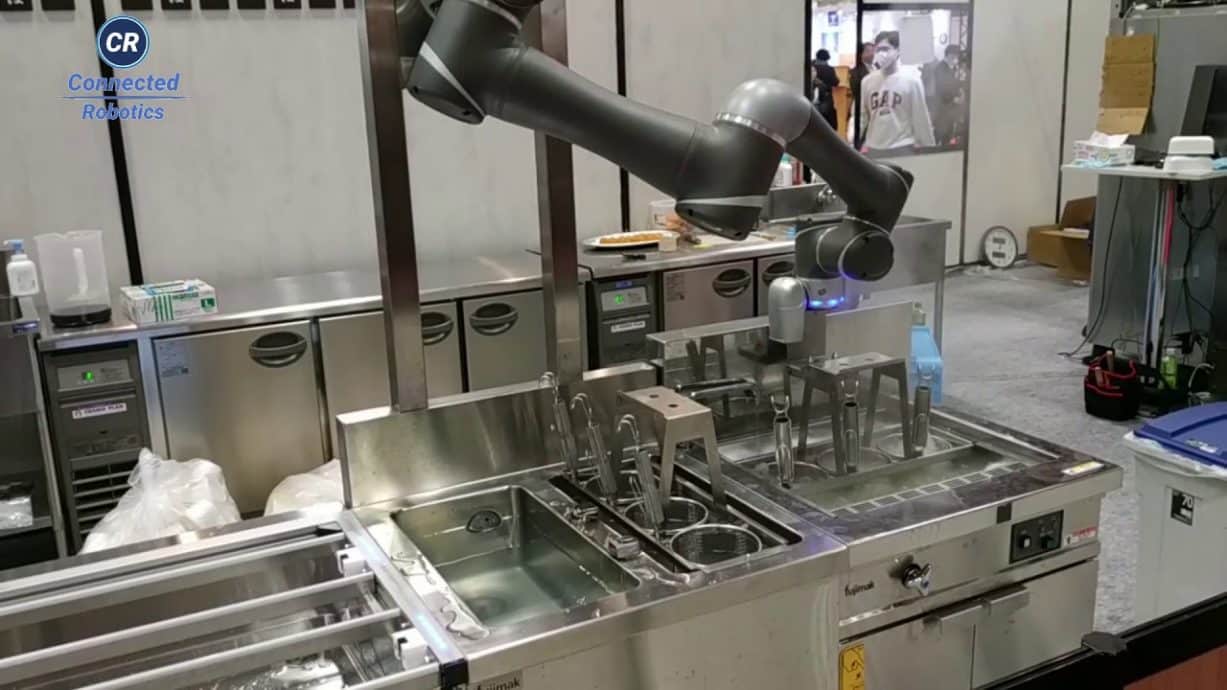
Connected Robotics’ partnership with JR East Group led to the development and deployment of a soba noodle-cooking robot at train station eateries, one of the most high-pressure food service environments in Japan where speed and consistency are essential for serving commuters between transfers. The two-armed robot performs the complete soba cooking process by fetching noodles from a box with one arm, placing them in a strainer, boiling them for precisely one minute and forty seconds, rinsing off surface starch, and dipping the noodles in iced water to achieve the firm texture that Japanese diners expect. Initial trials began at Higashikoganei Station on JR’s Chuo Line in March 2020, with the robot capable of producing 40 soba dishes per hour, matching the output of an average human cook. By 2021, an upgraded version deployed at JR Kaihimmakuhari Station in Chiba could cook 150 servings per hour, effectively substituting the work of one full-time employee. The collaborative cooking system assigns the robot to handle boiling, rinsing, and cooling while human employees add dipping sauce, soup, and toppings, preserving the artisanal finishing touches that define quality soba. JR East Foods stated its goal of implementing the soba robot at thirty stores by the end of fiscal 2025, signaling confidence in the technology’s readiness for scaled deployment across Japan’s railway network. This real-world deployment showcases how AI in robotics moves from laboratory demonstrations to practical commercial applications.
The soba robot’s deployment at train stations addressed practical workplace concerns beyond simple labor substitution, including physical safety for kitchen staff and hygiene improvements during the COVID-19 pandemic. Employees at station soba restaurants reported that the robot eliminated their exposure to scalding hot water and steam during peak service hours, reducing burn risk substantially. Connected Robotics highlighted the robot’s contactless cooking capability as useful for reducing coronavirus infection risk, a benefit that resonated strongly with both operators and customers during the pandemic period. The system’s integration with existing kitchen workflows was designed to require minimal renovation, fitting into the compact spaces typical of Japanese station eateries where every square meter matters. Customer reactions to robot-prepared soba have been positive in Japan, where cultural familiarity with automation through conveyor belt sushi and vending machine restaurants has created an accepting environment for kitchen robotics.
Reita the Ice Cream Robot
Beyond noodles and takoyaki, Connected Robotics expanded its product line to include Reita, an automated soft-serve ice cream dispensing robot that became one of the company’s most visible consumer-facing products. Reita features a distinctive cartoonish blue bear design with a robotic arm extending from its body, creating a memorable character that attracts customer attention while performing the functional task of dispensing perfectly swirled ice cream cones. The robot’s playful appearance reflects a deliberate design philosophy at Connected Robotics that embraces Japan’s cultural tradition of giving machines personality and approachability rather than presenting them as purely industrial tools. Reita demonstrates that food robots can serve as both labor-saving tools and customer engagement attractions, generating social media buzz and foot traffic alongside operational efficiency. The ice cream robot operates with consistent portion control, eliminating the waste that occurs when human workers dispense varying amounts, and maintains hygiene standards by reducing direct hand contact with food products. Reita’s deployment in commercial facilities, amusement parks, and food courts provided Connected Robotics with revenue and market validation while the company developed its more complex cooking systems for professional kitchens.
The character-driven design approach used for Reita reflects broader lessons about how Japanese consumers interact with robots in public spaces. Research on human-robot interaction in Japan consistently shows that anthropomorphic or character-based designs generate higher customer satisfaction and repeat engagement compared to purely functional industrial aesthetics. Connected Robotics leveraged this insight to create robots that restaurant owners see not as replacements for human warmth but as additions to the customer experience. The contrast with Western approaches to food automation, which tend to hide robotics behind kitchen walls, highlights fundamental cultural differences in how societies integrate technology into daily life. Reita’s success proved that a food robot could simultaneously solve a staffing problem and become a marketing asset for the businesses that deployed it.
Japan’s Labor Crisis and the Case for Kitchen Automation
Connected Robotics’ products exist within a demographic and economic context that makes kitchen automation not merely convenient but existentially necessary for Japan’s food service industry. Japan’s population aged 65 and older now exceeds 28 percent of the total, a figure projected to rise toward 40 percent by 2065, creating a shrinking workforce that cannot fill the positions required to maintain current service levels. The Recruit Works Institute projects that Japan will face a staggering labor shortfall of 11 million workers by 2040, with food service among the sectors most acutely affected due to physically demanding conditions, irregular hours, and relatively low wages. Japan’s convenience store industry alone reported a shortage of 172,000 workers in 2020, with only 87 percent of stores maintaining 24-hour operations compared to 92 percent in 2019. Prime Minister Fumio Kishida warned that Japan stands on the brink of whether it can continue to function as a society, framing automation as a national survival strategy rather than a business efficiency measure. The food service industry’s chronic labor challenges create a receptive market for robotics impacting the workplace in ways that would face greater resistance in countries with surplus labor.
Japan’s cultural relationship with robots fundamentally differs from Western attitudes, providing fertile ground for companies like Connected Robotics to deploy kitchen automation without the social friction common in other markets. Popular culture through anime and manga has portrayed robots as helpful companions for decades, fostering a sense of familiarity and even affection toward mechanical workers that simply does not exist at the same scale in Europe or North America. Japan’s largest table-service restaurant chain, Skylark, already uses approximately 3,000 cat-eared delivery robots across its locations, with employees describing robots as coworkers deserving of thanks rather than threats to job security. This cultural acceptance extends to elderly workers, with a 71-year-old Skylark employee telling reporters that half her job now involves robotic assistance and expressing gratitude rather than resentment. The combination of economic necessity and cultural receptivity creates conditions uniquely favorable for kitchen robotics adoption, explaining why Connected Robotics chose to build its business in Japan before pursuing international expansion.
Immigration restrictions compound Japan’s labor challenges by limiting the foreign workforce that other countries use to fill food service positions. While Japan has gradually expanded visa categories for skilled workers, the bureaucratic complexity and cultural integration requirements create barriers that automation can bypass entirely. The food service industry’s high turnover rate, which exceeds fifty percent annually in busy urban areas, means that even when workers are recruited, the cost of continuous training and replacement undermines operational stability. Connected Robotics directly addresses this cycle by offering robot systems that never quit, never need training repetitions, and maintain consistent performance regardless of staffing fluctuations.
Deep Learning Technology Behind the Cooking Robots
The labor crisis explains the demand, but Connected Robotics’ competitive advantage lies in the proprietary deep learning and computer vision technology that enables its robots to perform cooking tasks requiring judgment, not just mechanical repetition. Traditional industrial robots follow pre-programmed movements without adapting to variations in raw materials, cooking conditions, or environmental factors, making them unsuitable for the variable world of food preparation. Connected Robotics solves this by equipping its robot systems with camera-based sensing that continuously monitors cooking progress and compares visual data against trained models of ideal outcomes. The OctoChef’s AI can assess takoyaki doneness by analyzing color gradients, surface texture, and bubble formation in real time, mimicking the visual judgment that human takoyaki masters develop over years of practice. This sensing capability extends to the soba noodle robot, where the AI monitors boiling conditions and adjusts timing based on water temperature variations that would affect noodle texture. Connected Robotics describes its approach as combining robot control know-how from manufacturing with sensing and learning technology using deep learning to make kitchen robots genuinely intelligent rather than merely automated.
The cloud connectivity built into Connected Robotics’ systems creates a distributed learning network where improvements discovered at one installation benefit every robot in the fleet. When a human worker corrects the OctoChef’s output by identifying an imperfect takoyaki, that feedback is incorporated into the AI model and propagated to all connected units, accelerating the pace of improvement beyond what any single robot could achieve through its own experience. This networked learning approach mirrors strategies used in autonomous vehicle development, where fleet-wide data sharing enables faster progress than isolated testing. The company’s software platform, led by engineers with backgrounds in automotive AI and autonomous driving systems, treats each cooking robot as a node in an intelligent network rather than a standalone machine. This architecture positions Connected Robotics to scale its technology across diverse food categories because the underlying AI framework can be retrained for new dishes without redesigning the physical hardware.
Beyond Restaurants into Food Factory Automation
While consumer-facing restaurant robots generate media attention, Connected Robotics recognized early that food factory automation represents an equally significant market where its technology delivers even greater economic impact at scale. The company began developing robots for food factories alongside its restaurant products, targeting the high-volume, repetitive preparation tasks that dominate industrial food production. Food factories in Japan face the same demographic labor pressures as restaurants but operate on production schedules that make staffing shortfalls even more disruptive to supply chains. Connected Robotics’ factory-oriented systems handle tasks like batch cooking, quality inspection, packaging preparation, and dishwashing using the same AI-powered sensing technology deployed in its restaurant robots. The transition from restaurant to factory automation leveraged the company’s existing deep learning models while adapting robotic arm configurations and throughput requirements for industrial environments. Strategic partnerships with Hoshizaki Corporation, one of Japan’s leading commercial kitchen equipment manufacturers, provided Connected Robotics with manufacturing expertise and distribution channels essential for penetrating the factory market. The dual focus on restaurants and factories diversifies the company’s revenue and creates a technology feedback loop where lessons from high-volume factory operations improve the precision of restaurant-scale cooking systems, connecting to broader trends in robotics and manufacturing.
The company’s AI-powered dishwashing robot, developed through joint research with Tokyo University of Agriculture’s Mizuuchi Laboratory, represents a less glamorous but operationally critical category of kitchen automation. The dishwashing system uses computer vision to recognize different dish types without markers, then performs pre-washing, washing, and shelf arrangement automatically. In high-volume food service operations, dishwashing consumes significant labor hours and involves repetitive physical strain that contributes to worker turnover and injury. Connected Robotics identified dishwashing automation as a force multiplier that frees human workers to focus on customer-facing tasks and food preparation that require human creativity and judgment, aligning with the company’s founding vision of letting robots handle the brunt of kitchen work.
Investment Journey from Seed to Series B
Connected Robotics’ technology development has been fueled by a structured investment trajectory that brought increasingly prominent backers to the company at each stage, reflecting growing confidence in both the technology and the market opportunity. The company secured initial seed funding of approximately ¥100 million across two rounds in 2018 from Coral Capital, Draper Nexus, Astart, and several angel investors. The Series A round in July 2019 raised ¥850 million led by Global Brain Corporation, with participation from 31VENTURES Global Innovation Fund, UTokyo Innovation Platform, Sony Innovation Fund, and 500 Startups JP, bringing total funding to ¥950 million. The Series B round closed in February 2023 at approximately ¥1.7 billion, with strategic investors including Yaskawa Electric, Hoshizaki Corporation, and Mitsubishi HC Capital signaling that established industrial players viewed Connected Robotics’ technology as commercially viable. Total funding has reached over $21 million, according to CB Insights data, positioning the company among the best-capitalized food robotics startups globally. The inclusion of Yaskawa Electric, one of the world’s leading industrial robot manufacturers, as a Series B investor suggests potential hardware synergies and manufacturing scale advantages for future product development. Each funding round expanded not just capital but strategic partnerships that provide Connected Robotics with distribution channels, manufacturing capabilities, and domain expertise in AI-powered robotics advancement.
Investor commentary from the Series A round reveals the strategic thinking driving capital allocation into food robotics at a time when many venture firms still viewed the space as niche and unproven. Global Brain CEO Yasuhiko Yurimoto cited the high marketability of Connected Robotics’ cooking robot technology and the company’s potential to alleviate labor shortages across the food service industry and beyond. Sony Innovation Fund described Connected Robotics as a hybrid model combining management technology insight with deep understanding of both robot and restaurant industries. UTokyo Innovation Platform highlighted the academic knowledge base underpinning the company’s AI research, noting that Connected Robotics turns university research into practical commercial applications. The breadth of investor types spanning venture capital, corporate venturing, university technology transfer, and industrial manufacturing reflects the cross-sector appeal of food robotics solutions.
JR East Partnership and Railway Station Deployment
The partnership between Connected Robotics and JR East Group represents one of the most strategically significant relationships in the company’s history, providing access to Japan’s extensive railway station food service network. JR East Start Up Co., the venture arm of East Japan Railway, began collaborating with Connected Robotics in autumn 2019 to develop automated cooking systems for the Sobaichi chain of soba noodle eateries located inside train stations. Railway station food service is uniquely demanding because it serves customers who have minutes between train connections and expect consistent quality regardless of time of day or staffing conditions. The soba robot’s ability to cook 150 servings per hour while maintaining the precise texture standards that Japanese commuters demand validated Connected Robotics’ technology in one of the most challenging food service environments imaginable. JR East Foods’ goal of deploying robots at thirty station eateries by fiscal 2025 would create a visible network of robotic kitchen installations across one of the world’s busiest railway systems, normalizing the technology for millions of daily commuters. The partnership demonstrates how human-machine collaboration works in practice, with robots handling the physically demanding cooking tasks while human staff manage customer interaction and artisanal finishing.
JR East Start Up participated in the METI-backed Startup Program that originally connected the railway group with Connected Robotics, illustrating how Japanese government innovation programs actively facilitate partnerships between established corporations and emerging technology companies. The railway deployment also served as a proof of concept for hygiene-focused food preparation during the COVID-19 pandemic, when contactless cooking became a selling point beyond simple labor savings. Japan Restaurant Enterprise Co., which operates the Sobaichi eatery chain, provided the operational expertise needed to integrate robotic systems into existing kitchen workflows without disrupting service to customers who visit these stations daily and expect familiar food prepared to established standards.
Hoshizaki Partnership and Kitchen Equipment Integration
Connected Robotics’ strategic and capital partnership with Hoshizaki Corporation brings together a technology startup and one of Japan’s most established commercial kitchen equipment manufacturers, creating synergies that accelerate both product development and market penetration. Hoshizaki, known globally for ice machines, refrigeration, dishwashers, and dispensing systems, provides manufacturing expertise, supply chain infrastructure, and relationships with food service operators that Connected Robotics would take years to build independently. The partnership allows Connected Robotics to integrate its AI-powered robotic systems with Hoshizaki’s existing kitchen equipment ecosystem, creating turnkey automation solutions that install alongside familiar commercial kitchen hardware. For restaurant operators considering automation, the combination of a trusted equipment brand with an innovative robotics startup reduces perceived risk and simplifies procurement decisions. Hoshizaki’s investment in Connected Robotics during the Series B round signals corporate confidence that robotic cooking will become a standard component of commercial kitchen design rather than a specialized add-on. This equipment-integrated approach to food robotics differs from competitors who develop standalone systems requiring complete kitchen redesigns, reflecting Connected Robotics’ practical understanding of how restaurants actually adopt new technology within existing operations and broader trends in collaborative robotics in the workplace.
The Hoshizaki partnership also positions Connected Robotics for international expansion by leveraging Hoshizaki’s global distribution network, which reaches food service operators across North America, Europe, and Asia. While Connected Robotics’ current deployments focus on Japanese cuisine and Japanese market conditions, the underlying technology is adaptable to diverse food categories and cultural contexts. Hoshizaki’s presence in over twenty countries provides potential distribution channels for localized versions of Connected Robotics’ cooking systems, enabling the startup to pursue international markets without building sales infrastructure from scratch. The partnership model represents an increasingly common strategy in robotics where technology startups pair with established industrial companies to achieve scale that would be impossible through venture capital alone.
Omotenashi and the Human Side of Robotic Kitchens
Equipment integration addresses practical concerns, but the deeper cultural question of how robotic kitchens preserve Japan’s tradition of omotenashi, the spirit of selfless hospitality, requires thoughtful examination that goes beyond engineering efficiency. Japanese dining culture places enormous value on the personal connection between kitchen staff, servers, and guests, creating an expectation that food preparation involves human care, attention, and seasonal sensitivity that no machine can fully replicate. Connected Robotics’ founding vision explicitly addresses this tension by designing robots to handle the brunt of repetitive physical work while leaving staff free to concentrate on the humanistic side of service. The company’s philosophy treats automation not as a replacement for human hospitality but as a precondition for it, recognizing that exhausted, overworked kitchen staff cannot provide genuine omotenashi regardless of their intentions. By relieving human workers from dangerous, repetitive, and physically draining tasks, robotic kitchen systems theoretically enable better human-to-human interaction during the dining experience. The soba robot deployments illustrate this principle in practice, with employees reporting that freed time allows them to focus on customer service, fried food preparation, and maintaining dining area cleanliness. This human-centered approach to automation connects to broader discussions about whether AI will replace humans or augment their capabilities in service-oriented professions.
Customer reception of robot-prepared food in Japan has been remarkably positive, challenging assumptions that diners inherently prefer human-prepared meals over machine-prepared alternatives. Connected Robotics CEO Sawanobori has noted that Japanese customers react to food robots very differently than Western consumers, often expressing delight and curiosity rather than concern or suspicion. The novelty factor drives initial customer engagement, but repeat visits depend on food quality, which the AI-monitored cooking process maintains at a consistently high level. Japan’s decades of experience with automated food service through kaiten sushi conveyor belts, vending machine restaurants, and ticket-based ordering systems has created a consumer base comfortable with technology mediating their dining experience.
Competing in the Global Food Robotics Landscape
Customer acceptance in Japan provides a strong domestic foundation, but Connected Robotics operates within a growing global ecosystem of food robotics companies pursuing similar automation goals with different technological approaches and market strategies. Miso Robotics in the United States developed Flippy, a burger-flipping robot adopted by White Castle and other fast-food chains, taking a different approach by targeting Western fast food rather than Japanese cuisine. Dishcraft focused specifically on high-volume dishwashing automation, addressing the same pain point that Connected Robotics tackles with its AI dishwashing system. Companies like Spyce, Bear Robotics, and numerous Chinese food robotics startups compete for market share across different segments of the automated restaurant value chain. Connected Robotics’ competitive advantage rests on its unique combination of Japanese cuisine expertise, deep learning cooking intelligence, and strategic partnerships with established Japanese industrial companies that provide manufacturing and distribution scale. The company’s observation that robots capable of cooking Japanese cuisine do not exist in other countries highlights a market positioning strategy built on cultural specificity rather than generic automation. As the global food robotics market expands, Connected Robotics must balance its Japanese heritage advantage against the pressure to adapt its technology for international cuisines and kitchen environments, a challenge relevant to understanding how AI and robotics are evolving across different cultural contexts.
International competitors bring larger funding rounds and broader market access, with some US-based food robotics companies raising hundreds of millions of dollars compared to Connected Robotics’ more modest but strategically focused funding. Miso Robotics’ Flippy has achieved wider media recognition in English-language markets, while Chinese companies benefit from a domestic market with over one billion potential restaurant customers and aggressive government support for automation technology. Connected Robotics’ path to global relevance likely runs through its partnerships with internationally present companies like Hoshizaki and Yaskawa Electric rather than through direct market entry strategies that would require building brand recognition and local partnerships from scratch in every new country.
Ethical Considerations in Kitchen Automation
Global competition intensifies the ethical questions surrounding kitchen automation, as the technology’s spread raises concerns about job displacement, economic inequality, and the commodification of culinary traditions that define cultural identity. A 2023 study suggested that 82 percent of restaurant tasks could potentially be automated, sparking fears about mass layoffs in an industry that employs millions of workers worldwide. Connected Robotics’ narrative emphasizes that its robots supplement human workers rather than eliminate positions entirely, but critics note that the long-term economic logic of automation tends toward reducing headcount even when initial deployments maintain staffing levels. The ethical framework becomes more complex in countries where food service jobs provide essential income for workers with limited alternative employment options, unlike Japan where labor shortages make automation socially acceptable. Questions about who benefits from kitchen automation revenues, whether workers whose tasks are automated receive retraining support, and how automation affects the economic viability of small independent restaurants deserve careful attention as the technology matures. Connected Robotics’ founding story rooted in compassion for overworked kitchen staff provides a genuine ethical foundation, but the broader industry must ensure that labor-saving technology translates into improved worker welfare rather than simply reduced labor costs. These concerns connect to larger conversations about robots and the future of employment.
The preservation of culinary craftsmanship presents an additional ethical dimension as AI-powered cooking systems become more capable of replicating techniques that traditionally required years of human apprenticeship. Japanese food culture assigns deep respect to master chefs whose expertise represents lifetime dedication to specific culinary disciplines, and some traditionalists view robotic cooking as a devaluation of this human mastery. Connected Robotics addresses this concern by positioning its robots as tools that democratize access to skilled cooking techniques rather than commodities that diminish their cultural significance. The company’s goal of expanding accessibility of Japanese cuisine worldwide through robots that replicate expert techniques offers a counternarrative in which technology serves as a vehicle for cultural preservation and distribution rather than cultural erosion.
The Role of Government Policy in Food Robotics Adoption
Ethical debates play out within a policy landscape where government support has been instrumental in creating the conditions for food robotics companies like Connected Robotics to develop, test, and deploy their technology at commercial scale. Japan’s national government adopted the New Robot Strategy over a decade ago, and subsequent growth strategies have emphasized service robot development in nearly every annual policy framework since then. The 2025 Basic Policy on Economic and Fiscal Management specifically calls for strategies concerning robots as a key application area for AI and advanced semiconductors. Connected Robotics’ selection for the MAFF Small and Medium-sized Enterprise Innovation Promotion Project demonstrates how government programs actively funnel resources toward food technology startups that address national priorities. The METI and NEDO Task Force for Promoting Establishment of Implementation Models of Robots provided Connected Robotics with a platform to collaborate with established industry players and contribute to setting standards for commercial kitchen robotics. Government support extends beyond direct funding to include regulatory frameworks that facilitate robot deployment in food service environments, addressing safety certifications, food hygiene requirements, and workplace regulations that could otherwise create barriers to adoption. Japan’s proactive government approach to food robotics stands in contrast to countries where regulatory uncertainty slows technology deployment, explaining part of Japan’s leadership position in AI-powered robotics advancement.
Municipal governments in Japan have also begun investing in robotic food preparation technology, with Denver, Colorado providing an interesting international comparison by investing in AI systems to accelerate project reviews though in a different domain. Japanese prefectural governments have offered subsidies to restaurants and food factories that install approved robotic systems, reducing the upfront cost that represents the largest barrier to adoption for small and medium-sized food service operators. The combination of national strategy, agency-level program support, and local government subsidies creates a multi-layered policy ecosystem that systematically reduces barriers to food robotics adoption across Japan’s diverse food service landscape.
Future Products and the Loraine Breakfast Robot
Government support accelerates Connected Robotics’ development pipeline, which includes several products at various stages of commercialization that will expand the company’s kitchen automation capabilities beyond its current offerings. The Loraine breakfast cooking robot represents one of the most ambitious products in development, designed to prepare complete fried breakfast plates including eggs, bacon, toast, and side dishes with minimal human intervention. Connected Robotics also announced development of hot snack robots designed specifically for Japan’s convenience store market, where labor shortages have forced reduced operating hours and service cutbacks that directly impact the convenience value proposition. The convenience store application represents a potentially massive deployment opportunity because Japan’s approximately 56,000 convenience stores each maintain hot food counters that require continuous staffing and food quality monitoring throughout the day. An automatic dish washing system rounds out the near-term product roadmap, applying the same AI visual recognition technology used in cooking robots to the identification, sorting, and cleaning of dishware. Each product in the pipeline addresses a specific pain point identified through Connected Robotics’ close engagement with food service operators who understand which tasks consume the most labor and create the most worker dissatisfaction. The expanding product portfolio positions Connected Robotics to offer comprehensive kitchen automation platforms rather than single-function products, aligned with broader ambitions in AI-enabled smart kitchen technology.
Connected Robotics’ food factory product line targets high-volume production environments where even small efficiency improvements multiply across thousands of units processed daily. Factory deployments generate proprietary cooking data at volumes that far exceed restaurant-scale operations, feeding the company’s deep learning models with training material that improves accuracy across all product lines. The company’s technology roadmap suggests a future where its AI cooking platform becomes a horizontal capability adaptable to virtually any food preparation task, with specific products representing vertical applications built on a common intelligent foundation. This platform strategy, if executed successfully, would transform Connected Robotics from a maker of specific cooking robots into a provider of general-purpose kitchen intelligence that can be configured for any cuisine, any scale, and any market.
Challenges Facing Robotic Kitchen Adoption
Despite strong market conditions and technological progress, Connected Robotics and the broader food robotics industry face significant challenges that could slow adoption even in markets as receptive as Japan. The upfront cost of robotic kitchen systems remains prohibitive for many small and independent restaurants, which constitute the majority of food service establishments worldwide and operate on thin profit margins that leave little room for capital investment. Technical reliability in the demanding kitchen environment, where heat, moisture, grease, and constant vibration test mechanical systems beyond the norms of clean factory settings, creates maintenance requirements that add to total cost of ownership. Consumer expectations for food quality consistency mean that a single poorly cooked dish produced by a malfunctioning robot can damage a restaurant’s reputation more severely than a similar error by a human cook, because customers hold machines to higher standards of perfection. Integration with existing kitchen workflows requires customization for each installation, as no two restaurant kitchens have identical layouts, equipment configurations, or menu requirements. The limited menu of dishes that current robots can prepare restricts their applicability to restaurants with highly focused menus rather than establishments offering broad culinary variety. Workforce transition management presents an additional challenge, as restaurants must retrain existing staff for new roles that complement rather than compete with robotic systems, touching on the complexities explored in discussions about AI and job displacement.
Supply chain challenges for specialized robotic components, particularly the sensors, cameras, and processors that enable AI-powered cooking intelligence, create dependencies on semiconductor markets that have experienced significant disruption in recent years. Connected Robotics’ reliance on cloud connectivity for its distributed learning model introduces network reliability requirements that may be difficult to maintain in all kitchen environments, particularly older buildings or rural locations with limited internet infrastructure. Regulatory requirements for food contact surfaces, electrical safety in wet environments, and workplace coexistence between robots and human workers create compliance obligations that vary by jurisdiction, complicating international expansion plans. Each of these challenges is manageable individually, but their cumulative effect requires sustained investment in engineering, customer support, and regulatory affairs that can strain the resources of a startup still building toward profitability.
What Connected Robotics Means for the Future of Dining
These challenges shape but do not fundamentally alter the trajectory toward increasingly automated commercial kitchens, and Connected Robotics’ journey from a single takoyaki robot to a multi-product kitchen automation platform illustrates the pattern of incremental progress that defines successful technology adoption in complex industries. Within five years, experts predict more fully automated food preparation stations in urban centers across Japan, with Connected Robotics’ product portfolio positioned to serve the station eatery, convenience store, food factory, and full-service restaurant segments. The technology’s impact extends beyond Japan as the company’s partnerships with internationally present corporations create distribution pathways into markets experiencing their own versions of food service labor pressure. Connected Robotics’ vision of expanding accessibility of Japanese cuisine worldwide through robots could make dishes like handmade soba and perfectly formed takoyaki available in cities that currently lack the trained chefs needed to prepare them authentically. This culinary globalization through robotics represents a genuinely novel value proposition that no amount of recipe sharing or cooking education can replicate at scale. The convergence of AI capability, robotic precision, and demographic necessity points toward a future where the question is not whether commercial kitchens will adopt robotic cooking systems but how quickly different markets will embrace the transition. Understanding how the future of AI intersects with food technology reveals opportunities that extend far beyond simple labor savings.
The legacy of Connected Robotics, regardless of the company’s individual commercial trajectory, lies in demonstrating that AI-powered cooking robots can meet the quality standards of demanding Japanese consumers while improving working conditions for kitchen staff. The company’s founding narrative anchored in one engineer’s experience of physical breakdown from restaurant work remains a powerful reminder that behind every automation statistic are real human bodies performing tasks that machines can handle more safely and sustainably. Japan’s robotics expertise, demographic challenges, and cultural openness to automation created the ideal laboratory for developing food robotics technology that will eventually benefit kitchen workers and diners worldwide.
Lessons from Japan’s Robotic Kitchen Experiment
The future vision brings the analysis full circle to the lessons that Japan’s robotic kitchen experiment offers to food service operators, technology developers, and policymakers in other countries contemplating similar automation paths. Japan’s experience demonstrates that successful kitchen robotics deployment requires not just capable technology but an ecosystem of government support, cultural acceptance, strategic corporate partnerships, and a genuine labor market need that makes automation economically rational rather than merely technically impressive. Connected Robotics’ strategy of starting with focused products for specific dishes rather than attempting to build a universal cooking robot proved critical for building credibility and generating revenue that funded broader development. The collaborative model where robots handle physically demanding tasks while humans focus on hospitality, creativity, and quality finishing offers a template for automation that enhances rather than eliminates the human role in food service. Government policy that actively facilitates technology adoption through startup programs, research partnerships, regulatory clarity, and financial subsidies accelerated Japan’s food robotics development by years compared to markets where companies must navigate these challenges independently. The cultural lesson that robots can be embraced as colleagues rather than competitors challenges assumptions about public resistance to workplace automation that often prove overstated. For anyone studying the intersection of AI and the future of work, Japan’s robotic kitchen revolution provides a living case study in how technology, culture, and economic necessity can align to transform an entire industry.
Connected Robotics’ journey from a single founder’s difficult restaurant experience to a multi-million dollar company with partnerships across Japan’s railway and kitchen equipment industries encapsulates the startup narrative at its most compelling, a personal problem transformed into a systemic solution through technology, persistence, and strategic thinking. The food robotics industry remains in its early stages globally, and the lessons learned from Japan’s leading position will inform decisions made by operators, investors, and governments for decades to come. Whether you view robotic kitchens with excitement about expanded culinary access and improved worker safety or with concern about job displacement and cultural change, the reality is that the technology has moved beyond proof of concept into commercial deployment, and its continued evolution is effectively inevitable.
Key Insights on Connected Robotics and Robotic Kitchens
- Skylark, Japan’s largest table-service restaurant chain, already deploys approximately 3,000 cat-eared service robots, demonstrating widespread commercial readiness for food service automation in the Japanese market.
- Connected Robotics has raised over $21 million in total funding across ten rounds, with strategic investors including Sony Innovation Fund, Yaskawa Electric, and Hoshizaki Corporation providing both capital and industry expertise.
- Japan’s service robot market is projected to reach ¥400 billion ($2.7 billion) by 2030, nearly tripling from 2024 levels as demographic pressures accelerate automation adoption across food service and elder care sectors.
- The OctoChef robot uses deep learning and computer vision to assess takoyaki doneness, with networked cloud learning enabling every installation to benefit from cooking data gathered across the entire fleet of deployed units.
- Connected Robotics’ soba noodle robot at JR train stations cooks 150 servings per hour, matching the output of a human worker while eliminating burn risks and enabling contactless food preparation.
- Japan’s Recruit Works Institute projects a labor shortfall of 11 million workers by 2040, with food service among the most severely affected sectors due to physically demanding conditions and aging workforce demographics.
- Connected Robotics CEO Tetsuya Sawanobori’s health breakdown from restaurant overwork directly inspired the company’s mission, as described in his Series A funding announcement, grounding the startup’s automation agenda in genuine compassion for kitchen workers.
Comparing Robotic Kitchen Approaches
| Dimension | Connected Robotics (Japan) | Miso Robotics / Flippy (US) | Traditional Japanese Kitchen |
|---|---|---|---|
| Transparency of Process | Robots cook in view of customers; cloud data shared across fleet | Typically operates behind kitchen walls; less consumer visibility | Open kitchen designs common; chef skill visible to diners |
| Worker Participation | Collaborative model; humans handle finishing and customer service | Replaces specific cooking stations; humans manage other tasks | Full human involvement from prep through plating and service |
| Trust & Acceptance | High cultural acceptance; robots seen as helpful colleagues | Mixed reception; novelty appeals but some consumer skepticism | Deep trust built through personal chef-customer relationships |
| Decision Making | AI judges cooking quality via computer vision; humans override | AI monitors temperature and timing; human supervision required | Entirely human judgment based on experience and sensory assessment |
| Food Quality Control | Deep learning ensures consistency; fleet-wide model improvements | Sensor-based monitoring with programmed cooking parameters | Variable based on individual chef skill and daily conditions |
| Service Delivery Speed | 150 servings/hour (soba robot); consistent regardless of staffing | Varies by application; optimized for fast-food throughput | Limited by human stamina; slows during peak and understaffed periods |
| Accountability | Company maintains and updates AI; operator responsible for food safety | Robot-as-a-service model; Miso handles maintenance and updates | Chef personally accountable; restaurant reputation at stake |
Real-World Examples of Robotic Kitchen Impact
Sobaichi Station Eatery Soba Robot Deployment
The Sobaichi chain of soba noodle eateries at JR East train stations became the first real restaurant setting to implement Connected Robotics’ two-armed soba cooking robot in a commercial operation serving actual customers. The deployment at JR Kaihimmakuhari Station in Chiba demonstrated that the robot could handle the full cooking cycle from fetching noodles through boiling, rinsing, and iced water immersion at a rate of 150 servings per hour. Employees reported significant quality-of-life improvements including reduced exposure to scalding water and steam during long shifts. JR East Foods committed to deploying the technology at thirty locations by fiscal 2025, representing a significant scale-up from single-station trials. The soba robot proved especially valuable during the COVID-19 pandemic when contactless food preparation became a hygiene advantage rather than merely a labor-saving feature. The limitation of the deployment remains its narrow menu focus, as the robot handles only the noodle cooking process while humans still manage all other menu items, toppings, and customer interactions. Detailed coverage from Mainichi documented the robot’s operation and employee reactions.
OctoChef Takoyaki Robot at Nagasaki Launch
Connected Robotics’ first commercial deployment of the OctoChef takoyaki robot at a Nagasaki location marked a critical milestone in proving that AI-powered cooking robots could satisfy Japanese consumers’ demanding quality expectations for traditional street food. The robot performed all stages of takoyaki preparation from pouring oil through to serving finished octopus balls, using computer vision to judge cooking condition in real time. Customer reactions were overwhelmingly positive, with the novelty of watching a robot cook generating social media attention that drove foot traffic beyond what the restaurant had experienced with human-only cooking. The monthly rental model at approximately ¥250,000 proved economically viable compared to the cost of hiring and training specialized takoyaki cooks, as reported by Disrupting Japan. OctoChef subsequently expanded from single-restaurant installations to industrial-scale factory settings, demonstrating technology flexibility across different operational scales. The primary limitation was the robot’s specialization in a single dish, requiring restaurants to maintain human staff for all other menu items.
Skylark Restaurant Chain’s 3,000 Robot Fleet
While not a Connected Robotics deployment, Skylark’s fleet of approximately 3,000 cat-eared delivery robots across Japan’s largest table-service restaurant chain demonstrates the commercial-scale adoption of food service robotics that creates market conditions favorable to Connected Robotics’ cooking automation products. The cat-themed robots navigate dining rooms independently, delivering food from kitchen to table while expressing simple emotions through eye animations and vocalized phrases. A 71-year-old Skylark employee described the robots as helpful colleagues, estimating that half her job now involves some form of robotic assistance and expressing gratitude for the physical relief. The deployment, covered by Bloomberg and TechCrunch, illustrates that Japanese food service operators have moved well beyond pilot testing into full-scale robotic integration. The limitation of Skylark’s implementation is that its robots handle only food delivery rather than cooking, representing complementary automation that does not directly address the kitchen labor bottleneck that Connected Robotics targets.
Case Studies in Robotic Kitchen Development
Connected Robotics’ Series B and Strategic Expansion
Connected Robotics’ Series B funding round, which closed in February 2023 at approximately ¥1.7 billion, represented a pivotal moment when the company transitioned from technology demonstration to commercial-scale deployment with the backing of major industrial players. The problem the company faced was a classic startup challenge, having proven its technology works in pilot settings but needing significantly more capital and industry partnerships to manufacture, deploy, and maintain robotic systems across hundreds of food service locations simultaneously. The solution involved bringing strategic investors like Yaskawa Electric, one of the world’s leading industrial robot manufacturers, and Hoshizaki Corporation, a dominant commercial kitchen equipment company, alongside financial investors including Mitsubishi HC Capital. The measurable impact was a total funding position exceeding $21 million and partnerships that provided manufacturing expertise, distribution channels, and credibility with risk-averse food service operators, as documented by CB Insights financial data. The controversy surrounding the round centered on whether Japanese food robotics startups could achieve the rapid scaling that venture investors expect, given the customized nature of kitchen installations and the relatively modest deployment numbers compared to software startups. Connected Robotics’ continued focus on the Japanese domestic market despite having international distribution potential through its partners raises questions about the pace of global expansion.
Japan’s Government-Backed Robot Strategy
Japan’s national government has pursued a deliberate strategy to position the country as the global leader in service robotics, creating a policy environment that directly enabled Connected Robotics and dozens of other food technology startups to develop and deploy commercial products. The problem was Japan’s demographic crisis, with a workforce projected to shrink by 11 million by 2040 and a food service industry unable to attract sufficient workers to maintain operations across hundreds of thousands of restaurants, convenience stores, and food factories. The government’s solution involved the New Robot Strategy launched over a decade ago, annual growth strategy provisions emphasizing service robot development, the J-Startup acceleration program, and agency-level initiatives through METI and NEDO that provided funding, regulatory guidance, and corporate partnership facilitation. The measurable impact includes a service robot market projected to reach ¥400 billion by 2030 and the successful commercial deployment of cooking robots, delivery robots, and service automation systems across Japan’s food industry, as analyzed by RIETI research. The limitation of the government approach is its primary focus on domestic deployment, with relatively less attention paid to creating export frameworks that would help Japanese food robotics companies compete globally against well-funded American and Chinese competitors.
Cultural Acceptance of Food Robots in Japanese Dining
The widespread acceptance of food service robots among Japanese consumers represents a cultural case study with significant implications for how other countries might approach food automation deployment. The problem faced by food robotics companies globally is consumer resistance rooted in preferences for human-prepared food, concerns about job displacement, and unfamiliarity with robotic systems in intimate settings like dining. Japan’s solution emerged organically from decades of cultural conditioning through positive robot portrayals in anime and manga, practical experience with automated food service through conveyor belt sushi and vending machine restaurants, and a social consensus that robots fill essential roles in a labor-scarce economy. The measurable impact includes adoption rates that led Skylark to deploy 3,000 delivery robots and JR East Foods to commit to robotic soba cooking at 30 stations, with customer satisfaction surveys consistently showing positive reception to robot-prepared food. Research from multiple institutions, including analysis referenced in ZME Science, confirms that Japan’s cultural openness to robots as colleagues rather than threats is a significant competitive advantage for domestic food robotics companies. The limitation is that Japan’s cultural acceptance does not automatically transfer to other markets, meaning companies like Connected Robotics must develop culturally adapted deployment strategies for each international market they enter.
Frequently Asked Questions About Connected Robotics and Robotic Kitchens
Connected Robotics’ commercial robot lineup can prepare takoyaki octopus balls through the OctoChef system, soba noodles through its two-armed boiling and rinsing robot, and soft-serve ice cream through the Reita dispensing system. The company is developing additional products including the Loraine breakfast cooking robot, hot snack robots for convenience stores, and an AI-powered dishwashing system. Each robot specializes in specific food preparation tasks rather than attempting to cook an entire restaurant menu.
Connected Robotics uses a hybrid pricing model with an initial purchase package for the robot system followed by a monthly rental fee of approximately ¥250,000 or roughly $2,000. This subscription approach reduces the upfront capital requirement that would otherwise prevent small restaurant operators from adopting the technology. The monthly cost compares favorably to hiring a specialized cook when accounting for recruitment, training, benefits, and turnover costs in Japan’s tight labor market.
Connected Robotics’ AI-powered cooking systems achieve consistency levels that match or exceed human performance for the specific dishes they are designed to prepare. The OctoChef’s deep learning algorithms assess cooking quality through visual analysis that mimics the judgment of experienced takoyaki masters. Robots excel at repetitive precision tasks but currently cannot match human creativity for menu development, improvisation, or the subtle adjustments that master chefs make in response to ingredient variations.
Tetsuya Sawanobori founded Connected Robotics in 2017 after his personal health broke down within one year of working in a restaurant following graduate school. His experience with overwork from long hours and heavy manual labor motivated his determination to replace simple and physically demanding kitchen tasks with robots. Sawanobori holds degrees from the University of Tokyo and Kyoto University Graduate School in engineering and informatics.
Japan faces a projected labor shortfall of 11 million workers by 2040 as its population ages rapidly, with over 28 percent of citizens already aged 65 or older. The food service industry is especially affected due to physically demanding conditions, irregular hours, and relatively low wages that discourage younger workers. Immigration restrictions further limit the available workforce, making automation through robotic kitchen systems an economic necessity rather than simply a competitive advantage.
Deep learning enables Connected Robotics’ robots to make real-time cooking quality judgments using computer vision, analyzing factors like color, texture, and surface formation that human cooks assess through experience. The AI models improve continuously through cloud-connected feedback loops where data from all deployed robots is aggregated and used to refine cooking algorithms. Human workers can also train the robots by showing them examples of imperfect results that the AI should learn to avoid.
Connected Robotics currently focuses primarily on the Japanese domestic market, with deployments in train station eateries, restaurants, and food factories across the country. The company’s partnerships with internationally present companies like Hoshizaki Corporation and Yaskawa Electric provide potential distribution channels for global expansion. CEO Sawanobori has expressed the ambition of expanding Japanese cuisine accessibility worldwide through robots, though specific international deployment timelines have not been publicly announced.
Connected Robotics has secured strategic and capital partnerships with JR East Group for railway station food service deployment and Hoshizaki Corporation for kitchen equipment integration. Investment partners include Yaskawa Electric, Sony Innovation Fund, Global Brain Corporation, UTokyo Innovation Platform, and Mitsubishi HC Capital. These partnerships provide manufacturing expertise, distribution channels, and operational credibility that accelerate commercial deployment beyond what the startup could achieve independently.
Japanese customers have responded positively to robot-prepared food, often expressing curiosity and delight rather than the skepticism more common in Western markets. Japan’s decades of cultural familiarity with automation through conveyor belt sushi, vending machine restaurants, and positive robot portrayals in anime and manga create an accepting consumer environment. Customer satisfaction depends primarily on food quality, which the AI-controlled cooking process maintains at consistently high levels.
Japan’s government supports food robotics through multiple programs including the national New Robot Strategy, the J-Startup acceleration program run by METI, the METI and NEDO Task Force for Promoting Robot Implementation Models, and the MAFF Small and Medium-sized Enterprise Innovation Promotion Project. These programs provide funding, regulatory guidance, industry partnership facilitation, and visibility that help startups like Connected Robotics navigate the path from technology development to commercial deployment.
Kitchen robots face challenges including operation in harsh environments with heat, moisture, and grease that stress mechanical components beyond normal industrial conditions. Integration with varied kitchen layouts requires customization for each installation, and maintaining reliable cloud connectivity for AI-powered cooking intelligence can be difficult in older buildings. Current robots are limited to specific dishes rather than offering universal cooking capability, restricting their applicability to restaurants with focused menus.
Connected Robotics differentiates itself through specialization in Japanese cuisine, deep learning cooking intelligence, and strategic partnerships with established Japanese industrial companies including Yaskawa Electric and Hoshizaki Corporation. Miso Robotics targets the American fast-food market with products like the Flippy burger-flipping robot and has achieved wider English-language media recognition. Connected Robotics’ competitive advantage lies in its unique combination of Japanese culinary expertise and AI cooking technology that does not exist in other countries.
The underlying AI and robotic platform developed by Connected Robotics is technically adaptable to diverse food categories because the deep learning framework can be retrained for new dishes without redesigning the physical hardware. The cloud-connected learning architecture means new cooking models can be developed and deployed across the robot fleet through software updates. Practical adaptation would require training data for specific cuisines, customized ingredient handling configurations, and cultural localization of the customer experience.
Kitchen robots can reduce food waste through precise portion control and consistent cooking that minimizes errors resulting in discarded food. Energy consumption varies by system but automated cooking processes can optimize fuel and electricity usage compared to human-operated equipment that may be left running during idle periods. The environmental trade-off includes the manufacturing footprint of robotic systems and the energy required for cloud computing infrastructure that supports AI-powered cooking intelligence.
Complete elimination of human cooks is unlikely in the foreseeable future because current technology handles specific repetitive tasks rather than the full range of creative, adaptive, and interpersonal functions that human cooks perform. Connected Robotics explicitly designs its systems for human-robot collaboration rather than full replacement, with robots handling physically demanding and repetitive tasks while humans focus on hospitality, creativity, and quality finishing. The most probable future involves increasing automation of routine cooking tasks alongside continued human involvement in menu innovation, customer interaction, and quality oversight.