

Introduction
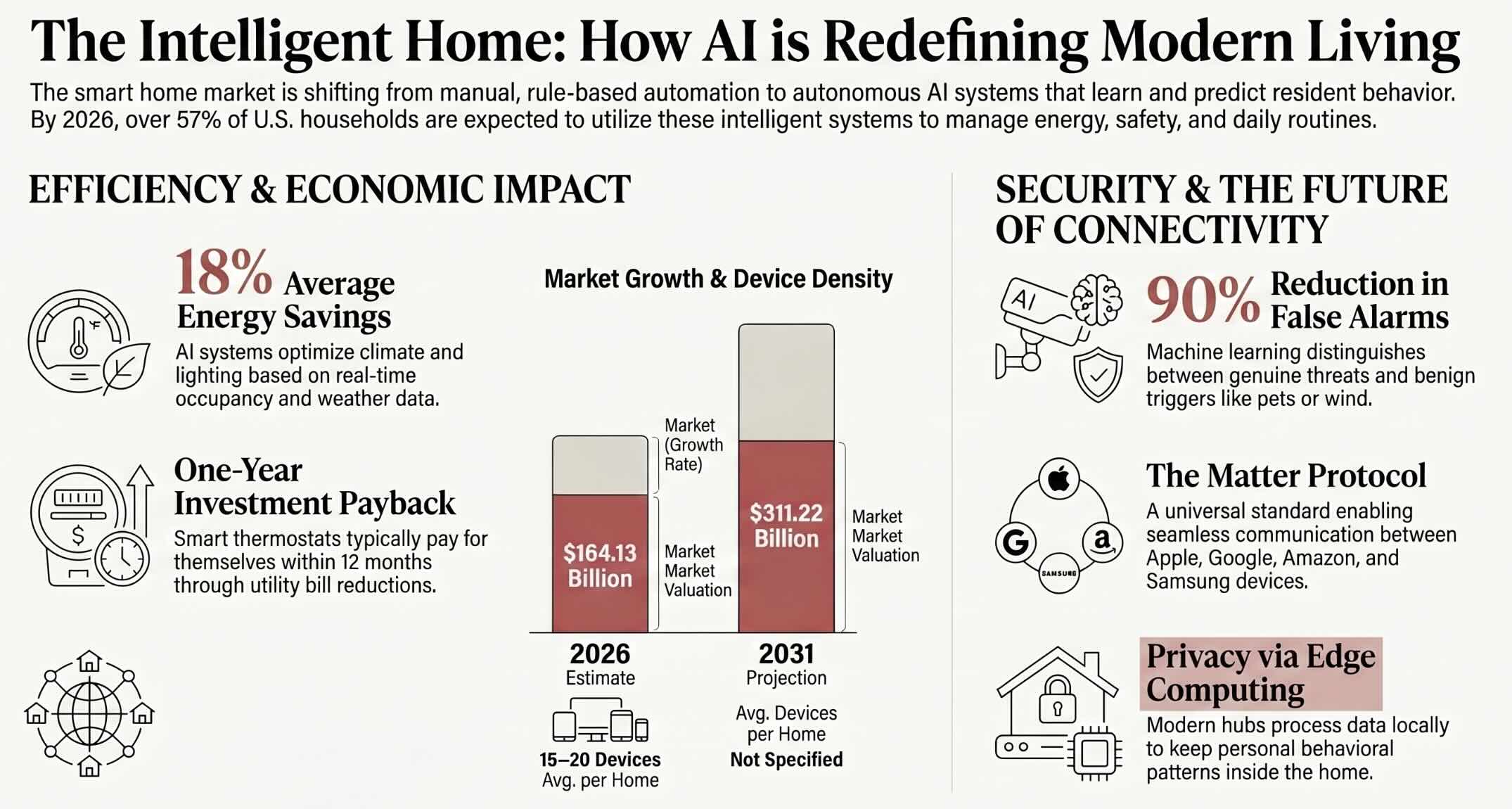
The modern home is quietly becoming one of the most sophisticated computing environments most people will ever encounter. According to Mordor Intelligence’s 2026 market analysis, the smart homes market is estimated at $164.13 billion in 2026 and is expected to reach $311.22 billion by 2031, growing at a compound annual growth rate of 13.65%. That trajectory reflects a fundamental shift in how people think about their living spaces, moving from manual control to intelligent automation that learns, adapts, and anticipates. Over 57% of U.S. households are expected to have at least one smart home device by 2026, with the average smart home containing 15 to 20 connected devices. Artificial intelligence is the engine driving this transformation, turning isolated gadgets into coordinated systems that manage energy, security, health, and comfort without constant human input. This article explores how AI is reshaping the residential experience across every dimension of daily life.
Essential Questions About AI in Smart Homes
How does AI impact smart homes? AI transforms smart homes by learning resident behaviors and automating routines for lighting, temperature, security, and energy consumption, creating personalized environments that adapt without manual programming.
What are the biggest benefits of AI in smart homes? The primary benefits include energy savings averaging 18% through intelligent management, security systems that reduce false alarms by up to 90%, and personalized comfort that adjusts to individual preferences automatically.
Are AI smart homes safe and private? AI smart homes introduce both enhanced security through intelligent monitoring and new privacy risks through continuous data collection, requiring homeowners to balance convenience with strong cybersecurity practices and informed device selection.
Key Takeaways
- Privacy remains the top concern for 60% of smart home users, making edge computing and local AI processing critical to mainstream adoption.
- The global smart home market is projected to grow from $164.13 billion in 2026 to $311.22 billion by 2031, driven by AI integration across security, energy, and comfort systems.
- AI-powered energy management systems deliver average savings of 18% on household energy consumption, with smart thermostats paying for themselves within one year.
- The Matter protocol, backed by Apple, Google, Amazon, and Samsung, is eliminating vendor lock-in and enabling seamless cross-brand device communication for the first time.
Table of contents
- Introduction
- Essential Questions About AI in Smart Homes
- Key Takeaways
- What Is an AI-Powered Smart Home
- How Artificial Intelligence Transforms the Living Experience
- Voice Assistants and the Evolution of Natural Language Control
- AI-Driven Energy Management and Sustainability
- Smart Security Systems Powered by Machine Learning
- Predictive Maintenance and Appliance Intelligence
- The Matter Protocol and Cross-Brand Interoperability
- Edge Computing and Local AI Processing
- Personalized Comfort Through Behavioral Learning
- Health Monitoring and Wellness in Connected Homes
- Smart Kitchens and AI-Powered Food Management
- Privacy Risks in an Always-Listening Home
- Cybersecurity Challenges for IoT Ecosystems
- Accessibility and Aging in Place
- The Economics of Smart Home Adoption
- Environmental Impact Beyond the Home
- Where Smart Homes Are Heading Next
- Choosing the Right AI Ecosystem for Your Home
- Key Insights
- Real-World Examples
- Case Studies
- Frequently Asked Questions About AI in Smart Homes
What Is an AI-Powered Smart Home
An AI-powered smart home is a residential environment where interconnected devices use artificial intelligence and machine learning to automate household functions, learn occupant preferences, and optimize performance across lighting, climate, security, entertainment, and energy systems without requiring constant manual control. The defining characteristic that separates an AI smart home from simple home automation is the capacity to learn and adapt; traditional automation follows static rules, while AI systems observe patterns, predict needs, and adjust behavior over time. This collaboration between AI and IoT creates a living environment that becomes more responsive and efficient the longer it operates.
The intelligence layer in a modern smart home operates across multiple domains simultaneously, coordinating devices that were previously isolated into a unified system. A smart thermostat that learns your schedule, a security camera that distinguishes between family members and strangers, and a lighting system that adjusts based on the time of day and ambient light levels all represent different applications of the same underlying AI capabilities: pattern recognition, prediction, and autonomous decision-making. The strongest smart homes in 2026 are defined not by how many devices they contain but by whether those devices work together coherently as an integrated system. Research firm MarketsandMarkets estimates that the AI in IoT market will grow from $5.1 billion in 2020 to $16.2 billion by 2026, driven largely by this integration into smart home devices.
AI Smart Home Impact Calculator
Estimate your annual savings, security improvement, and environmental impact based on your smart home setup. Adjust the sliders and toggle the devices you use.
How Artificial Intelligence Transforms the Living Experience
The transformation that AI brings to residential living goes far beyond the convenience of voice-activated light switches and remotely controlled thermostats. AI introduces a layer of anticipatory intelligence that observes, learns, and acts on behalf of residents in ways that feel increasingly natural over time. A Gitnux industry report found that 60% of users report higher satisfaction with homes equipped with AI-based automation solutions compared to conventional setups. That satisfaction stems from the cumulative effect of dozens of small optimizations: lights that dim at the right moment, heating that adjusts before you arrive home, and music that plays your preferred genre based on the day and time.
The shift from reactive to predictive automation marks the most significant change in how homes function since the introduction of central heating and air conditioning. Earlier smart home systems required users to program schedules, create rules, and manually configure device interactions. Modern AI-powered systems observe occupancy patterns through sensors and connected devices, then build behavioral models that anticipate needs without explicit programming. This evolution from rule-based automation to behavioral learning is what makes AI smart homes genuinely intelligent rather than simply connected. The digital transformation happening in residential spaces mirrors the same AI-driven shift occurring across industries.
The practical impact on daily routines is substantial for households that embrace the technology fully across their living environment. A family’s morning routine can unfold without a single manual interaction: the coffee maker starts at the predicted wake time, bathroom lighting adjusts to a warm tone, the thermostat raises the temperature in occupied rooms while keeping empty rooms cool, and the garage door opens as the car approaches. Each of these actions is triggered by learned patterns rather than static timers, meaning the system adapts when schedules change. The convenience factor is significant, but the deeper value lies in the cognitive load reduction that comes from having an environment that manages itself.
Voice Assistants and the Evolution of Natural Language Control
Voice assistants have become the primary interface between humans and their smart home ecosystems, evolving from novelty gadgets into essential household infrastructure. AI-enabled voice assistants accounted for over 60% of smart speaker sales globally, and their accuracy in understanding user commands now exceeds 95% according to industry surveys. The evolution from simple command recognition to contextual understanding represents a fundamental shift in how people interact with technology at home. Modern assistants powered by large language models can understand multi-step instructions, maintain conversational context, and even interpret the intent behind ambiguous requests.
The competitive landscape among virtual personal assistants continues to shape the smart home experience in significant ways. Amazon’s Alexa AI upgrade introduced generative AI capabilities that allow more natural, conversational interactions rather than rigid command structures. Google Assistant leverages the company’s search infrastructure to provide contextually rich responses that integrate real-time information. Apple’s Siri prioritizes on-device processing for privacy, while Samsung’s Bixby focuses on deep integration with the company’s extensive appliance ecosystem. Each approach reflects different philosophies about the balance between capability, privacy, and ecosystem control.
The next frontier for voice control is proactive assistance, where the system speaks to you before you speak to it, offering relevant suggestions based on context and learned preferences. Imagine your assistant informing you that traffic is heavier than usual and suggesting you leave ten minutes early, or noting that the weather forecast shows rain and recommending you close the windows before leaving. These proactive interactions require sophisticated natural language generation capabilities combined with deep understanding of user routines and preferences. The technology to deliver this experience exists today, and its deployment across mainstream voice assistants is accelerating through 2026 and beyond.
AI-Driven Energy Management and Sustainability
Energy management represents one of the most financially tangible benefits that AI brings to the smart home environment for homeowners and renters alike. Field studies consistently show that AI-powered energy management systems deliver average savings of 18% on household energy consumption. Smart thermostats alone generate substantial returns: Ecobee’s internal data shows users save an average of $220 per year on energy bills, meaning the $249 device pays for itself in just over a year. Connected thermostats can save 10% to 23% by learning occupancy patterns and syncing with demand-response signals, according to the U.S. Department of Energy.
The intelligence behind these savings goes well beyond simple scheduling and temperature setbacks that earlier programmable thermostats offered. AI systems analyze multiple data streams simultaneously, including weather forecasts, occupancy sensor readings, energy pricing signals from the grid, and historical consumption patterns for the specific household. This multi-variable optimization produces energy savings that manual programming could never match because humans cannot continuously process and respond to that many inputs. Smart lighting delivers the fastest return on investment of any smart home category, with studies showing 15 to 25% energy savings over traditional lighting through automated dimming, occupancy-based control, and daylight harvesting.
The integration with renewable energy sources adds another dimension to AI-driven sustainability that extends the smart home’s impact beyond individual utility bills. AI systems can balance household consumption based on solar panel generation capacity and grid demand, shifting energy-intensive tasks like dishwashing and laundry to periods of peak solar production. Smart metering and dynamic pricing models enable cost-effective energy use during off-peak hours, and battery storage systems managed by AI can store excess solar energy for use during expensive peak demand periods. The global smart energy market is projected to reach $38.62 billion by 2026, reflecting the growing intersection of AI, renewable energy, and residential automation.
The environmental implications of widespread AI energy management extend beyond individual households to the broader electrical grid infrastructure. When thousands of smart homes coordinate their energy consumption in response to grid signals, the cumulative effect reduces peak demand, decreases the need for polluting peaker power plants, and supports the integration of intermittent renewable energy sources. The U.S. Affordable Home Energy Shot initiative aims to achieve a 50% reduction in household energy costs by 2030, and AI-powered climate technology is central to that goal. Smart homes are evolving from passive energy consumers into active participants in a more resilient, efficient, and sustainable energy system that benefits entire communities.
Smart Security Systems Powered by Machine Learning
AI has fundamentally changed what home security systems can detect, how they respond, and how effectively they protect residents from threats. AI-powered security cameras have reduced false alarms by up to 90% in smart homes by using machine learning to distinguish between genuine threats, pets, passing vehicles, and benign environmental triggers like moving tree branches. That reduction in false positives solves one of the most persistent frustrations of traditional security systems and directly increases homeowner trust in automated monitoring. Seventy percent of smart home device owners prefer AI features that specifically enhance security, making it the most valued application of residential AI.
The capabilities of modern AI security extend well beyond simple motion detection into sophisticated threat analysis and proactive protection. Facial recognition technology enables smart locks to automatically grant or deny entry based on recognized faces, eliminating the need for keys or codes while maintaining detailed access logs. Computer vision systems analyze behavioral patterns in real time, identifying anomalies that may indicate security threats such as unusual door openings, unfamiliar individuals lingering near entry points, or unexpected activity during periods when the home should be unoccupied. AI can also integrate with neighborhood security networks to provide community-wide threat intelligence and faster emergency response coordination.
The evolution from reactive alarm systems to predictive security represents the most significant advancement in residential protection since the introduction of electronic monitoring. Traditional systems could only detect and report incidents after they occurred. AI-powered systems can identify suspicious patterns before an intrusion attempt, trigger deterrent measures like automated lighting and audio alerts, and provide real-time video verification that helps authorities distinguish between genuine emergencies and nuisance calls. This proactive approach protects homes more effectively while simultaneously reducing the burden on emergency services from false alarm responses that waste resources and erode response times.
Predictive Maintenance and Appliance Intelligence
AI transforms the relationship between homeowners and their appliances by shifting maintenance from a reactive, break-and-fix model to a predictive, data-driven approach that prevents failures before they occur. AI-driven predictive maintenance in smart homes prevents up to 40% of appliance failures by monitoring performance data and identifying patterns that indicate impending problems. A smart washing machine that detects unusual vibration patterns, a refrigerator that notices declining compressor efficiency, or an HVAC system that identifies reduced airflow can all alert homeowners to emerging issues before they result in costly breakdowns or water damage.
The financial and practical benefits of predictive maintenance compound over time as IoT devices accumulate performance data specific to each household’s usage patterns. A modern residence can leverage predictive maintenance alerts for its HVAC system, automatically scheduling service based on real-time performance data, which avoids costly emergency repairs and optimizes operational efficiency. AI-powered flood detection and mitigation systems have reduced flood damages by up to 28% by identifying leak patterns and triggering automatic shutoff valves before significant damage occurs. The cumulative savings from prevented failures, extended appliance lifespans, and optimized maintenance scheduling make predictive intelligence one of the highest-value applications of AI in residential settings.
The Matter Protocol and Cross-Brand Interoperability
The interoperability challenge has been one of the most significant barriers to smart home adoption, and the Matter protocol represents the industry’s most credible solution to date. Developed by the Connectivity Standards Alliance and backed by technology giants including Apple, Google, Amazon, and Samsung, Matter is an open-source connectivity standard that allows devices from different manufacturers to communicate seamlessly without proprietary hubs or ecosystem-specific integrations. Over 550 technology companies worldwide are developing Matter-compatible products, and the latest smart home trends presented at CES 2025 showcased rapid adoption across every major device category.
Before Matter, a homeowner with Philips Hue lights using Zigbee, August locks using Bluetooth, and Nest cameras using WiFi needed three separate apps and could not create unified automation routines across all devices. Matter eliminates that fragmentation by providing a universal language that all certified devices can speak, regardless of manufacturer or underlying communication technology. As of early 2026, certified categories include lighting and electrical devices, locks and access controls, climate systems, appliances including robot vacuums and ovens, energy management systems including EV chargers and solar inverters, safety sensors, and cameras with live streaming capability.
Matter’s local-first design philosophy addresses both performance and privacy concerns by enabling devices to communicate directly without routing data through cloud servers. All communications between Matter devices are encrypted with mandatory device authentication, providing enterprise-grade security that reduces attack vectors compared to cloud-dependent systems. This architectural choice means that smart home automations continue to function even during internet outages, a critical reliability improvement over purely cloud-based platforms. The upcoming Matter updates will add smarter energy management integration, stronger security frameworks, and expanded device categories, positioning the protocol to become the foundational infrastructure layer for controlling IoT devices across the entire residential ecosystem.
Edge Computing and Local AI Processing
The shift toward edge computing in smart homes addresses two of the most persistent concerns about AI-powered residential technology: latency and privacy. Edge AI processing keeps data local by running machine learning models directly on the device or on a local hub rather than sending every piece of data to remote cloud servers for analysis. This approach dramatically reduces response times for time-sensitive actions like security alerts, while simultaneously keeping personal behavioral data within the home rather than transmitting it to corporate data centers.
The technical architecture of edge computing in smart homes builds on advances in fog computing and specialized AI chips designed for low-power, always-on processing. Modern smart home hubs contain neural processing units capable of running sophisticated computer vision models, natural language understanding, and behavioral prediction algorithms entirely on-device. Apple’s HomeKit architecture exemplifies this approach, processing Siri requests and HomeKit Secure Video analysis on the Apple TV or HomePod rather than in the cloud. Edge computing represents the architectural foundation that makes privacy-preserving AI smart homes technically viable at consumer price points, removing the false choice between intelligence and data protection.
Personalized Comfort Through Behavioral Learning
The comfort dimension of AI smart homes extends far beyond basic temperature and lighting control into a deeply personalized experience that adapts to individual preferences within a multi-person household. AI systems learn that one family member prefers cooler sleeping temperatures while another prefers warmth, that the home office needs brighter task lighting on weekdays but softer ambient light on weekends, and that the living room entertainment system should lower the blinds and adjust the lighting when a movie starts. These preferences are not programmed through menus and schedules; they emerge from continuous observation and pattern recognition over weeks and months of normal living.
The sophistication of behavioral learning in modern smart homes allows for context-aware adjustments that consider multiple variables simultaneously when making decisions. Temperature, lighting, sound levels, and even window treatments can adjust based on the time of day, the weather outside, which rooms are occupied, what activities are underway, and who specifically is present. A study by Gitnux found that 48% of smart home consumers use AI to automate daily routines, significantly reducing the manual intervention required to maintain a comfortable living environment. The 55% of consumers willing to pay more for AI-enabled devices offering personalized experiences reflects the growing recognition that intelligent personalization delivers genuine quality-of-life improvements.
The transition from household-level automation to individual-level personalization represents the most meaningful comfort advancement in residential AI technology. Older smart home systems applied the same settings universally, creating compromises that satisfied no one perfectly. Modern multi-zone systems use presence detection, voice identification, and learned preferences to create micro-environments tailored to whoever occupies a space at any given moment. When one person enters the kitchen, the lighting, temperature, and background music adjust to their preferences; when another person joins them, the system finds an intelligent compromise based on both profiles.
The long-term implications of behavioral learning extend into predictive wellness and lifestyle optimization that go beyond basic comfort parameters. AI systems that understand a household’s patterns can identify changes that might indicate health issues, such as irregular sleep schedules, altered activity levels, or unusual thermostat adjustments that suggest fever. The line between comfort optimization and health monitoring through wearables and sensors is blurring as the same behavioral data that drives personalized comfort can also serve as an early warning system for physical and mental well-being changes.
Health Monitoring and Wellness in Connected Homes
The emergence of health-focused AI applications in smart homes represents a rapidly growing segment that extends residential technology into wellness and preventive care. Twenty-four percent of households with home IoT devices already use AI for health monitoring and wellness purposes, and the global market for smart health and fitness devices is projected to reach $29.4 billion by 2026. Smart homes are evolving into comprehensive health monitoring environments that track air quality, sleep patterns, physical activity, water consumption, and overall wellness indicators through a network of ambient sensors and connected devices.
The applications range from environmental health monitoring to direct physiological tracking through non-intrusive sensors embedded in the living environment. Air quality monitors powered by AI can detect elevated levels of particulate matter, volatile organic compounds, or carbon dioxide and automatically adjust ventilation, activate air purifiers, or alert residents to potential risks. Smart mattresses and sleep tracking systems analyze sleep quality and adjust bedroom temperature, lighting, and noise levels to optimize rest. Connected bathroom fixtures can monitor hydration levels and basic health indicators, providing data that builds a longitudinal picture of household wellness without requiring clinical visits.
The potential for AI-powered homes to serve as ambient health monitoring environments is particularly significant for aging populations and individuals managing chronic conditions. Robot companions can assist with daily routines, medication reminders, and fall detection. AR mirrors provide exercise and posture guidance through AI feedback, supporting rehabilitation and fitness programs. Smart devices that detect changes in gait, activity levels, or daily routines can alert family members or caregivers to potential health issues before they become emergencies, extending the period during which elderly residents can live independently in their own homes.
Smart Kitchens and AI-Powered Food Management
The kitchen represents one of the most rapidly evolving spaces in the AI-powered smart home, with connected appliances transforming how households manage food, cook meals, and reduce waste. Smart refrigerators equipped with internal cameras and AI image recognition can track food inventory in real time, alert homeowners when items are approaching expiration dates, and automatically generate shopping lists based on consumption patterns. The smart kitchen segment is predicted to lead growth in the smart home market overall, driven by consumer preference for connected ovens, intelligent dishwashers, and voice-enabled cooking assistants.
AI-powered cooking assistants go beyond simple recipe display to provide step-by-step guidance that adapts to available ingredients, dietary restrictions, and cooking skill levels. Connected ovens adjust temperature and cooking time based on the specific dish being prepared, using internal sensors and AI algorithms to achieve optimal results without constant monitoring. The combination of inventory management, waste reduction, and automated cooking assistance makes the smart kitchen one of the most practical and financially impactful applications of AI in the home, addressing real pain points around time, money, and food sustainability. These innovations align with the broader IoT ecosystem described in analyses of IoT applications across industries.
Privacy Risks in an Always-Listening Home
The privacy implications of AI smart homes represent the most significant barrier to adoption and the dimension that requires the most careful consumer attention and regulatory oversight. Sixty percent of users prioritize privacy when evaluating smart home technology, and concerns about data collection practices are well-founded. Voice assistants are always listening for their wake words, security cameras continuously capture video, and behavioral learning systems track movement patterns, occupancy schedules, and personal preferences in granular detail. The aggregate of this data creates an intimate digital portrait of household life that few consumers fully understand or have explicitly consented to share.
The risks extend beyond abstract privacy concerns into concrete security vulnerabilities that affect real households in measurable ways. In December 2025, Bitdefender released details regarding global cyber attacks directed at smart home devices, revealing that attack attempts targeted a wide variety of device types in an opportunistic manner. Fifty-six percent of smart lock users express concerns about hacking vulnerabilities, and the growing volume of connected devices in each home multiplies the potential entry points for malicious actors. The privacy concerns surrounding AI in smart homes are not theoretical; they represent active, evolving threats that demand ongoing attention from both manufacturers and consumers.
The tension between intelligence and privacy is not a problem to be solved once but a continuous balancing act that requires informed consumer choices, responsible manufacturer practices, and evolving regulatory frameworks. Edge computing, local AI processing, and protocols like Matter that prioritize on-device communication over cloud routing represent architectural responses to privacy concerns. But technology alone is insufficient. Homeowners need clear, understandable privacy policies, granular control over what data is collected and shared, and the ability to delete their data completely. The concerns documented about Big Tech’s smart home strategies highlight the importance of regulatory oversight alongside technological safeguards.
Cybersecurity Challenges for IoT Ecosystems
The cybersecurity landscape for smart homes is fundamentally different from traditional computing security because the attack surface encompasses dozens of connected devices with varying security capabilities, update cycles, and manufacturer support lifespans. Every smart bulb, sensor, camera, and thermostat represents a potential entry point into the home network, and many IoT devices were designed with functionality and cost prioritization over security. The challenge is compounded by the fact that most homeowners lack the technical expertise to assess the security posture of individual devices or to configure network segmentation that isolates vulnerable devices from sensitive systems.
The types of threats facing smart home ecosystems range from unauthorized surveillance through compromised cameras to more sophisticated attacks that exploit IoT devices as entry points into broader home networks containing computers with financial data and personal information. AI itself introduces additional attack vectors: adversarial inputs can fool computer vision systems, voice spoofing can compromise voice-authenticated smart locks, and poisoned training data can corrupt the behavioral models that drive automated decision-making. The evolving cybersecurity landscape demands that smart home manufacturers adopt zero-trust authentication, end-to-end encryption, and automatic security update mechanisms as baseline requirements rather than premium features.
Regulatory responses to IoT security concerns are beginning to take shape, though enforcement remains uneven across jurisdictions and product categories globally. The Matter protocol’s mandatory encryption and authentication requirements represent a significant step forward for devices that adopt the standard. California’s IoT security law requires manufacturers to equip connected devices with reasonable security features, and the European Union’s Cyber Resilience Act imposes security requirements throughout a product’s lifecycle. Homeowners can reduce their exposure by choosing devices from manufacturers with strong security track records, maintaining a dedicated IoT network separate from their primary computing network, and ensuring all devices receive regular firmware updates.
Secure federated learning approaches for IoT represent one promising technical solution that enables AI models to improve through distributed training without centralizing sensitive household data. This technique allows smart home devices to learn from aggregated patterns across many households while keeping individual data on local devices. As the number of connected devices per household continues to grow, federated learning and other privacy-preserving machine learning techniques will become essential for maintaining both intelligence and security in residential AI ecosystems.
Accessibility and Aging in Place
AI smart homes offer transformative benefits for elderly residents and people with disabilities who want to maintain independence in their own living environments. Voice-controlled systems eliminate the need for manual switches, touchscreens, or smartphone apps that may present barriers for individuals with mobility limitations or visual impairments. AI-powered monitoring can detect falls, track medication schedules, identify changes in daily routines that might signal health decline, and alert caregivers to potential issues without requiring the resident to actively summon help. These capabilities extend the window during which individuals can safely live independently by years.
The accessibility applications of smart home AI go beyond assistive technology into genuine quality-of-life improvements that support dignity and autonomy for aging populations. Automated lighting that activates when a resident gets up at night reduces fall risk without requiring night lights that disturb sleep. Smart locks that recognize authorized visitors eliminate the frustration of managing physical keys for people with arthritis or cognitive decline. AI-powered homes that adapt to changing physical and cognitive capabilities over time represent one of the most socially significant applications of residential technology, addressing a growing demographic need as populations age across developed economies. The intersection of AI and smart city infrastructure extends these accessibility benefits from individual homes to entire communities designed for inclusive living.
The Economics of Smart Home Adoption
The financial case for smart home technology has shifted from an early-adopter luxury proposition to a mainstream investment that delivers measurable returns across multiple categories. Smart thermostats generate $220 in average annual energy savings, smart lighting reduces electricity costs by 15 to 25%, and predictive maintenance prevents appliance failures that could cost thousands of dollars in emergency repairs and water damage remediation. The average smart home containing 15 to 20 connected devices represents a household technology investment that increasingly pays for itself through operational savings within two to three years.
The market dynamics driving adoption costs downward continue to accelerate as manufacturing scales and competition intensifies among major platforms. The global smart home market size is valued at approximately $133.3 billion in 2026 and is projected to grow to $850 billion by 2040, according to Roots Analysis. That growth trajectory reflects falling hardware costs, improving interoperability through Matter, and expanding consumer awareness of tangible benefits. The IoT smart homes market, including all connected devices and supporting infrastructure, was valued at $155.9 billion in 2025 and is projected to reach $947.24 billion by 2033, growing at a remarkable compound annual growth rate of 25.3%.
The real estate industry is increasingly recognizing AI smart home features as a differentiator that commands premium valuations and accelerates sales cycles. The AI-integrated real estate market value is expected to cross $1.335 trillion by 2029 in the United States alone, and generative AI applications in real estate are expanding rapidly. Builders and developers are incorporating smart home infrastructure, including pre-wired networking, smart panels, and hub-ready electrical systems, as standard features in new construction rather than premium upgrades. For existing homeowners, the combination of energy savings, security improvements, and property value enhancement makes smart home technology one of the most financially compelling home improvement categories available.
Environmental Impact Beyond the Home
The environmental benefits of AI smart homes extend well beyond individual energy savings to influence grid-level energy management, carbon emission reduction, and broader sustainability goals. When AI manages energy consumption across millions of connected homes simultaneously, the aggregate effect reduces peak demand on electrical grids, decreases reliance on fossil fuel-powered peaker plants, and supports the integration of renewable energy sources that produce power intermittently. Smart homes equipped with solar panels, battery storage, and AI-managed energy systems can function as distributed energy resources that strengthen grid resilience during extreme weather events.
The intersection of smart home technology and climate action is gaining recognition from policymakers and environmental organizations who see residential energy optimization as a scalable pathway to emission reduction. Connected thermostats, smart water heaters, and AI-managed appliance scheduling can collectively reduce a household’s carbon footprint by a meaningful margin without requiring significant lifestyle changes or sacrifices in comfort. The role of AI in addressing climate challenges at the residential scale complements industrial and transportation decarbonization efforts, filling a gap that policy interventions alone have struggled to address.
Smart LED bulbs that use up to 75% less energy than incandescent alternatives, combined with AI-driven optimization that ensures lights are only active when and where needed, represent just one example of how technology multiplication effects compound across a fully connected home. The environmental case for AI smart homes is strongest when individual efficiency gains are viewed as part of a coordinated grid-wide system, where millions of homes collectively optimize energy consumption, reduce waste, and support the transition to renewable energy sources. The cumulative impact of these distributed intelligence systems on national energy consumption and carbon emissions is projected to grow significantly as adoption rates accelerate through the end of the decade.
Where Smart Homes Are Heading Next
The evolution of AI in smart homes through the remainder of the decade will be defined by three converging trends: deeper personalization through multimodal AI, expanded health and wellness integration, and the maturation of agentic home systems that act autonomously on behalf of residents. IoT predictions suggest 75 billion connected devices globally by 2030, and a substantial share of that growth will occur within residential environments as new categories of smart home devices enter the market. The future of AI in the home is not about adding more gadgets but about creating a unified intelligence that manages the entire living experience as a coherent system.
Emotional AI represents one of the most intriguing frontiers in residential technology, with assistants that can detect mood through voice tone, facial expressions, and behavioral patterns, then adjust the home environment accordingly. A system that recognizes stress through voice analysis might dim the lights, lower the temperature slightly, and queue calming music without being asked. While the technology raises significant ethical questions about surveillance and emotional manipulation, it also offers genuine wellness benefits for residents who struggle with environmental self-regulation. The ethical implications of advanced AI in intimate settings like the home require particularly careful consideration as these capabilities mature.
The most significant shift ahead is the transition from smart homes that respond to commands and learned patterns to agentic homes that independently manage complex, multi-step tasks across the entire household ecosystem. An agentic home system could coordinate a morning departure routine that involves adjusting the thermostat, locking doors, arming the security system, turning off unnecessary appliances, and optimizing the remaining energy consumption for an empty house, all triggered by a single departure detected through location data and occupancy sensors. This level of autonomous coordination requires the same agentic AI capabilities that are transforming enterprise environments, applied to the residential context where the stakes are personal comfort, safety, and well-being.
Choosing the Right AI Ecosystem for Your Home
Selecting an AI ecosystem is one of the most consequential decisions a homeowner makes when building a connected living environment, because platform choice influences device compatibility, privacy practices, and long-term flexibility. The major ecosystems, including Amazon Alexa, Google Home, Apple HomeKit, and Samsung SmartThings, each offer distinct advantages and trade-offs that align with different priorities. Amazon provides the broadest device compatibility and the most extensive third-party integration library. Google delivers superior natural language understanding and search-powered contextual awareness. Apple offers the strongest privacy protections through on-device processing and minimal data collection. Samsung provides the deepest integration with a wide range of household appliances.
The Matter protocol has significantly reduced the risk of ecosystem lock-in by ensuring that certified devices work across all major platforms, but the choice of primary ecosystem still determines the quality of the user experience, the depth of AI personalization, and the privacy posture of the entire setup. Homeowners who prioritize privacy should lean toward Apple’s ecosystem, while those seeking maximum device compatibility and affordability may prefer Amazon or Google. The 43% of users who cite connectivity issues as a smart home drawback underscore the importance of choosing a platform with robust interoperability and reliable performance across the specific devices a household plans to deploy.
The most resilient smart home strategy combines a primary ecosystem for daily interaction with Matter-compatible devices that can transition between platforms as needs and preferences evolve over time. This approach avoids the all-or-nothing commitment that trapped early adopters in proprietary ecosystems with limited flexibility. As the smart home market matures and consumer expectations around privacy, interoperability, and AI capability continue to rise, the platforms that earn long-term loyalty will be those that balance intelligence with transparency and convenience with respect for user autonomy.
Key Insights
- GovTech cybersecurity analysis highlights that Bitdefender detected opportunistic cyber attacks directed at a wide variety of smart home device types, confirming that IoT security remains a critical and growing concern.
- According to Mordor Intelligence’s market analysis, the smart homes market will reach $311.22 billion by 2031 at a 13.65% CAGR, driven by Matter-enabled interoperability and tax incentives that lower connected device ownership costs.
- Gitnux industry research shows that AI-powered security cameras reduce false alarms by up to 90%, fundamentally changing the reliability equation for residential security systems.
- MarketsandMarkets research projects the global smart home market at $95.83 billion in 2026, with AI and voice-enabled solutions identified as the primary growth drivers across all device categories.
- According to SkyQuest’s IoT smart homes analysis, the IoT smart homes market was valued at $155.9 billion in 2025 and is expected to reach $947.24 billion by 2033 at a 25.3% CAGR.
- Digitalholics’ trend research indicates that over 57% of U.S. households will have at least one smart home device by 2026, with the average smart home containing 15 to 20 connected devices.
- A Gitnux compilation of AI home statistics found that AI-driven predictive maintenance prevents up to 40% of appliance failures, while energy management systems deliver average savings of 18%.
- The Connectivity Standards Alliance reports that over 550 companies are developing Matter-compatible products, with certified categories expanding to include cameras, EV chargers, and solar inverters in 2026.
The data across these sources reveals a market at an inflection point where technology maturity, interoperability standards, and consumer demand have aligned to accelerate adoption beyond the early-adopter segment. The financial case for smart home technology is now clear across energy savings, security improvements, and property value enhancement. Privacy and cybersecurity remain the primary friction points that will determine whether adoption reaches its full potential. The organizations and platforms that solve the privacy-intelligence trade-off most effectively will capture the largest share of a market that multiple analysts project will exceed $300 billion within the next five years.
| Dimension | AI-Powered Smart Homes | Traditional Home Automation |
|---|---|---|
| Transparency | AI systems can explain actions through voice feedback and activity logs, showing why lights dimmed or temperature changed based on learned patterns | Rule-based systems follow static schedules with minimal feedback beyond confirming command execution |
| Participation | Residents actively shape their environment through daily behavior that the AI observes and incorporates into personalized automation models | Users must manually program every schedule, rule, and device interaction through apps or control panels |
| Trust | Builds trust through consistent, accurate predictions that align with resident preferences, though continuous data collection raises surveillance concerns | Trust is straightforward because the system does exactly what it is told, with no data collection beyond basic operation |
| Decision Making | AI makes autonomous decisions about energy use, lighting, temperature, and security based on multi-variable analysis of occupancy, weather, and preferences | All decisions require explicit human programming; the system cannot adapt to changing conditions without manual reconfiguration |
| Misinformation | AI voice assistants can provide inaccurate information or misinterpret commands, potentially triggering unintended actions in connected home systems | Traditional systems execute commands literally with no interpretation, eliminating the risk of misunderstood intent |
| Service Delivery | Proactive, anticipatory service that adjusts the environment before residents express a need, creating seamless experiences that improve over time | Reactive service that responds only to explicit commands or pre-programmed schedules without adaptation |
| Accountability | Complex AI decision chains can make it difficult to determine why a specific action occurred, creating accountability gaps between manufacturers, platforms, and users | Clear accountability because every action traces directly to a user-programmed rule or manual command |
Real-World Examples
Amazon Alexa’s Generative AI Transformation
Amazon deployed a major generative AI upgrade to Alexa that fundamentally changed how the assistant interacts with smart home devices and their users. The upgrade enabled conversational, multi-step interactions where users can issue complex instructions like adjusting multiple room settings through natural dialogue rather than individual commands. According to coverage of Alexa’s AI evolution, the system now maintains conversational context across interactions, remembers user preferences, and can proactively suggest automations based on observed patterns. The measurable impact includes higher user engagement rates and increased device utilization across Alexa-connected smart home ecosystems. Critics note that the enhanced conversational capability increases the volume of voice data collected and processed, intensifying privacy concerns that Amazon has not fully addressed through its data retention and sharing policies.
Ecobee Smart Thermostat Energy Savings
Ecobee’s smart thermostat platform demonstrates the financial impact of AI-driven energy management through documented, measurable household savings across millions of installations. The company’s SmartSensor technology monitors occupancy in multiple rooms, creating truly personalized comfort zones that only heat or cool occupied spaces. According to Ecobee’s published user data, users save an average of $220 per year on energy bills, meaning the $249 device pays for itself in just over a year. The system’s integration with utility demand-response programs enables additional savings during peak pricing periods, creating a compounding economic benefit over the device’s lifespan. The limitation is that actual savings vary significantly based on climate zone, home insulation quality, and pre-existing thermostat programming habits, meaning some users see substantially less benefit than the average figure suggests.
Valeo and Google Cloud’s AI Deployment Across 100,000 Employees
While primarily an enterprise example, automotive supplier Valeo’s deployment of Google Cloud’s Gemini models across its entire global workforce illustrates the same AI integration principles that are scaling in residential settings. As reported by domain-b’s technology analysis, the deployment generated approximately 35% AI-assisted code production and demonstrated that large-scale AI integration is achievable when organizational commitment matches technical capability. The relevance to smart homes lies in the fact that the same Gemini models powering enterprise workflows also power Google Home’s residential AI ecosystem, meaning improvements in the enterprise domain directly enhance the consumer smart home experience. The limitation is that enterprise-scale deployment resources and change management capabilities far exceed what individual consumers can apply to their residential technology environments.
Case Studies
Matter Protocol Adoption: Solving the Interoperability Crisis
The smart home industry’s interoperability challenge had frustrated consumers and stalled mass adoption for over a decade before the Connectivity Standards Alliance introduced the Matter protocol. The problem was fundamental: every major platform, including Amazon Alexa, Google Home, Apple HomeKit, and Samsung SmartThings, operated as a closed ecosystem where devices designed for one platform could not communicate with devices from another. Homeowners who invested in one ecosystem faced vendor lock-in, limited device choices, and the risk that their chosen platform could be discontinued or deprioritized. The solution was an open-source, IP-based connectivity standard that all major platforms agreed to support, backed by mandatory encryption and local-first communication architecture. As documented in CalmOps’ comprehensive Matter analysis, over 550 companies are now developing Matter-compatible products across lighting, locks, climate systems, appliances, energy management, and cameras. The measurable impact is a reduction in consumer friction and a documented increase in multi-brand smart home configurations. The ongoing limitation is that Matter certification does not guarantee equal functionality across all platforms, and some advanced features remain platform-specific despite baseline interoperability.
AI Energy Optimization in U.S. Residential Markets
The United States Department of Energy’s Affordable Home Energy Shot initiative set an ambitious target of reducing household energy costs by 50% by 2030, creating a policy framework that accelerated AI-powered energy management adoption nationwide. The challenge was that residential electricity accounts for one-fifth of total energy use in developed economies, yet most households lacked the technology and information to optimize their consumption. The solution combined connected thermostats, adaptive lighting, granular consumption dashboards, and AI algorithms that learn occupancy patterns and sync with demand-response signals to minimize waste. According to Mordor Intelligence’s market research, connected thermostats can save 10% to 23% on heating and cooling costs through behavioral learning alone. The measurable impact includes documented energy savings averaging 18% across AI-managed homes and growing participation in utility demand-response programs that provide financial incentives for reducing consumption during peak periods. The limitation is that the benefits disproportionately favor homeowners over renters, and the upfront cost of smart energy systems remains a barrier for lower-income households despite long-term savings.
Smart Home Cybersecurity: The Bitdefender IoT Threat Analysis
The cybersecurity threat landscape for smart home devices reached a new level of visibility when Bitdefender published its December 2025 analysis of global cyber attacks targeting IoT devices in residential environments. The problem was that the rapid proliferation of connected devices had created an expanded attack surface that most homeowners were neither aware of nor equipped to defend. Bitdefender’s research, documented in GovTech’s cybersecurity analysis, revealed that attack attempts were directed at a wide variety of device types, demonstrating the opportunistic nature of IoT-focused cyber threats. The finding that 67% of executives in enterprise surveys reported data breaches from unapproved AI tools underscored that the same security gaps affecting businesses also affect households where personal devices connect to corporate networks through remote work. The measurable impact of the research was increased consumer awareness and growing manufacturer adoption of mandatory security features, including automatic firmware updates and encrypted communications. The limitation is that awareness alone does not solve the security problem; legacy devices that cannot be updated remain vulnerable, and many consumers continue to prioritize convenience and price over security features when purchasing smart home products.
Frequently Asked Questions About AI in Smart Homes
AI transforms smart homes by enabling devices to learn resident behaviors, predict needs, and automate functions across energy management, security, comfort, and health monitoring. The impact includes average energy savings of 18%, security systems that reduce false alarms by 90%, and personalized comfort that adapts to individual preferences without manual programming.
Smart thermostats alone save an average of $220 per year on energy bills, with connected thermostats reducing heating and cooling costs by 10% to 23% through behavioral learning. Smart lighting adds another 15% to 25% in electricity savings, and AI-managed appliance scheduling further reduces consumption during peak pricing periods.
AI smart homes face real cybersecurity risks, with every connected device representing a potential entry point for malicious actors. Homeowners can reduce exposure by choosing Matter-certified devices with mandatory encryption, maintaining a dedicated IoT network, ensuring regular firmware updates, and selecting manufacturers with documented security track records.
Matter is an open-source connectivity standard developed by the Connectivity Standards Alliance and backed by Apple, Google, Amazon, and Samsung. It enables devices from different manufacturers to communicate seamlessly, eliminates vendor lock-in, provides mandatory encryption, and supports local operation without cloud dependency.
AI improves home security by using machine learning to distinguish between genuine threats and benign triggers, reducing false alarms by up to 90%. Advanced features include facial recognition for access control, behavioral pattern analysis for anomaly detection, and integration with neighborhood security networks for community-wide threat intelligence.
AI smart homes offer significant benefits for aging in place, including voice-controlled systems that eliminate the need for manual switches, fall detection through ambient sensors, medication schedule monitoring, and automated alerts to caregivers when daily routines change. These capabilities extend the period of safe independent living by adapting to changing physical and cognitive capabilities over time.
Privacy risks include continuous data collection through always-listening voice assistants, security cameras, and behavioral learning systems that create detailed digital portraits of household life. Sixty percent of users prioritize privacy when evaluating smart home technology, and mitigating risks requires choosing devices with local processing, understanding data collection policies, and maintaining granular control over what information is shared.
AI smart homes reduce environmental impact through intelligent energy management that cuts household consumption by an average of 18%, integration with renewable energy sources that optimize solar panel utilization, and participation in demand-response programs that reduce peak grid demand. Smart LED bulbs use up to 75% less energy than incandescent alternatives when combined with AI-driven optimization.
Edge computing processes AI workloads directly on local devices or hubs rather than sending data to remote cloud servers. This approach reduces response times for time-sensitive actions, keeps personal data within the home, and ensures smart home automations continue functioning during internet outages.
Entry-level smart home setups starting with a voice assistant, smart thermostat, and a few connected lights can cost under $500, with the thermostat alone paying for itself within a year through energy savings. More comprehensive systems with security cameras, smart locks, and whole-home automation typically range from $2,000 to $10,000, depending on the scope of integration and device quality.
The best ecosystem depends on individual priorities: Amazon Alexa offers the broadest device compatibility, Google Home provides superior natural language understanding, Apple HomeKit delivers the strongest privacy protections, and Samsung SmartThings offers deep appliance integration. The Matter protocol now ensures baseline cross-platform compatibility, reducing the risk of any single ecosystem choice.
Modern AI smart homes using Matter-compatible devices and edge computing can maintain core functionality during internet outages because many automations process locally. Voice assistant capabilities that depend on cloud-based AI models will be reduced, but lighting schedules, thermostat programs, security sensor monitoring, and local device communication can continue operating independently.
AI smart homes learn through continuous observation of behavior patterns, including when you adjust the thermostat, which lights you turn on at different times, how you use appliances, and your occupancy patterns. Machine learning algorithms build behavioral models from this data over weeks and months, then use those models to predict and automate your preferred settings without requiring explicit programming.
The smart home market is driven by convergence across consumer electronics, energy management, telecommunications, home security, and healthcare industries. Financial services and insurance companies are also contributing through premium reductions for homes with smart security systems, while the real estate industry increasingly treats smart home features as differentiators that command higher property valuations.