
How Starbucks Uses AI and Data Inside the Deep Brew Platform
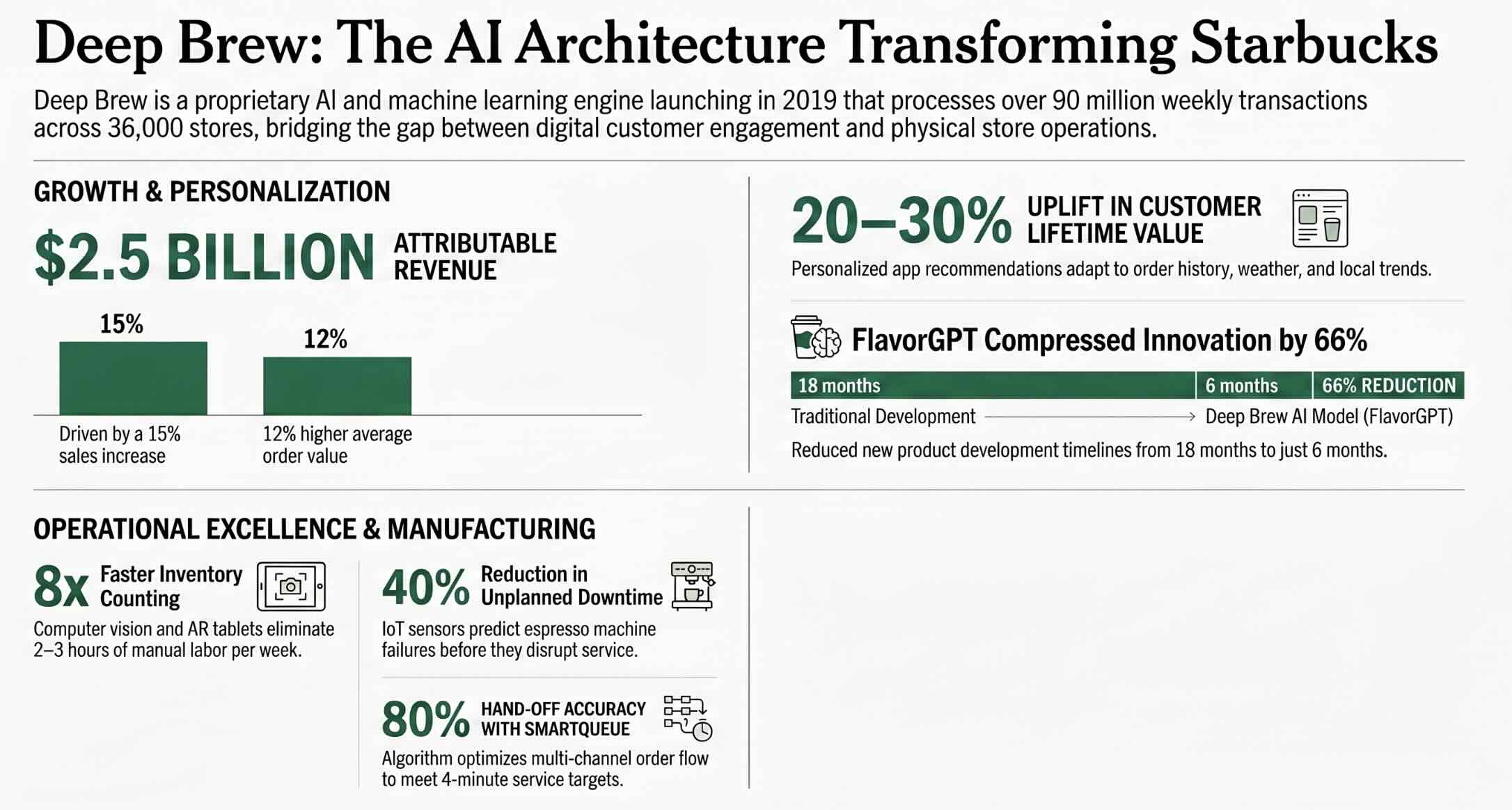
Starbucks has evolved from a Seattle coffee shop into one of the most data-sophisticated companies in global retail, processing over 90 million weekly app transactions across 36,000 stores worldwide through an AI platform that touches every dimension of its business from personalized drink recommendations to predictive espresso machine maintenance. The company’s proprietary AI and machine learning platform, Deep Brew, was formally launched in 2019 and has since generated an estimated USD 2.5 billion in attributable revenue by driving a 15 percent sales increase and a 12 percent rise in average order value through hyper-personalized customer engagement. Deep Brew now extends far beyond marketing into operational territory, optimizing labor scheduling, automating inventory counts, predicting equipment failures on IoT-connected espresso machines, and even accelerating new product development through a generative AI engine called FlavorGPT that compressed concept-to-launch timelines from 18 months to just 6. More than 30 percent of U.S. Starbucks orders are now placed through mobile, and customers experiencing AI-driven personalization show a 20 to 30 percent uplift in lifetime value according to McKinsey’s AI Retail Report. In 2025, Starbucks deployed AI-powered inventory counting across thousands of North American stores, scanning shelves eight times more frequently than manual methods and virtually eliminating stockouts on high-demand items. This article explores how Starbucks uses Deep Brew to transform every aspect of its operations, from the drink suggestion on your phone screen to the maintenance schedule of the espresso machine that brews it. The result is a company that former CEO Kevin Johnson described as aspiring to be “as good at AI as the tech giants” within a decade.
Key Questions On Starbucks Deep Brew
What is Starbucks Deep Brew?
Starbucks Deep Brew is a proprietary AI and machine learning platform launched in 2019 that powers personalized customer recommendations, optimizes store labor scheduling, automates inventory management, enables predictive equipment maintenance, and drives product innovation across Starbucks’ 36,000 global stores.
How does Starbucks use AI?
Starbucks uses AI through Deep Brew to personalize mobile app recommendations, predict store staffing needs, automate inventory counting, maintain IoT-connected espresso machines, develop new products through generative AI, and sequence orders through its SmartQueue algorithm for faster service.
What is FlavorGPT at Starbucks?
FlavorGPT is Starbucks’ generative AI engine integrated into Deep Brew in 2024 that aids new product development and flavor simulation, reducing concept-to-launch timelines from 18 months to 6 months and enabling the company to introduce seasonal drinks faster in response to consumer trends.
Key Takeaways
- FlavorGPT compressed new product development from 18 months to 6 months, directly contributing to a 4 percent same-store sales increase during the spring 2024 promotion period.
- Deep Brew has generated an estimated USD 2.5 billion in attributable revenue through a 15 percent sales increase and 12 percent higher average order value driven by AI-powered personalization.
- The Siren Craft System raised overall equipment effectiveness from 72 to 86 percent across five roasting plants, cut unplanned downtime by 40 percent, and saved 9,500 maintenance labor hours in fiscal 2024.
- AI-powered inventory counting deployed with NomadGo counts stock eight times more frequently than manual methods, deployed across all North American company-operated stores by September 2025.
Table of contents
- How Starbucks Uses AI and Data Inside the Deep Brew Platform
- Key Questions On Starbucks Deep Brew
- Key Takeaways
- Understanding Starbucks Deep Brew
- The Evolution of Starbucks as a Data Company
- How Deep Brew Powers Personalized Customer Experiences
- Operational Intelligence: From Scheduling to Supply Chain
- The Siren Craft System and Predictive Manufacturing
- IoT-Connected Equipment and Predictive Maintenance
- FlavorGPT and AI-Driven Product Innovation
- Green Dot Assist: Generative AI for Baristas
- Data Privacy, Ethics, and Customer Trust
- Real-World Examples of AI Transforming Retail
- Case Studies in AI-Driven Food Service Transformation
- The Business Impact and Competitive Position
- What the Future Holds for Starbucks and Deep Brew
- Key Insights
- Frequently Asked Questions
Understanding Starbucks Deep Brew
Starbucks Deep Brew is the company’s proprietary artificial intelligence and machine learning platform that processes customer transaction data, weather patterns, location intelligence, and operational metrics to deliver personalized recommendations, optimize store operations, automate inventory management, predict equipment maintenance needs, and accelerate product innovation across Starbucks’ global network of over 36,000 stores.
Deep Brew Impact Explorer
Model the impact of Starbucks’ Deep Brew AI platform across personalization, operations, and manufacturing. Adjust store-level parameters to see how AI optimization transforms coffee retail at scale.
Store Profile
Select a Deep Brew module to explore its impact on Starbucks operations.
The Evolution of Starbucks as a Data Company
Starbucks' transformation into a data-driven enterprise began long before Deep Brew received its name, with the Starbucks mobile app launched in 2011 serving as the foundation for what would become one of the most sophisticated customer data ecosystems in retail. The app created a direct digital relationship with millions of customers, capturing transaction histories, beverage preferences, visit frequency, time-of-day patterns, and location data that formed the raw material for machine learning models that would come years later. The Digital Flywheel strategy, which connected the mobile app, loyalty program, payment system, and personalization engine into a self-reinforcing feedback loop, became the architectural blueprint for Deep Brew's development. Former CEO Kevin Johnson, who brought three decades of technology industry experience from IBM, Microsoft, and Juniper Networks, championed AI as central to the company's future and set the aggressive timeline that pushed Deep Brew from concept to operational platform in just two years. The project was partly inspired by McDonald's 2019 acquisition of Dynamic Yield, a reinforcement learning company, which signaled that AI-driven personalization was becoming table stakes in the competitive quick-service restaurant market. Starbucks' evolution from coffee retailer to data company reflects a strategic recognition that in modern retail, the ability to understand and anticipate customer behavior at scale is as valuable as the product itself.
The technology partnerships that underpin Deep Brew reflect Starbucks' approach of building on enterprise-grade infrastructure rather than developing every component internally. Microsoft Azure provides the cloud computing foundation, with the two companies maintaining a deep partnership that extends from infrastructure to the Azure OpenAI integration powering the Green Dot Assist barista tool. Predictive analytics platforms similar to those used by Amazon for product recommendations provided a conceptual model for Deep Brew's personalization engine, though Starbucks adapted the approach for the unique dynamics of food and beverage retail. The company also invested USD 100 million in Valor Siren Ventures, a food-focused venture fund, and took an equity stake in Brightloom, a restaurant technology company, to accelerate its digital platform capabilities. IoT in the retail industry provides context for understanding how Starbucks' connected store infrastructure, from IoT-enabled espresso machines to smart inventory systems, creates the data layer that Deep Brew requires to function effectively.
How Deep Brew Powers Personalized Customer Experiences
The customer-facing dimension of Deep Brew is its most visible application, delivering personalized recommendations, promotions, and menu suggestions that transform the Starbucks mobile app from a simple ordering tool into an AI-driven concierge that learns individual preferences and anticipates needs. The platform employs collaborative filtering and reinforcement learning algorithms that analyze order history, time of day, weather conditions, local events, seasonal patterns, and even what other customers with similar profiles have ordered to generate recommendations tailored to each individual user. When a regular morning customer opens the app on a rainy afternoon, Deep Brew adjusts its suggestions from the usual cold brew to warm seasonal drinks, demonstrating the contextual intelligence that distinguishes sophisticated personalization from simple purchase history recall. Personalized AI-driven customer experiences represent a growing competitive differentiator in retail, and Starbucks' approach demonstrates how deep data integration across touchpoints creates personalization that feels intuitive rather than algorithmic. The Starbucks Rewards loyalty program, which feeds behavioral data back into Deep Brew, creates a virtuous cycle where increased engagement generates more data, which improves personalization, which drives further engagement. Deep Brew's personalization engine does not simply recommend products; it constructs a continuously evolving model of each customer's relationship with coffee, adapting to changes in taste, routine, and context that make every interaction feel personally crafted.
The marketing dimension of Deep Brew extends personalization beyond product recommendations into the targeting, timing, and content of promotional offers that drive incremental purchases and strengthen customer loyalty. AI-driven segmentation divides the customer base into micro-segments based on behavioral patterns, spending propensity, lapsed engagement risk, and product preferences, enabling marketing campaigns that achieve significantly higher conversion rates than broadcast promotions. How AI chooses the ads you see explains the broader principles of algorithmic ad targeting that Deep Brew applies specifically to Starbucks' promotional ecosystem. Dynamic menu suggestions displayed on in-store digital screens adapt to local conditions, time of day, and current inventory levels, creating a responsive experience that bridges digital and physical channels. The result is measurable: customers experiencing AI-driven personalization show a 20 to 30 percent uplift in lifetime value compared to those receiving generic communications.
Operational Intelligence: From Scheduling to Supply Chain
While personalization captures headlines, Deep Brew's operational applications may deliver even greater value to Starbucks' bottom line by optimizing the complex logistics of running 36,000 stores across 78 markets worldwide. AI-driven labor scheduling analyzes historical sales data, customer foot traffic, seasonal trends, local events, and weather conditions to predict the busiest hours for each store, automatically generating optimized work schedules that ensure the right number of baristas are deployed at the right times. This predictive approach reduces both overstaffing during slow periods and understaffing during rushes, improving customer service while controlling labor costs and enhancing employee satisfaction through more predictable, balanced schedules. Streamlining workflows with AI is evident throughout Deep Brew's operational toolkit, where automation handles the data-heavy analysis that would otherwise consume management time across thousands of locations. Supply chain optimization uses Deep Brew to forecast demand for individual ingredients at each store, automatically calculating replenishment orders that maintain product availability while minimizing waste. Deep Brew's operational intelligence transforms Starbucks store management from a series of manual decisions based on experience and intuition into a data-driven system that continuously optimizes every operational variable across the entire global network.
The SmartQueue order-sequencing algorithm represents one of Deep Brew's most impactful operational innovations, addressing the chronic challenge of managing order flow during peak periods when mobile, drive-through, and in-store orders compete for barista attention. The algorithm has driven a double-digit improvement in cafe orders handed off in under four minutes at test locations, with 80 percent of in-cafe orders now meeting that target. The role of AI in boosting automation is demonstrated in how SmartQueue coordinates complex multi-channel order flows that would overwhelm human sequencing during the morning rush. Inventory counting was transformed in 2025 through a partnership with NomadGo, deploying AI-powered tablets that use computer vision, 3D spatial intelligence, and augmented reality to count stock in minutes rather than hours. Chief Technology Officer Deb Hall Lefevre stated that inventory is now "counted eight times more frequently, giving us real-time visibility and enabling faster, more precise replenishment." The system was deployed across all North American company-operated stores by September 2025, eliminating 2 to 3 hours of weekly manual counting per store and converting that time into customer-facing barista activity.
The Siren Craft System and Predictive Manufacturing
Deep Brew's reach extends beyond retail stores into Starbucks' manufacturing operations, where the Siren Craft System applies AI to the roasting and production processes that determine the quality and availability of every product that reaches store shelves. Deployed across five North American roasting plants, the system raised overall equipment effectiveness from 72 percent to 86 percent within two quarters, representing a significant improvement in manufacturing productivity. The predictive maintenance capabilities cut unplanned downtime by 40 percent, saving 9,500 maintenance labor hours in fiscal 2024 and ensuring that production lines operate continuously during the high-demand periods that drive Starbucks' seasonal revenue peaks. Product rework was reduced from 4.5 percent to 1.8 percent, translating to 3.2 million fewer discarded units and USD 11.4 million in cost avoidance that flows directly to the bottom line. Machine learning algorithms power the predictive models that identify equipment degradation patterns before failures occur, scheduling maintenance during planned downtime rather than interrupting production. The Siren Craft System demonstrates that Deep Brew's value extends from the consumer-facing tip of the Starbucks operation all the way back through manufacturing, creating an AI-optimized value chain from roasting plant to customer's cup.
Energy consumption per pound of coffee roasted dropped by 9 percent through AI-optimized production scheduling, contributing to Starbucks' science-based climate commitments. The system's API pushes batch-level flavor profiles directly into Deep Brew's consumer-facing applications, so the mobile app can alert customers when freshly roasted lots of their favorite blend arrive at nearby stores. Near real-time inventory visibility shortened replenishment lead time to distribution centers by 22 percent, keeping popular beverages in stock during the peak promotional periods where stockouts directly cost sales. AI for competitive advantage is demonstrated in how the Siren Craft System creates manufacturing efficiencies that competitors without integrated AI platforms cannot easily replicate.
IoT-Connected Equipment and Predictive Maintenance
At the individual store level, Deep Brew integrates with IoT-connected equipment to create an intelligent store infrastructure where every piece of critical equipment communicates its operational status to predictive maintenance systems. The Mastrena super-automatic espresso machines, which are central to Starbucks' beverage production, are fitted with sensors that centrally log and analyze every shot delivered, monitoring extraction time, temperature, pressure, and volume to detect drift from optimal parameters. Deep Brew's predictive analytics assess this continuous stream of machine data to identify potential areas for tuning and schedule preventative maintenance before performance degradation affects drink quality or causes equipment failure. IoT trends shaping retail include the kind of connected equipment monitoring that Starbucks has implemented at scale, where the data generated by daily operations becomes the foundation for continuous operational optimization. Remote diagnostics capabilities allow Starbucks to identify and potentially resolve equipment issues without dispatching technicians, reducing maintenance costs and minimizing the service disruptions that affect both customer experience and store revenue. IoT-connected equipment transforms Starbucks stores from collections of independent machines into integrated systems where every device contributes data that Deep Brew uses to maintain optimal performance across the entire operational environment.
The connectivity infrastructure extends beyond espresso machines to encompass refrigeration systems, ovens, grinders, and brewing equipment, creating a comprehensive picture of store-level operational health. This equipment data feeds into store manager dashboards that highlight maintenance priorities, equipment performance trends, and energy consumption patterns that inform both immediate operational decisions and longer-term capital planning. Deep learning techniques power the anomaly detection models that distinguish normal operational variation from early indicators of equipment degradation, enabling intervention at the optimal point where maintenance cost is minimized and equipment lifetime is maximized.
FlavorGPT and AI-Driven Product Innovation
Building on Deep Brew's data foundation, Starbucks integrated generative AI into its product development process in 2024 through FlavorGPT, an AI engine that simulates flavor combinations, predicts consumer reception, and accelerates the journey from concept to commercial launch. Traditional beverage development at Starbucks required approximately 18 months from initial concept to store availability, a timeline that limited the company's ability to respond to emerging flavor trends and seasonal opportunities. FlavorGPT compressed this timeline to approximately 6 months by using AI to simulate thousands of flavor combinations, predict consumer preferences based on Deep Brew's taste profile data, and identify the most promising candidates for human evaluation and refinement. The system directly contributed to three incremental seasonal drinks in fiscal 2024 that drove a 4 percent same-store sales increase during the spring promotion period. Generative AI and its impact on business is demonstrated in how FlavorGPT transforms product development from a primarily creative, intuition-driven process into a data-informed discipline where AI narrows the innovation funnel before human tasters make final selections. FlavorGPT represents the frontier of Deep Brew's evolution, where AI moves beyond optimizing existing operations into actively creating the products that drive Starbucks' growth, effectively becoming a digital member of the product development team.
The integration of FlavorGPT with Deep Brew's consumer data creates a closed-loop innovation system where customer preferences captured through app interactions, loyalty program behavior, and purchase patterns inform the AI-generated flavor suggestions that become future menu offerings. This feedback loop means that every customer transaction contributes not just to personalization of existing offerings but to the development of entirely new products that reflect demonstrated demand rather than speculative market research. AI and recipe development illustrates the broader trend of AI entering the creative dimensions of food and beverage development. The competitive advantage this creates is significant, as Starbucks can identify and commercialize flavor trends faster than competitors relying on traditional development cycles, capturing market share during the narrow windows when new flavors have maximum consumer appeal.
Green Dot Assist: Generative AI for Baristas
Starbucks' fiscal 2026 roadmap centers on Green Dot Assist, a generative AI assistant powered by Microsoft Azure OpenAI technology that is designed to enhance barista efficiency, accuracy, and customer service capabilities directly at the point of interaction. The system operates through headsets and point-of-sale interfaces, providing baristas with real-time guidance on complex recipes, allergen compliance, menu localization, and customer-specific preferences drawn from Deep Brew's personalization database. Piloted at 35 U.S. cafes and rolled out to over 1,500 European stores, Green Dot Assist represents Starbucks' most visible integration of generative AI into daily store operations. The voice AI capability supports over 20 languages, cutting service times by 20 percent in markets where baristas serve linguistically diverse customer bases. The future of chatbot development is being advanced by applications like Green Dot Assist that move conversational AI from customer-facing chatbots into employee-facing productivity tools. Green Dot Assist embodies Starbucks' philosophy that AI should empower human workers rather than replace them, providing baristas with an always-available AI assistant that enhances their capabilities while preserving the human connection that defines the Starbucks experience.
Early case studies from 2025 cite measurable improvements in order accuracy and labor efficiency, particularly in high-volume or regionally diverse markets where the complexity of the menu and customer base creates the greatest cognitive load for baristas. New employee onboarding is accelerated through Green Dot Assist's ability to guide less experienced baristas through complex preparations, reducing training time while maintaining the quality standards that experienced staff deliver. Natural language processing challenges are relevant to Green Dot Assist's operation, as the system must interpret barista queries in noisy store environments and deliver concise, actionable guidance without disrupting the pace of service. The 2026 roadmap includes expansion to 1,000 or more stores for "predictive and voice-first" coffee experiences that further integrate Green Dot Assist into the standard Starbucks operational model.
Data Privacy, Ethics, and Customer Trust
Starbucks' extensive data collection and AI-powered personalization raise important questions about privacy, transparency, and the ethical use of customer information that the company must address to maintain the trust that underpins its loyalty ecosystem. Processing 90 million weekly app transactions generates enormous volumes of behavioral data that, while enabling personalization, also creates privacy responsibilities that extend across multiple jurisdictions with different regulatory requirements. Starbucks maintains compliance with GDPR in Europe and CCPA in the United States through secure data storage, encryption protocols, and privacy policies that outline how and why data is collected, giving customers control over their personal information. Dangers of AI privacy concerns are amplified in consumer-facing AI applications where the granularity of behavioral tracking can make customers uncomfortable if they perceive the personalization as intrusive rather than helpful. AI ethics and governance frameworks must evolve alongside Starbucks' expanding AI capabilities to ensure that the pursuit of personalization does not compromise the customer trust that makes the loyalty program valuable in the first place. The ethical challenge for Starbucks is maintaining the balance between personalization that delights customers and data collection that respects their privacy, recognizing that the loyalty ecosystem depends on trust that aggressive data practices could erode.
Algorithmic fairness is another ethical dimension, as Deep Brew's recommendation and promotion targeting systems must avoid biases that could result in different quality of service or promotional value for different customer segments based on demographic characteristics. Dangers of AI bias in retail personalization can manifest as pricing discrimination, promotional inequality, or service differentiation that disproportionately affects certain groups. Starbucks' leadership, including Johnson and CTO Gerri Martin-Flickinger, have consistently emphasized that AI is not intended to replace employees but to empower them, a message that addresses both workforce anxiety and the ethical positioning of the company's technology strategy.
Real-World Examples of AI Transforming Retail
Starbucks' deployment of AI-powered inventory counting through its partnership with NomadGo demonstrates how computer vision and augmented reality can solve operational problems that traditional methods have struggled with for decades. The system, which uses handheld tablets with computer vision and 3D spatial intelligence, was live across thousands of coffeehouses by September 2025 and deployed to all North American company-operated stores. The measurable outcome is inventory counted eight times more frequently than manual methods, real-time visibility into stock levels, and the elimination of 2 to 3 hours of weekly manual counting per store that converts directly into customer-facing barista time. The limitation is that the system requires reliable tablet hardware and connectivity in every store, and the initial deployment focused on company-operated locations rather than licensed stores that represent a significant portion of the Starbucks network. Source: Starbucks official press release
The Siren Craft System deployment across five North American roasting plants illustrates how AI-driven manufacturing optimization delivers measurable returns at enterprise scale within compressed timeframes. The system raised overall equipment effectiveness from 72 to 86 percent, cut unplanned downtime by 40 percent, reduced product rework from 4.5 to 1.8 percent, and lowered energy consumption per pound of coffee by 9 percent. The measurable outcome includes USD 11.4 million in cost avoidance from reduced waste, 9,500 saved maintenance labor hours, and 22 percent shorter replenishment lead times to distribution centers. The limitation is that the significant capital investment and integration complexity of the Siren Craft System restrict its deployment to major manufacturing facilities rather than the distributed store network. Source: DigitalDefynd Starbucks AI case study
Amazon's use of predictive analytics and personalized recommendations provides a parallel case that contextualizes Starbucks' approach within the broader landscape of AI-powered retail personalization. Amazon's data collection and personalization strategy shares architectural similarities with Deep Brew's Digital Flywheel, where customer data flows into recommendation engines that drive incremental revenue while building competitive moats through accumulated behavioral intelligence. The measurable outcome for Amazon includes approximately 35 percent of revenue attributed to personalized recommendations, a benchmark that validates the commercial potential of the approach Starbucks has adapted for food and beverage retail. The limitation of direct comparison is that Amazon operates primarily in e-commerce where personalization drives purchase decisions, while Starbucks must balance digital personalization with the physical, experiential dimensions of in-store coffee culture.
Case Studies in AI-Driven Food Service Transformation
The Digital Flywheel and Revenue Attribution
Starbucks' Digital Flywheel strategy demonstrates how connecting mobile ordering, loyalty programs, payment systems, and AI personalization into a self-reinforcing ecosystem generates measurable revenue growth that exceeds what any individual component could deliver independently. The problem was that Starbucks' massive customer base interacted with the brand through disconnected channels, limiting the company's ability to understand individual customer journeys and optimize each touchpoint for maximum engagement and spend. The solution connected the Starbucks app, Rewards loyalty program, mobile payment, and Deep Brew personalization engine into an integrated platform where every interaction generates data that improves personalization, which drives engagement, which generates more data. The measurable impact includes USD 2.5 billion in attributed revenue, 15 percent sales increase, 12 percent higher average order value, and 20 to 30 percent customer lifetime value uplift for personalized versus non-personalized experiences. The limitation is that the Digital Flywheel depends on customers engaging through digital channels, and the approximately 70 percent of transactions that occur outside the app ecosystem do not benefit from the same level of personalization. The case demonstrates that AI personalization delivers maximum value not as a standalone feature but as a component of an integrated digital ecosystem where each element reinforces the others. Source: Kernel Growth Starbucks AI framework analysis
AI-Powered Inventory Transformation with NomadGo
Starbucks' 2025 deployment of AI-powered inventory counting addresses the fundamental operational challenge that has limited supply chain optimization across retail: the gap between what companies think they have in stock and what they actually have on shelves at any given moment. The problem was that manual inventory counts, performed weekly or less frequently by store staff, provided only periodic snapshots that were often inaccurate, leading to stockouts that disappointed customers and overstocking that created waste. The solution deployed NomadGo's technology combining computer vision, 3D spatial intelligence, and augmented reality on handheld tablets that baristas use to scan shelves and instantly see accurate stock counts. The measurable impact includes eight times more frequent inventory counts, elimination of 2 to 3 hours of weekly manual counting per store, real-time visibility enabling automated restock triggers, and deployment across all North American company-operated stores by September 2025. The limitation is that the system provides counting accuracy but still requires integration with demand forecasting and supply chain logistics systems to translate visibility into optimized replenishment decisions. The case illustrates that the most impactful AI solutions in retail often address mundane operational problems rather than customer-facing innovations. Source: Supply Chain Dive and Starbucks official
FlavorGPT and Accelerated Product Innovation
The integration of generative AI into Starbucks' product development process through FlavorGPT addresses the competitive imperative to bring new beverages to market faster in an industry where seasonal and trend-driven innovation directly impacts same-store sales growth. The problem was that the traditional 18-month development cycle for new beverages limited Starbucks' ability to capitalize on emerging flavor trends and respond to viral social media phenomena that create sudden demand spikes for specific ingredients and combinations. The solution deployed FlavorGPT as a generative AI engine that simulates flavor combinations, predicts consumer reception using Deep Brew's taste profile data, and identifies the most promising candidates for human evaluation, compressing the development cycle to approximately 6 months. The measurable impact includes three incremental seasonal drinks in fiscal 2024, a 4 percent same-store sales increase during the spring promotion period, and a structural competitive advantage in innovation speed over competitors using traditional development processes. The limitation is that AI-generated flavor suggestions still require extensive human evaluation, testing, and refinement, and the system's predictions are only as good as the taste preference data that Deep Brew has accumulated. The case demonstrates how generative AI can accelerate creative processes without replacing human judgment, serving as a powerful ideation tool that narrows the innovation funnel rather than autonomously creating finished products. Source: AInvest Starbucks analysis
The Business Impact and Competitive Position
The financial returns from Starbucks' AI investment demonstrate how deep integration of machine learning across customer engagement, operations, and manufacturing creates compound advantages that justify continued technology spending. The USD 2.5 billion in Deep Brew-attributed revenue, combined with the USD 11.4 million in manufacturing cost avoidance from the Siren Craft System, represents a return profile that validates AI as one of Starbucks' most productive capital allocations. Measuring ROI on AI investments is particularly clear in Starbucks' case because the company can trace specific revenue uplifts and cost reductions to identifiable AI applications, creating a feedback loop that justifies progressive expansion of the platform's scope. The competitive implications are significant, as Starbucks' years of accumulated customer data, operational optimization, and AI infrastructure create switching costs and competitive moats that new entrants and existing competitors cannot easily replicate. AI for competitive advantage is demonstrated in how Deep Brew's benefits compound over time as models improve with more data, operational workflows incorporate more AI-driven decisions, and the gap between AI-enabled and traditional operators widens. Starbucks' AI investment has created a self-reinforcing competitive advantage where each dollar spent on Deep Brew generates both immediate operational returns and long-term strategic value through accumulated data assets and organizational AI capability that competitors would require years to build.
What the Future Holds for Starbucks and Deep Brew
The trajectory of Deep Brew points toward increasingly autonomous store operations, deeper generative AI integration, and expansion into predictive and voice-first customer experiences that further blur the line between digital and physical coffee culture. Starbucks' 2026 roadmap, revealed at Dreamforce, centers on deploying predictive and voice-first coffee experiences across 1,000 or more stores, where AI anticipates customer needs and enables ordering through natural conversation rather than screen-based interfaces. The integration of Deep Brew with broader Starbucks initiatives, including blockchain-powered "bean to cup" traceability, sustainability monitoring, and store design optimization, suggests a future where AI touches every dimension of the company's operations and customer relationships. Future trends in AI business applications include the kind of end-to-end AI integration that Starbucks is pursuing, where the platform becomes the operating system for the entire enterprise rather than a collection of point solutions. The possibility of Deep Brew evolving into a technology platform that Starbucks licenses to franchisees, partners, and potentially other food service operators would transform the company from purely a coffee retailer into a technology vendor in the food service AI space. The future of Deep Brew is a Starbucks where AI is so deeply integrated into every customer interaction and operational process that it becomes invisible, creating experiences that feel effortlessly personal while operating on a foundation of machine intelligence that touches billions of data points daily.
Emerging jobs in AI within Starbucks' organization reflect the company's growing identity as a technology company, with roles in data science, machine learning engineering, AI ethics, and digital product management increasingly central to the company's talent strategy. The aspiration to be "as good at AI as the tech giants" within a decade positions Starbucks not just as a retail AI leader but as a potential competitor for technical talent with companies like Google, Amazon, and Microsoft that have historically dominated AI recruitment. The coming decade will determine whether Starbucks' Deep Brew platform achieves the autonomous operational capabilities and generative creative tools that its roadmap envisions, fundamentally redefining what a coffee company can be in the age of artificial intelligence.
Key Insights
- Customers experiencing AI-driven personalization show a 20 to 30 percent uplift in lifetime value compared to those receiving generic communications, per McKinsey's AI Retail Report 2025.
- Deep Brew has generated an estimated USD 2.5 billion in attributable revenue through a 15 percent sales increase and 12 percent higher average order value, powered by hyper-personalized recommendations across 90 million weekly app transactions.
- The Siren Craft System raised overall equipment effectiveness from 72 to 86 percent across five roasting plants, cut unplanned downtime by 40 percent, saved 9,500 maintenance labor hours, and avoided USD 11.4 million in costs during fiscal 2024.
- AI-powered inventory counting with NomadGo counts stock eight times more frequently than manual methods, deployed across all North American company-operated stores by September 2025 and eliminating 2 to 3 hours of weekly counting per store.
- FlavorGPT compressed new product development from 18 months to 6 months, introducing three seasonal drinks in fiscal 2024 that drove a 4 percent same-store sales increase during spring promotions.
- The SmartQueue order-sequencing algorithm achieved a double-digit improvement in cafe orders handed off in under four minutes, with 80 percent of in-cafe orders meeting that target at test locations.
- Green Dot Assist, powered by Microsoft Azure OpenAI, supports over 20 languages and has been piloted at 35 U.S. cafes and rolled out to over 1,500 European stores for fiscal 2026.
| Dimension | Traditional Coffee Retail | Starbucks Deep Brew-Powered Operations |
|---|---|---|
| Customer Knowledge | General market research and periodic surveys with limited individual insight | Continuous behavioral modeling across 90 million weekly transactions with individual-level personalization |
| Menu Recommendations | Static menu boards with seasonal promotions applied uniformly | AI-driven suggestions personalized by individual preference, time, weather, location, and context |
| Inventory Management | Weekly manual counts with manager-estimated restock orders | AI-powered counting eight times more frequently with automated replenishment triggers |
| Labor Scheduling | Manager judgment based on experience and historical patterns | Predictive scheduling using traffic, weather, events, and seasonal trend data |
| Equipment Maintenance | Scheduled maintenance and reactive repair after failure | IoT-connected predictive maintenance identifying issues before service disruption |
| Product Development | 18-month cycles driven by culinary intuition and market research | 6-month cycles powered by FlavorGPT generative AI with consumer preference data |
| Order Sequencing | First-in-first-out with barista judgment during peak periods | SmartQueue algorithm optimizing multi-channel order flow for under-4-minute delivery |
| Supply Chain Visibility | Periodic reports with limited real-time insight into store-level conditions | Near real-time visibility with 22 percent shorter replenishment lead times |
Frequently Asked Questions
Deep Brew is Starbucks' proprietary AI and machine learning platform, launched in 2019, that powers personalized customer recommendations, optimizes store labor scheduling, automates inventory management, enables predictive equipment maintenance, and drives product innovation. The platform processes over 90 million weekly app transactions and operates across Starbucks' 36,000 global stores. It has been credited with generating approximately USD 2.5 billion in attributable revenue.
Deep Brew analyzes order history, time of day, weather conditions, local events, and taste preferences to generate individually tailored drink recommendations, promotional offers, and menu suggestions. The system uses collaborative filtering and reinforcement learning to continuously refine its understanding of each customer. Personalized experiences drive a 20 to 30 percent uplift in customer lifetime value.
FlavorGPT is a generative AI engine integrated into Deep Brew in 2024 that simulates flavor combinations and predicts consumer reception to accelerate new product development. It compressed the concept-to-launch timeline from 18 months to approximately 6 months. The system contributed to three seasonal drinks in fiscal 2024 that drove a 4 percent same-store sales increase.
Green Dot Assist is a generative AI assistant powered by Microsoft Azure OpenAI that supports baristas through headsets and point-of-sale systems with real-time recipe guidance, allergen compliance, and customer preference information. It supports over 20 languages and has been piloted at 35 U.S. cafes and rolled out to over 1,500 European stores. The system cuts service times by 20 percent in linguistically diverse markets.
Starbucks uses AI-powered tablets developed with NomadGo that combine computer vision, 3D spatial intelligence, and augmented reality to count inventory eight times more frequently than manual methods. The system was deployed across all North American company-operated stores by September 2025. It eliminates 2 to 3 hours of weekly manual counting per store while providing real-time visibility for automated replenishment.
The Siren Craft System is Deep Brew's manufacturing AI platform deployed across five North American roasting plants. It raised equipment effectiveness from 72 to 86 percent, cut unplanned downtime by 40 percent, and saved 9,500 maintenance labor hours. The system also reduced product rework from 4.5 to 1.8 percent, saving USD 11.4 million in costs.
Deep Brew predicts store traffic using historical sales data, weather forecasts, local events, and seasonal trends to automatically generate optimized work schedules for each store. This ensures the right number of baristas are deployed at peak times while avoiding overstaffing during slow periods. The approach improves both customer service and employee satisfaction.
Starbucks uses IoT-connected Mastrena espresso machines fitted with sensors that log and analyze every shot, monitoring extraction time, temperature, pressure, and volume. Deep Brew processes this data for predictive maintenance that identifies potential issues before they cause equipment failure. This connected equipment approach reduces downtime and maintains consistent beverage quality.
SmartQueue is Deep Brew's order-sequencing algorithm that manages the flow of mobile, drive-through, and in-store orders during peak periods. The algorithm has driven a double-digit improvement in cafe orders handed off in under four minutes. At test locations, 80 percent of in-cafe orders now meet the four-minute target.
Starbucks maintains compliance with GDPR and CCPA through secure data storage, encryption protocols, and transparent privacy policies that give customers control over their personal information. The company's privacy policy outlines how and why data is collected across its digital platforms. Ongoing governance frameworks address the ethical dimensions of AI-driven personalization.
Deep Brew has been credited with approximately USD 2.5 billion in attributable revenue through a 15 percent sales increase and 12 percent higher average order value. The platform's personalization engine drives measurable uplifts in customer lifetime value. Manufacturing optimization through the Siren Craft System has added USD 11.4 million in cost avoidance.
Microsoft Azure provides the cloud computing infrastructure and Azure OpenAI powers the Green Dot Assist barista assistant. NomadGo developed the AI-powered inventory counting technology deployed across North American stores. Starbucks also invested in Brightloom for digital platform capabilities and USD 100 million in Valor Siren Ventures for food technology innovation.
FlavorGPT simulates thousands of flavor combinations and predicts consumer reception using Deep Brew's taste profile data to identify promising new beverage candidates. Human evaluators then refine and test the AI-generated suggestions before commercial launch. This approach compressed the development cycle from 18 months to 6 months.
Starbucks leadership has consistently emphasized that Deep Brew empowers baristas rather than replacing them by automating inventory counting, scheduling, and equipment monitoring so staff can focus on craft and customer connection. Green Dot Assist provides guidance that enhances barista capabilities rather than substituting for their skills. The company invests in training programs that help staff work effectively alongside AI tools.
Starbucks' roadmap includes predictive and voice-first coffee experiences in 1,000 or more stores, expansion of Green Dot Assist globally, deeper integration with sustainability monitoring and blockchain traceability, and potential licensing of Deep Brew technology to partners. The company aspires to be "as good at AI as the tech giants" within a decade. Deep Brew is evolving from a collection of AI tools into a comprehensive enterprise operating system.