
Introduction
For centuries, the dream of a machine that could replicate the skill of a master chef remained firmly in the realm of science fiction, but a London-based robotics company has turned that fantasy into a functioning kitchen appliance that can prepare over 5,000 recipes with sub-millisecond precision. The global food robotics market was valued at approximately USD 2.81 billion in 2025 and is projected to reach USD 15.29 billion by 2034, growing at a compound annual growth rate of 20.7 percent. Moley Robotics, founded in 2015 by Russian-British mathematician and computer scientist Mark Oleynik, has developed the world’s first fully robotic kitchen featuring two articulated robotic arms with five-fingered hands equipped with tactile sensors that replicate the exact movements of professional chefs. The system captures the cooking techniques of world-class chefs through 3D motion recording and gesture recognition algorithms, then reproduces every stir, flip, pour, and seasoning with identical precision every single time. The robotic hands, developed in collaboration with Universal Robots and German robotics firm SCHUNK, underwent 11 development cycles and 100,000 test operation cycles before reaching commercial readiness. This article explores how Moley works, the technology behind its chef-replicating robotic arms, the culinary partnerships that define its recipe library, and what the world’s most advanced robotic kitchen means for the future of home and commercial cooking. The first recipe Moley ever learned was a crab bisque created by Tim Anderson, the winner of MasterChef UK 2011, establishing a culinary pedigree that runs through every dish the system prepares.
Key Questions On Moley Robotic Kitchen
What is the Moley robotic kitchen?
The Moley robotic kitchen is the world’s first fully robotic cooking system featuring two articulated arms with five-fingered hands that replicate the exact movements of professional chefs. It captures cooking techniques through 3D motion recording and uses gesture recognition algorithms to reproduce dishes with sub-millisecond precision across over 5,000 recipes.
How does Moley learn to cook?
Moley learns to cook through a motion capture system that uses integrated 3D cameras and a wired glove to record every movement a human chef makes while preparing a dish. Custom algorithms translate these human movements into digital instructions, and the robotic kitchen reproduces the entire sequence to cook an identical meal from scratch.
How much does the Moley robotic kitchen cost?
The Moley robotic kitchen ranges from approximately USD 70,000 for a base configuration to USD 335,000 for a fully installed R-Kitchen with robotic arms, smart storage, UV disinfection, and a complete appliance suite. A smaller single-arm Chef’s Table model is available starting at approximately GBP 50,000.
Key Takeaways
- Recipes are developed by Michelin-starred and award-winning chefs including Tim Anderson (MasterChef UK 2011), Andreas Caminada, Andrew Clarke, and Toni Toivanen, ensuring culinary credibility at the highest level.
- Moley’s robotic arms with five-fingered hands underwent 11 development cycles and 100,000 test operation cycles in collaboration with Universal Robots and SCHUNK, enabling them to manipulate nearly any kitchen tool with human-like dexterity.
- The system captures chef techniques through 3D motion recording and gesture recognition algorithms, reproducing entire cooking sequences with sub-millisecond precision across over 5,000 planned recipes.
- Moley holds over 60 utility patents including 11 granted patents, positioning it as the technology leader in residential robotic kitchen development.
Table of contents
- Introduction
- Key Questions On Moley Robotic Kitchen
- Key Takeaways
- Understanding What Moley Is
- The Vision Behind Moley Robotics
- How Moley Captures and Replicates Chef Movements
- The Moley Kitchen Product Range
- The Culinary Partnerships That Define Moley’s Library
- The Technology Under the Hood
- Moley in the Competitive Kitchen Robotics Landscape
- The Culinary Debate: Art, Craft, and Machines
- Real-World Examples of Residential Kitchen Robotics
- Case Studies in Robotic Kitchen Development
- Challenges Facing Robotic Kitchen Adoption
- What the Future Holds for Moley and Home Kitchen Robotics
- Key Insights
- Frequently Asked Questions
Understanding What Moley Is
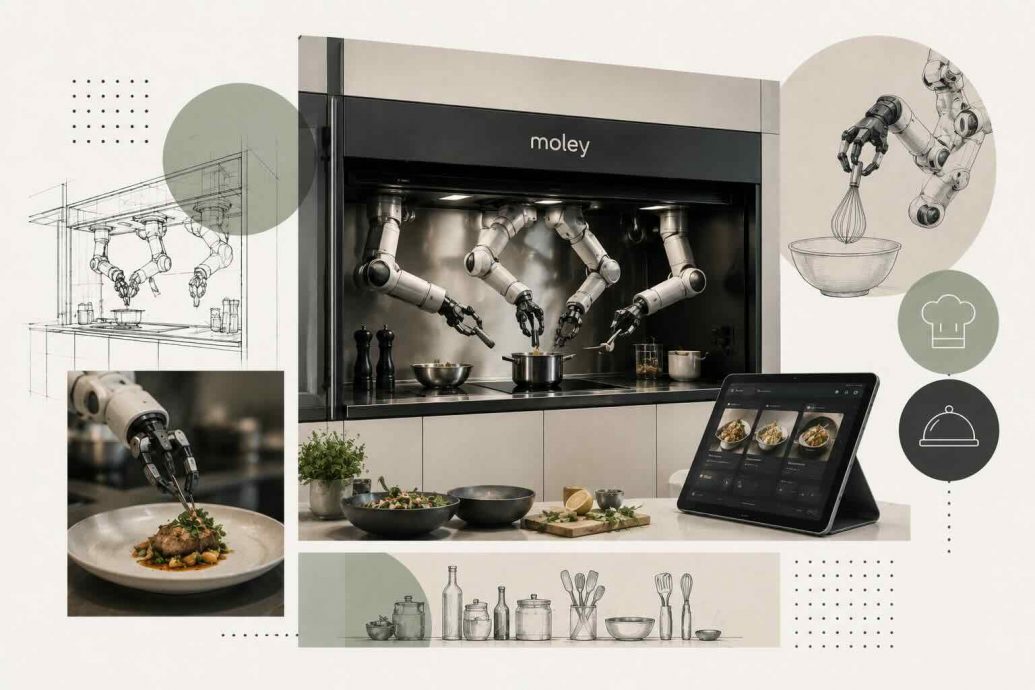
Moley is the world’s first fully robotic kitchen system that uses two articulated arms with five-fingered, tactile-sensor-equipped hands mounted on an overhead rail to replicate the recorded movements of professional chefs, preparing, cooking, plating, and cleaning meals autonomously across a library of over 5,000 recipes in both residential and commercial environments.
Moley Kitchen Value Calculator
Compare the long-term cost and value of a Moley Robotic Kitchen against traditional dining alternatives. Adjust your household profile to see when robotic cooking pays for itself.
Household Profile
Configure your household profile to model the value of a Moley robotic kitchen.
The Vision Behind Moley Robotics
Mark Oleynik founded Moley Robotics in 2015 with a deceptively simple premise: what if the best cooking in the world could be available to anyone, regardless of their culinary skill, simply by pressing a button? Oleynik, whose background spans computer science, economics, and a Harvard Business School degree, recognized that the kitchen represented one of the last major domains of daily life untouched by meaningful automation. His insight was that cooking, unlike most industrial processes, requires not just precision but the adaptive dexterity that only articulated hands with multiple degrees of freedom could provide. The company debuted its proof-of-concept prototype at the Hannover Messe industrial robotics trade fair in Germany in April 2015, generating global media coverage and establishing Moley as the most ambitious project in residential food robotics. Over six years of development, Moley moved from that initial prototype to a market-ready robotic cooking platform augmented with a smart kitchen environment. Oleynik's vision was not to build a kitchen gadget but to create an entirely new category of home technology: a robotic system that brings the skill of a Michelin-starred chef into any kitchen where it is installed.
The founding insight that distinguished Moley from other food robotics approaches was the decision to replicate human chef movements rather than developing machine-specific cooking methods. AI in robotics and the next phase of technology points toward increasingly human-like robotic systems, and Moley represents the most literal implementation of this principle in the consumer market. This approach meant that any dish a human chef could cook could, in theory, be taught to the Moley system, creating an expandable recipe library limited only by the number of chefs willing to record their techniques. Food robotics transforming the industry has taken multiple technological paths, from the dispensing-and-heating approach of systems like Beastro to the single-purpose automation of pizza robots, but Moley chose the most technically challenging route: replicating the full range of human cooking dexterity. The London showroom at 16 Wigmore Street now serves as the company's flagship demonstration space, where visitors experience the robotic arms preparing dishes in real time.
How Moley Captures and Replicates Chef Movements
The technological core of Moley's system is its motion capture and reproduction pipeline, which translates the intuitive, adaptive movements of professional chefs into precise digital instructions that robotic arms can execute identically across thousands of preparations. An integrated 3D camera system and a wired glove capture every motion a chef makes while preparing a recipe, recording not just the gross movements of arms and hands but the subtle adjustments in grip pressure, wrist angle, and tool manipulation that distinguish competent cooking from exceptional cooking. Custom gesture recognition algorithms developed by Moley's engineering team process this motion data, translating human biomechanics into digital commands that the robotic system can execute with sub-millisecond accuracy. Computer vision applications in Moley's system extend beyond motion capture to include real-time monitoring of cooking progress, ingredient positioning, and tool tracking that ensures the robotic execution matches the chef's original performance. The integrated scale in the Moley Kitchen supports precise ingredient weight control, ensuring that each meal is identical to the one cooked by the original chef. Moley's motion capture system transforms the ephemeral art of cooking into a reproducible digital asset, enabling the movements of a world-class chef to be preserved, shared, and replicated with perfect fidelity indefinitely.
The reproduction phase requires robotic hardware capable of matching the dexterity and adaptability that human hands bring to cooking, a challenge that pushed the boundaries of commercial robotics engineering. The two robotic arms travel along an overhead rail system that provides access to every functional area of the kitchen, from the stovetop and oven to the sink, storage compartments, and plating areas. End effectors in robotics are critical to Moley's approach, as the five-fingered hands must grip, rotate, pour, stir, flip, and place with the same fluidity that human hands achieve through decades of practice. The SCHUNK-developed hands went through 11 development cycles and 100,000 test operation cycles to achieve the reliability and precision that commercial deployment demands. Each hand incorporates tactile sensors that provide force feedback, enabling the system to adjust its grip for different tools, weights, and textures, from a delicate whisk to a heavy cast-iron pan. The collaboration with Universal Robots provided the articulated arm platform, while SCHUNK's expertise in precision gripping technology delivered the hand dexterity that makes Moley's approach to cooking automation unique in the robotics industry.
Moley also introduced a recipe creator tool that enables chefs to add new meals to the culinary library without requiring the full motion capture setup for every recipe. This tool simplifies the programming process by allowing chefs to define cooking sequences through a structured interface that specifies ingredients, quantities, temperatures, timing, and technique parameters. Machine learning from theory to practice informs the system's ability to generalize cooking techniques across recipes, adapting recorded movements to accommodate variations in ingredient quantities and cooking parameters without requiring complete re-recording.
The Moley Kitchen Product Range
Moley offers several kitchen configurations that address different market segments, from IoT-enabled platforms designed for future robotic upgrade to fully autonomous installations that represent the pinnacle of residential kitchen technology. The R-Kitchen is the flagship configuration, featuring two full robotic arms with five-fingered hands, integrated appliances, a smart storage system, and the complete Moley software platform, priced from approximately USD 248,000 to USD 335,000. The X-Kitchen is an IoT cooking platform equipped with a smart fridge and storage that includes a pre-set support structure for future robotic module installation, enabling homeowners to invest in the smart kitchen ecosystem today and upgrade to full robotic capability when they are ready. The A-AiR Kitchen represents the most advanced configuration, adding three additional degrees of freedom through a gantry system that enables complex two-handed operations with even greater precision. AI-enabled smart kitchens represent a growing market category, and Moley's tiered approach enables entry at multiple price points while maintaining upgrade pathways to full automation. Moley's product range strategy recognizes that residential robotic kitchen adoption will occur gradually, with the X-Kitchen serving as a gateway that introduces smart kitchen capabilities while creating an installed base that can convert to full robotic operation over time.
The Chef's Table, a more compact single-arm system priced at approximately GBP 50,000, represents Moley's response to demand for a more accessible entry point into robotic cooking. This smaller system demonstrates the core cooking capabilities in a format that fits existing kitchen spaces without requiring full kitchen renovation. The 43-inch 4K touchscreen serves as the command center for all Moley configurations, allowing users to browse recipes, generate automatic shopping lists, control cooking parameters, and integrate with scales for precise measurements. Samsung Bot Chef and other consumer robotics kitchen concepts represent a competitive landscape where Moley distinguishes itself through the completeness of its cooking capability rather than the specificity of its automation. The UV-disinfection system integrated into the R-Kitchen sterilizes both the worktop and the air in the cooking zone, addressing food safety concerns that are particularly relevant in autonomous cooking environments where human oversight is reduced.
The Culinary Partnerships That Define Moley's Library
The quality of Moley's output depends entirely on the caliber of chefs whose techniques are recorded and the rigor with which their recipes are captured and translated into robotic instructions. Tim Anderson, the MasterChef UK 2011 champion and author of several cookbooks, created the first recipe Moley ever learned, a crab bisque that established the benchmark for what the system could achieve. Michelin-starred chef Andreas Caminada brings the precision and creativity of fine dining to the recipe library, while award-winning chefs including Andrew Clarke, Toni Toivanen, Kiiche Okabe, and the Berezutskiy brothers contribute dishes spanning diverse culinary traditions. AI and recipe development is evolving alongside robotic cooking, but Moley's approach ensures that every recipe begins with genuine human culinary artistry rather than algorithmic generation. The recipe library spans cuisines from Italian and French to Japanese, Korean, Thai, and Indian, offering users a global culinary journey that reflects the international backgrounds of its contributing chefs. Moley's culinary partnerships transform the recipe library from a technical database into a curated collection of culinary artistry, where the recorded techniques of world-class chefs become accessible to anyone with a Moley kitchen installed in their home.
The dietary management capabilities of the Chef's Table platform enable users to maintain specific nutritional programs, whether focused on low-calorie, vegan, vegetarian, or personalized nutrition plans tailored to individual health goals. Moley's health positioning claims that shifting to a fresh, low-processed meal quality standard can reduce the risk of food-related diseases and extend lifespan by up to 11 years, framing the robotic kitchen as a wellness investment rather than merely a convenience appliance. The future of hospitality with AI includes the intersection of nutrition science, personalized health data, and automated food preparation that Moley's platform enables. The ability to track exact ingredient quantities, cooking temperatures, and nutritional profiles for every meal creates a level of dietary control that manual cooking, with its inherent variability, cannot match.
The Technology Under the Hood
Beyond the visible robotic arms, Moley's system incorporates a sophisticated technology stack that manages every aspect of the kitchen environment, from ingredient storage and temperature management to appliance control and safety monitoring. The patented mini-manipulation system represents Moley's most significant technical innovation, empowering the robots with dynamic control that allows execution of highly intricate operations in unpredictable environments with unmatched performance and adaptability. The robotic arms can seamlessly manage a variety of kitchen equipment including faucets, ovens, blenders, whisks, and induction cooktops, transitioning between tools with the fluidity that cooking demands. Robotics and manufacturing principles inform the mechanical design, but the adaptation of industrial robotic precision for the unpredictable environment of food preparation required innovations that go well beyond standard manufacturing robotics. The automatic ingredient storage system with refrigerating mode maintains ingredient freshness while organizing components for efficient access by the robotic arms during preparation. Moley's patented mini-manipulation technology solves one of robotics' hardest problems: enabling machines to perform the fine motor tasks that humans execute instinctively but that require extraordinary engineering to replicate mechanically.
The system can operate in both automatic and manual modes, a design choice that addresses the concern that a robotic kitchen might alienate users who enjoy cooking but want robotic assistance for routine meals or complex dishes beyond their skill level. In manual mode, the Moley interface provides step-by-step prompts that guide human users through recipes with the same precision that the robotic system applies, effectively serving as an interactive cooking instructor. Working with AI in collaborative settings reflects this hybrid approach where human and machine capabilities complement each other rather than operating in mutual exclusion. The self-cleaning capability handles post-cooking cleanup autonomously, washing cookware, wiping surfaces, and preparing the kitchen for the next meal without human intervention. Over 60 utility patents protect Moley's intellectual property, including 11 granted patents that cover the mini-manipulation system, motion capture pipeline, and various mechanical innovations that competitors would need to engineer around.
Moley in the Competitive Kitchen Robotics Landscape
Moley occupies a unique position in the food robotics ecosystem, competing not against commercial kitchen automation systems but against the emerging category of premium residential and luxury cooking technology. Beastro by Kitchen Robotics targets the ghost kitchen market with a multi-cuisine dispensing system priced at USD 5,990 per month. Pazzi, the autonomous pizza robot achieves full end-to-end autonomy for a single food category. Spyce's robotic kitchen and Connected Robotics in Japan address commercial food service with cuisine-specific approaches. Moley's distinction lies in its approach to replicating human chef movements through articulated hands, which theoretically enables it to cook anything a human chef can cook rather than being limited to the specific food types that a particular automated system is designed to handle. The price point of USD 70,000 to USD 335,000 positions Moley in the luxury appliance market alongside brands like Sub-Zero, La Cornue, and Gaggenau, where affluent homeowners invest significant sums in kitchen technology. Moley competes not just on automation capability but on the promise of culinary excellence at home, positioning its robotic kitchen as a luxury lifestyle product that brings Michelin-starred cooking to the domestic environment.
The commercial kitchen market represents Moley's planned expansion beyond residential installations, where the system's ability to replicate chef techniques at scale could transform restaurant operations. Oleynik has publicly discussed deploying Moley systems in commercial kitchens where consistency across multiple locations is critical, such as restaurant chains where ensuring identical quality at every branch is a persistent challenge. The role of AI in boosting automation in commercial food service points toward increasing adoption of technologies that reduce labor dependency while maintaining or improving food quality. The food robotics market forecasts reaching approximately USD 30.8 billion by 2030, with residential robotic kitchens expected to achieve mass-market pricing below EUR 30,000 by 2030, which would dramatically expand Moley's addressable market.
The Culinary Debate: Art, Craft, and Machines
The existence of a machine that can replicate the movements of a master chef raises profound questions about the nature of cooking, whether culinary skill is merely technical execution or something more intangible that machines cannot capture. Tim Anderson himself acknowledged the tension, describing Moley as producing "the most perfectly cooked pasta I have ever seen" while noting that the system executes his recorded techniques rather than creating new ones. The distinction between reproduction and creation is central to the debate: Moley can perfectly replicate a recorded performance, but it cannot improvise, taste, adjust seasonings based on personal preference during cooking, or respond to the subtle cues that experienced chefs process unconsciously. Impact of AI on creative workspaces mirrors this discussion, where the relationship between human creativity and machine execution is being negotiated across multiple disciplines. The system's consistent perfection may actually represent a limitation, as the small variations that make each handmade meal unique are precisely what automation eliminates. The culinary debate around Moley ultimately asks whether cooking is primarily a technical skill that machines can master through precision, or a creative art that requires the human capacity for taste, judgment, and improvisation that no amount of engineering can replicate.
Proponents argue that Moley democratizes culinary excellence by making dishes that would normally require years of training and expensive ingredients accessible to anyone willing to invest in the technology. The health argument is compelling: access to professionally prepared, nutritionally optimized meals every day could transform dietary habits in ways that improve long-term health outcomes. Critics counter that the expense of the system limits its democratizing potential to the affluent, and that the social and emotional dimensions of cooking, preparing food for loved ones, teaching children to cook, experimenting with flavors, would be diminished by outsourcing the process to a machine. Automation versus AI is an important distinction in this context: Moley combines mechanical automation of physical tasks with AI-driven adaptation, but it does not possess the creative intelligence that would enable it to invent new dishes or respond to feedback about personal taste preferences during preparation.
Real-World Examples of Residential Kitchen Robotics
Moley Robotics' London showroom at 16 Wigmore Street serves as the world's first luxury robot kitchen demonstration space, where potential buyers experience the system preparing dishes in real time before committing to installations priced at six figures. The showroom allows visitors to watch the robotic arms execute recipes from Moley's chef-developed library, taste the results, and explore the different kitchen configurations from the entry-level X-Kitchen to the fully autonomous R-Kitchen. The measurable outcome is a physical demonstration environment that converts interest into orders by providing tangible proof that the technology delivers on its promises. The limitation is that the showroom experience, conducted in an optimized demonstration environment, may not fully represent the integration challenges that homeowners encounter during installation in existing residential kitchens. Source: Moley Robotics official website
Samsung's Bot Chef concept, unveiled at CES, represents a competing vision for residential kitchen automation that uses a modular approach with attachable robotic arms designed to integrate with Samsung's broader smart home ecosystem. Samsung Bot Chef takes a different approach from Moley by designing robot arms that attach to existing kitchen countertops rather than requiring a full kitchen installation, potentially offering a lower-cost entry point. The measurable outcome is a proof-of-concept that validates consumer interest in kitchen robotics from a major appliance manufacturer with global distribution capabilities. The limitation is that Samsung's concept remains primarily in the development stage and has not yet achieved the commercial availability or recipe library depth that Moley offers.
The Thermomix TM7, launched in 2025, represents the most commercially successful automated cooking device at scale, offering guided cooking, precision temperature control, and integrated weighing at a price point around EUR 1,139 that makes it accessible to mainstream consumers. While it lacks the articulated arms and chef-replication capabilities of Moley, the Thermomix demonstrates the consumer appetite for automated cooking assistance and provides context for how price reduction could expand the market for more capable robotic kitchens. The measurable outcome is tens of millions of units sold globally, validating the consumer market for kitchen automation. The limitation is that the Thermomix automates a narrow set of cooking functions compared to Moley's comprehensive approach, serving as a sophisticated kitchen tool rather than a complete cooking replacement.
Case Studies in Robotic Kitchen Development
From Proof of Concept to Commercial Product
Moley's six-year journey from a proof-of-concept demonstration at Hannover Messe 2015 to a market-ready product launched at GITEX Dubai in December 2020 illustrates the engineering complexity and capital requirements of bringing a consumer robotic kitchen to market. The problem was that no existing robotic platform could handle the diverse, fine-motor tasks required for cooking, where every recipe demands different tools, temperatures, timing, and hand movements that industrial robots were not designed to perform. The solution involved developing the patented mini-manipulation system, collaborating with Universal Robots for articulated arms and SCHUNK for five-fingered hands, and creating a motion capture pipeline that translates human chef movements into digital instructions. The measurable impact is a functioning commercial product with sub-millisecond execution accuracy, over 60 utility patents, and a recipe library developed by Michelin-starred and award-winning chefs. The limitation is that six years of development and the resulting price point of USD 70,000 to USD 335,000 restrict the addressable market to high-net-worth individuals and luxury residential projects. The case demonstrates that consumer kitchen robotics requires fundamentally different engineering approaches than commercial food automation, with dexterity and versatility taking precedence over speed and volume. Source: Wikipedia and industry reporting
Chef Motion Capture and Recipe Library Development
The creation of Moley's recipe library through chef motion capture represents a novel approach to preserving and scaling culinary expertise that has implications beyond kitchen robotics. The problem was that culinary skill is traditionally transmitted through years of apprenticeship and practice, creating a bottleneck where the supply of expert cooking is limited by the number of trained chefs available at any given time. The solution deployed 3D cameras and wired gloves to capture every movement of professional chefs during recipe preparation, using gesture recognition algorithms to translate these movements into digital instructions reproducible by robotic arms. The measurable impact is a growing library targeting over 5,000 recipes from world-class chefs including Tim Anderson, Andreas Caminada, and Andrew Clarke, each recorded with the fidelity needed for perfect robotic reproduction. The limitation is that motion capture requires chefs to adapt their natural cooking style to the physical constraints of the recording system, and some techniques may not transfer perfectly to robotic execution due to differences in hand geometry and force application between human and mechanical fingers. The case establishes a new paradigm for culinary knowledge preservation where the techniques of master chefs can be archived and shared globally rather than being lost when a chef retires or passes away. Source: KTCHNRebel and New Atlas
Luxury Residential Market Positioning
Moley's positioning in the luxury residential market tests whether robotic kitchen technology can command premium pricing in a consumer segment accustomed to investing heavily in kitchen design and appliances. The problem was finding a market willing to pay six-figure prices for a first-generation consumer product that requires significant installation investment and represents an entirely new product category without established consumer expectations. The solution positioned Moley alongside established luxury kitchen brands, opening a flagship showroom in London's Wigmore Street, and emphasizing the culinary credentials of contributing chefs and the health benefits of consistently prepared, nutritionally optimized meals. The measurable impact is the establishment of a commercial presence in the luxury residential market, media coverage across publications from Financial Times to International Business Times, and growing consumer interest demonstrated at CES and GITEX exhibitions. The limitation is that the luxury positioning inherently limits volume, and the long-term viability of the business depends on achieving price reductions that expand the addressable market to mainstream affluent consumers. The ongoing challenge is whether Moley can maintain its premium positioning while pursuing the cost engineering needed to bring prices into the range that market forecasters predict will trigger mass adoption. Source: Air Mail and OnOff.gr
Challenges Facing Robotic Kitchen Adoption
Despite Moley's technological achievements, significant barriers stand between the current luxury product and the mass-market adoption that would transform how people interact with food in their homes. Price remains the most obvious constraint, as even the most affordable Moley configuration costs more than many people spend on an entire kitchen renovation, limiting the market to the affluent segment where six-figure appliance investments are feasible. Installation complexity is substantial, as the R-Kitchen requires structural modifications, precise calibration, and dedicated space that may not be available in existing homes without significant renovation work. Ingredient preparation still requires human involvement, as users must cut, measure, and position ingredients in designated locations before the robotic system can begin cooking. Automation in incremental steps may prove more practical for most consumers than the full kitchen replacement that Moley represents, with individual automated appliances providing targeted assistance within traditional kitchen workflows. The gap between Moley's technological capability and mass-market adoption is defined not by engineering limitations but by the economics, infrastructure, and cultural acceptance barriers that every transformative technology must overcome to move from luxury novelty to household essential.
Cultural resistance to robotic cooking reflects deeply held beliefs about the role of food preparation in family life, personal identity, and social connection that purely functional arguments cannot override. Many people derive satisfaction, creative expression, and emotional connection from cooking, and would view robotic replacement of this activity as a loss rather than a gain regardless of the quality of the output. Maintenance and repair of sophisticated robotic systems in residential environments creates service requirements that traditional kitchen appliances do not demand, potentially generating frustration for homeowners accustomed to appliances that operate for years without professional attention. Whether robots will take our jobs extends into the domestic sphere with Moley, where the question is not about employment but about whether replacing a fundamental human activity with robotic execution enhances or diminishes the quality of daily life.
What the Future Holds for Moley and Home Kitchen Robotics
The trajectory of Moley and the broader residential kitchen robotics market points toward progressive price reduction, expanding capability, and gradual consumer acceptance that will unfold over the next decade rather than arriving as a sudden disruption. Industry forecasters project that affordable robotic kitchens priced below EUR 30,000 will reach the mass market by 2030, a price point that would dramatically expand Moley's addressable market from ultra-luxury to upper-mainstream consumer segments. Oleynik's plans for commercial kitchen deployment would create a dual market strategy where residential sales fund continued development while commercial installations demonstrate the technology's reliability at volume. The future of AI in business applications includes food preparation as one of the most significant consumer-facing robotics opportunities, with the food robotics market projected to grow seven-fold by 2034. The integration of generative AI with Moley's recipe system could enable natural-language recipe requests where users describe what they want to eat and the system generates and prepares custom dishes, moving beyond recorded chef recipes to truly adaptive cooking. The future of Moley is a world where robotic kitchen technology evolves from a luxury appliance into a standard feature of home design, where the question shifts from "can a robot cook?" to "whose chef's technique should the robot use tonight?"
The most significant long-term impact of Moley's approach may be the preservation and democratization of culinary heritage through motion-captured chef techniques that can be shared globally. Rare cooking traditions, endangered cuisine styles, and the techniques of aging master chefs could be recorded and reproduced indefinitely, creating a living archive of human culinary achievement. Emerging jobs in AI in the food robotics space will include culinary programmers, robotic kitchen technicians, and recipe capture specialists who bridge the gap between human artistry and mechanical reproduction. The integration of health monitoring data with personalized nutrition programs managed by robotic kitchens could create closed-loop wellness systems where meals are automatically adjusted based on individual health metrics, transforming the kitchen from a cooking space into a precision health management platform.
Key Insights
- Tim Anderson described Moley's output as producing "the most perfectly cooked pasta I have ever seen", validating that robotic execution of captured chef techniques achieves results that satisfy even the original chef's standards.
- Moley's robotic hands developed with SCHUNK underwent 11 development cycles and 100,000 test operations, achieving the five-fingered dexterity needed to manipulate kitchen tools from whisks to heavy pans.
- The motion capture system uses 3D cameras and wired gloves to record chef movements, translating human biomechanics into digital instructions that the robotic kitchen reproduces with sub-millisecond accuracy.
- Moley holds over 60 utility patents including 11 granted, covering its patented mini-manipulation system, motion capture pipeline, and mechanical innovations that establish its intellectual property leadership.
- The R-Kitchen is priced from USD 248,000 to USD 335,000 for full installation, while the Chef's Table single-arm system offers entry from approximately GBP 50,000, and the base configuration starts at USD 70,000.
- Recipe contributors include MasterChef UK 2011 winner Tim Anderson and Michelin-starred chef Andreas Caminada, whose recorded techniques ensure culinary credibility at the highest professional level.
- The global food robotics market is projected to grow from USD 2.81 billion in 2025 to USD 15.29 billion by 2034 at 20.7 percent CAGR, with affordable robotic kitchens expected to reach the mass market by 2030.
| Dimension | Human Chef Cooking | Moley Robotic Kitchen |
|---|---|---|
| Precision | Varies with skill, fatigue, and attention; approximate measurements and timing | Sub-millisecond accuracy with integrated scales ensuring identical preparation every time |
| Culinary Range | Unlimited creativity, improvisation, and adaptation to available ingredients | Limited to recorded recipes and programmable sequences within the system's dexterity range |
| Consistency | Each preparation differs slightly based on cook's condition and interpretation | Identical execution across unlimited preparations of the same recipe |
| Learning Source | Years of training, practice, apprenticeship, and experiential knowledge | 3D motion capture of professional chef techniques translated through gesture recognition |
| Operating Hours | Limited by human endurance, scheduling, and availability | 24/7 availability with self-cleaning between preparations |
| Cost per Meal | Labor cost plus ingredients; highly variable by chef skill level | Ingredient cost only after initial system investment; zero labor cost per meal |
| Creativity | Infinite capacity for improvisation, experimentation, and personal expression | Executes recorded sequences; cannot improvise or create new dishes independently |
| Emotional Connection | Cooking as personal expression, care, tradition, and social bonding | Functional meal delivery without the interpersonal and emotional dimensions |
Frequently Asked Questions
The Moley robotic kitchen is the world's first fully autonomous residential cooking system, featuring two articulated robotic arms with five-fingered hands that replicate the recorded movements of professional chefs. The system was developed by Moley Robotics, founded in London in 2015 by Mark Oleynik. It can prepare, cook, plate, and clean up meals from a library of over 5,000 recipes.
Moley learns recipes through a motion capture system that records every movement a human chef makes during preparation using integrated 3D cameras and a wired glove. Custom gesture recognition algorithms translate these recorded movements into digital instructions that the robotic arms reproduce with sub-millisecond accuracy. A recipe creator tool also allows chefs to program recipes through a structured interface.
The Moley robotic kitchen ranges from approximately USD 70,000 for a base configuration to USD 335,000 for a fully installed R-Kitchen with robotic arms, smart storage, UV disinfection, and a complete appliance suite. The Chef's Table, a more compact single-arm system, is available starting at approximately GBP 50,000. Market analysts project that affordable robotic kitchens could reach below EUR 30,000 by 2030.
Moley's recipes are developed by world-class chefs including Tim Anderson (MasterChef UK 2011 winner), Michelin-starred chef Andreas Caminada, Andrew Clarke, Toni Toivanen, Kiiche Okabe, and the Berezutskiy brothers. These chefs prepare their recipes for live 3D recording, and the system captures the nuances of their techniques. The library spans Italian, French, Japanese, Korean, Thai, Indian, and many other cuisines.
Moley can cook a wide range of dishes including pasta, risotto, stir-fries, soups, paella, fish stew, and preparations spanning cuisines from around the world. The system can operate kitchen tools including whisks, blenders, pans, and can control ovens and induction cooktops. The recipe library targets over 5,000 dishes with ongoing additions from contributing chefs.
Moley includes a self-cleaning capability where the robotic arms wash cookware, wipe down surfaces, and prepare the kitchen for the next meal without human intervention. The R-Kitchen also includes UV-disinfection of the worktop and air in the cooking zone. This automated cleanup eliminates one of the most time-consuming aspects of home cooking.
Moley kitchens are designed for both automatic and manual modes. In manual mode, the interface provides step-by-step prompts that guide human users through recipes with professional-level precision. The bespoke cookware and utensils are designed for seamless human use, ensuring homeowners do not sacrifice their own cooking autonomy by installing the system.
The patented mini-manipulation system is Moley's core technical innovation that enables the robotic hands to perform highly intricate operations with dynamic control in unpredictable kitchen environments. This technology provides the fine motor capability needed for tasks like whisking, seasoning, and flipping that require constant adjustment. It represents Moley's most significant intellectual property contribution to the field of consumer robotics.
Moley offers three main configurations: the R-Kitchen with full robotic arms, the X-Kitchen as an IoT platform pre-set for future robotic upgrade, and the A-AiR Kitchen with an additional gantry system for enhanced dexterity. The Chef's Table provides a compact, single-arm alternative. Each configuration uses the same software platform and recipe library.
Moley Robotics holds over 60 utility patents including 11 granted patents that cover its mini-manipulation system, motion capture and gesture recognition pipeline, and various mechanical innovations. This extensive patent portfolio establishes Moley as the intellectual property leader in residential robotic kitchen technology.
Moley operates a luxury showroom at 16 Wigmore Street in London where visitors can watch the robotic kitchen prepare dishes in real time and taste the results. The company also demonstrates at major technology exhibitions including CES and GITEX. Virtual cooking events are periodically hosted online for remote audiences.
Moley is currently focused on markets where it has established distribution and installation capabilities, with primary availability in Europe and growing interest from the Middle East, Asia, and North America. The X-Kitchen IoT platform offers a globally accessible entry point while full R-Kitchen installations require local installation expertise.
Moley addresses food safety through UV-disinfection of the worktop and cooking zone air, precise temperature control throughout cooking, limited human contact during food preparation, and automated self-cleaning after each use. The integrated scales ensure exact ingredient quantities, and the consistent execution eliminates the human error that causes many food safety incidents.
Moley plans to expand into commercial kitchens where consistent quality across multiple restaurant locations is critical, pursue progressive price reduction toward mass-market accessibility, and integrate generative AI for adaptive recipe creation. The residential market is expected to grow as prices decline toward EUR 30,000 by 2030. Long-term possibilities include integration with health monitoring data for personalized nutrition management.
Moley is unique in replicating the full range of human chef movements through articulated five-fingered hands, while competitors like Beastro use dispensing and induction cooking, and Pazzi specializes in pizza automation. Moley targets the residential luxury market rather than commercial food service. Its approach of capturing and reproducing chef techniques creates the broadest culinary range of any robotic kitchen system currently available.