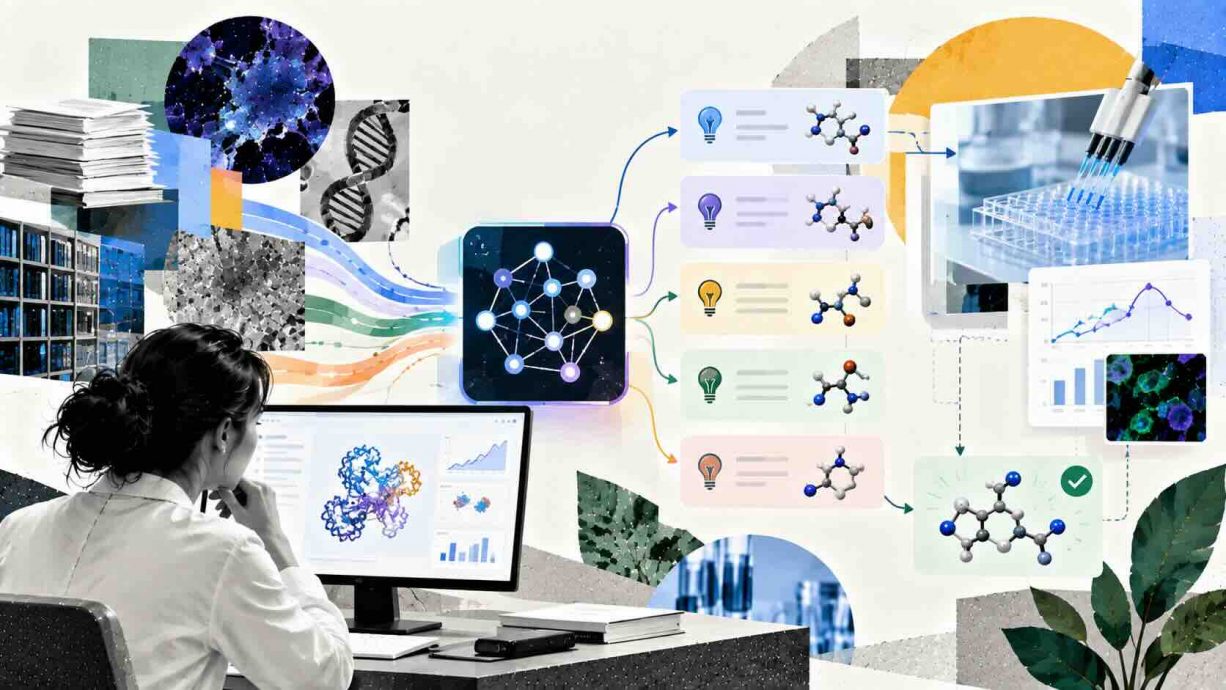

Introduction
AI for Scientific Hypothesis Generation has moved from a speculative research topic into a working tool that laboratories now test every week. In a blind study of more than 100 natural language processing experts, ideas written by a language model were rated more novel than ideas written by human specialists. That single result captures both the excitement and the anxiety surrounding the field, because novelty is not the same thing as truth. A hypothesis is only a tentative explanation, and its value appears only after someone designs an experiment that could prove it wrong. This guide explains how machines propose those explanations, where they have already produced lab-validated results, and where they have embarrassed their creators. You will also find a practical workflow, an honest look at risks and ethics, and a realistic view of what autonomous discovery can and cannot do. Read on if you want a grounded picture instead of marketing claims.
Quick Answers on AI for Scientific Hypothesis Generation
What is AI for scientific hypothesis generation?
AI for Scientific Hypothesis Generation uses language models, knowledge graphs, and multi-agent systems to propose testable explanations from published evidence. Scientists then rank, challenge, and experimentally test those proposals.
Does AI-generated hypothesis work actually get validated in labs?
Yes, in selected cases. Google’s AI co-scientist proposed leukemia drug candidates that suppressed tumor cell viability in laboratory tests, and FutureHouse’s Robin proposed ripasudil for dry macular degeneration.
What is the biggest weakness of AI hypothesis generators?
AI hypothesis generators struggle most with feasibility and factual reliability. Benchmarks show models produce novel ideas but score low on practicality, and they sometimes hallucinate numbers or mechanisms.
Key Takeaways
- AI for Scientific Hypothesis Generation works best as a ranked idea engine that feeds human judgment and laboratory validation, not as a replacement for either.
- Multi-agent systems with tournament ranking, such as Google’s AI co-scientist, have produced hypotheses later supported by wet-lab experiments in leukemia and liver fibrosis.
- Studies consistently show a trade-off: language models generate highly novel ideas, but their feasibility and factual accuracy lag behind human experts.
- Grounding every proposal in retrieved literature, logging provenance, and testing cheap falsifiable predictions first keeps AI hypothesis work trustworthy.
Table of contents
- Introduction
- Quick Answers on AI for Scientific Hypothesis Generation
- Key Takeaways
- Understanding AI for Scientific Hypothesis Generation in Plain Terms
- Why the Hypothesis Is Science’s Real Bottleneck
- From Swanson’s Fish Oil to Modern Language Models
- How AI for Scientific Hypothesis Generation Forms an Idea
- Knowledge Graphs and Literature Mining as Raw Material
- Language Models as Idea Engines
- Multi-Agent Systems and Tournament Reasoning
- Closing the Loop With Robotic Labs and Simulation
- Drug Repurposing and Biomedical Discovery
- Materials Science, Chemistry, and Physics
- Genomics, Neuroscience, and the Social Sciences
- Measuring a Good Hypothesis: Novelty, Feasibility, and Truth
- The Novelty and Feasibility Trade-Off
- Hallucination and the Risk of Confident Nonsense
- Bias, Homogenization, and Regression to the Mean
- Putting AI for Scientific Hypothesis Generation to Work in Your Lab
- Choosing Models and Tools for Research Teams
- Ethics, Authorship, and Accountability
- Reproducibility and Peer Review Under Strain
- What Changes for Scientists and Their Careers
- The Future of Autonomous Discovery and Its Limits
- Key Insights From the Research on AI Hypothesis Generation
- Three Examples That Show What AI Hypothesis Tools Really Deliver
- Three Case Studies in Machine-Proposed Science
- Common Questions About AI for Scientific Hypothesis Generation
Understanding AI for Scientific Hypothesis Generation in Plain Terms
AI for Scientific Hypothesis Generation is the use of machine learning systems to propose testable, evidence-grounded explanations, which researchers then rank, challenge, and verify through experiments.
An Interactive From AIplusInfo
Triage an AI-generated hypothesis before it costs you bench time
Score a candidate idea on novelty, feasibility, evidence, and cost to test, then see how the priority shifts with the speed of feedback in your field.
7 of 10
4 of 10
5 of 10
Cell assays
Priority score
0
Benchmark context: in IdeaBench, GPT-4o reached a novelty insight score of 0.766 while every tested model scored below 0.35 on feasibility, which is why feasibility and evidence carry extra weight here. Weights are an illustrative teaching model, not a validated metric.
Why the Hypothesis Is Science's Real Bottleneck
Every experiment begins with a guess about how the world works, and the quality of that guess decides whether months of lab time produce insight or noise. The scientific literature now grows faster than any person can read, so promising connections hide between papers that no single researcher will ever open together. Roughly 34 million biomedical abstracts sit in PubMed alone, and that corpus is only one of many databases a modern researcher is expected to track. The shortage in modern science is rarely data or instruments; it is the time and attention needed to choose which question is worth asking next. A graduate student might read a few hundred papers in a year, while a language model can scan millions of them in an afternoon. That asymmetry explains why funders, journals, and pharmaceutical firms now treat hypothesis generation as an engineering problem and not only a creative art. The rest of this guide explains whether that framing holds up under evidence.
Economists have started to formalize the same intuition in mathematical models of discovery. A National Bureau of Economic Research model of prioritized search argues that predictive systems let researchers rank candidate ideas by likelihood of success before spending resources. Their central finding is that higher-fidelity predictions raise the odds of successful innovation and shorten search times. The authors attach an important condition, which is that prediction gains deliver nothing without enough testing capacity to act on them. A lab that receives a thousand ranked ideas but can run ten experiments per month has not solved its bottleneck. The bottleneck has simply moved from imagination to validation, and that shift shapes every practical decision discussed later.
Human hypothesis formation also carries well-documented weaknesses that machines might help correct. Researchers anchor on the theories they learned in training, cite the authors they already know, and rarely wander into neighboring disciplines where an analogous problem was already solved. A survey of the field describes the human-centric era of discovery as vulnerable to cognitive biases and disciplinary silos. Machines have their own biases, but those biases differ from ours, which creates the possibility of useful disagreement between the two. When an AI system surfaces a link between a kinase pathway and an eye disease, the value lies in the prompt to look. Treating the output as a prompt rather than a verdict is the first habit every responsible team should adopt.
From Swanson's Fish Oil to Modern Language Models
AI for Scientific Hypothesis Generation did not begin with chatbots, because the idea of mining literature for hidden connections is older than the web. In the 1980s the information scientist Don Swanson noticed that one set of papers described blood viscosity changes in Raynaud syndrome while another described how fish oil reduces blood viscosity. Neither literature cited the other, yet joining them suggested fish oil as a treatment. That proposal later received support in a prospective study according to later reviews. He did the same for magnesium and migraine by tracing shared biochemical pathways through intermediate concepts. These episodes created the research field now called literature-based discovery, or LBD. They also showed that a hypothesis can be assembled from published facts alone, without a single new measurement.
Swanson's logic is usually summarized as the ABC model in the literature. If concept A connects to B, and B connects to C, then A and C may be related even when no paper says so. Systems built on that logic usually work in one of two distinct modes. Open discovery starts with one concept and searches outward for links and outcomes. Closed discovery starts with two concepts and hunts for the bridging terms that connect them. The earliest program to automate this reasoning, Arrowsmith, appeared in 1986 and still shapes how researchers think about the problem. Later systems such as MOLIERE and KnIT added statistical embeddings and knowledge graphs to the same basic idea. Each generation widened the evidence base but kept the central trick of joining separated literatures.
Large language models changed the interface more than the principle. A 2025 survey organizes the field into three generations: human-centric reasoning, literature-based discovery, and LLM-driven approaches that include prompting, fine-tuning, knowledge graph integration, and multi-agent collaboration. Instead of specifying concepts A and C in a query language, a scientist now describes a problem in plain English and receives a structured proposal with reasoning attached. That convenience brings new risks, because a statistical language model can write a fluent mechanism whether or not the underlying papers support it. Swanson's systems were limited but transparent, since every link traced back to a citation a human could check. Modern systems are broader but can invent links, which is why provenance and retrieval have become central design requirements.
The same survey lists the unresolved problems that follow modern systems from that earlier era. Factual accuracy, interpretability, bias reproduction, and computational cost all appear among the challenges it identifies for language model hypothesis generators. Swanson's fish oil proposal succeeded because a human expert judged the link plausible and a clinical study then tested it. The lesson carried forward is that discovery pipelines succeed when human expertise sits at the filtering step, not when it is removed. Today's language models generate candidates at a scale Swanson could not imagine, yet the filtering problem has grown rather than shrunk. Anyone building a modern workflow inherits that old lesson, and the later sections on evaluation and workflow design return to it.
How AI for Scientific Hypothesis Generation Forms an Idea
Most hypothesis generators follow the same broad loop, even when their internals differ widely. First the system gathers evidence, which might be papers, database records, experimental measurements, or a researcher's written problem statement. Next it builds a representation of that evidence, such as a knowledge graph, a vector index, or a long prompt context. It then proposes candidate explanations, scores or critiques them, and returns a ranked list with supporting rationale. The loop can repeat several times, with each pass revising weak proposals using feedback from the critique step. What separates a useful system from a toy is not the generation step but the quality of the retrieval, critique, and ranking wrapped around it.
A helpful way to understand the options is to compare reasoning styles. Deduction applies a known rule to derive a prediction, induction generalizes from observed cases, and abduction infers the best explanation for a surprising observation. Hypothesis generation is mostly abductive, because the scientist begins with a puzzling result and asks what could have produced it. Language models imitate abduction by pattern completion over everything they have read, which explains both their creativity and their tendency to rationalize. Systems that add retrieval, tools, and critique agents try to discipline that raw pattern completion with checkable evidence. The more a pipeline forces its proposals to cite verifiable sources, the closer its behavior comes to real abductive reasoning.
Scoring is the quiet engine that drives the whole loop. A hypothesis can be judged on novelty, meaning distance from existing literature, on feasibility, meaning ease of testing, and on relevance to the goal. The weighted combination of novelty, feasibility, and relevance appears in several evaluation frameworks, and the weights depend on context. A pharmaceutical team might weight feasibility heavily, since failed assays are expensive, while a theoretical physics group might reward bold novelty. Automated scoring can use embeddings to measure semantic distance from prior work, or it can ask another language model to rate each idea. Both shortcuts are imperfect, which is why expert review remains the final arbiter in credible pipelines.
Knowledge Graphs and Literature Mining as Raw Material
Building on that loop, most serious systems rest on a structured map of what is already known. Knowledge graphs store entities such as genes, drugs, diseases, and materials as nodes, with relationships such as inhibits, binds, or causes as edges. When an AI system looks for a missing edge that a graph pattern strongly implies, it is performing a modern version of Swanson's ABC reasoning. Our guide to semantic knowledge graphs for LLM agents explains how those structures give agents a reliable memory of facts. Graphs reduce hallucination because every edge can point back to a source document. They also make explanations easier to audit than a raw language model answer.
Retrieval-grounded research assistants complement graphs by pulling actual passages from the literature. The open-source assistant described in our coverage of OpenScholar outperforming ChatGPT in research shows how citing real papers improves trust in literature synthesis. Datasets matter as much as algorithms in this part of the stack. A survey of hypothesis generation catalogs resources including ChEMBL with over 2 million compounds, the Materials Project with more than 133,000 materials, and UK Biobank with 500,000 participants. Choosing the right corpus for a domain often improves results more than switching to a larger model.
Language Models as Idea Engines
Shifting from graphs to generative models, the most visible change of recent years is that a general-purpose chatbot can now brainstorm in nearly any scientific field. Researchers at MIT and elsewhere tested GPT-4 across battery chemistry, magnon physics, and quantum sensing, and concluded that human curation is essential for now. In battery chemistry the model suggested electrolyte candidates and dual-functional molecular designs that the authors considered worth testing in the laboratory. In quantum sensing the results were borderline, and the model sometimes appeared to invent connections based on similar terminology. The authors described GPT-4 as knowledgeable, frequently wrong, and interesting to talk to, much like a colleague. That description is a fair summary of the whole category, because fluency and correctness are separate properties in a language model. Teams that forget the distinction tend to treat a confident paragraph as a finding.
Prompt sensitivity is the next practical problem that teams encounter. When the same MIT team asked three times about magnon-mediated superconductivity, the model gave three different answers, suggesting the effect would be weaker, stronger, or either. That instability is not a bug that a patch will remove, since sampling randomness is built into how these models generate text. Researchers manage it by running many samples, asking for structured outputs, and comparing answers for consistency before trusting any single response. Our primer on what generative AI actually is explains why probabilistic generation produces this behavior. Consistency across samples is a weak but useful signal, and disagreement is a cheap warning that a claim needs checking.
Reasoning-focused models offer research teams a partial but genuinely useful relief. Systems that deliberate before answering, usually called reasoning models, tend to produce better-structured arguments and catch some errors. Extra thinking time lets a model draft a mechanism, test it against what it knows, and revise before presenting it. Yet deliberation is only as reliable as the knowledge it draws on, so a reasoning model with a flawed premise can build an elaborate and wrong argument. Retrieval from trusted sources therefore matters even more for reasoning models than for plain chat models. The best configurations combine deliberate reasoning with grounded evidence and an independent critic.
Multi-Agent Systems and Tournament Reasoning
Stepping back from single prompts, the most influential design of the past two years assigns different roles to cooperating agents. Google's AI co-scientist uses Generation, Reflection, Ranking, Evolution, Proximity, and Meta-review agents coordinated by a Supervisor that allocates resources. The generation agent proposes ideas, the reflection agent critiques them, and the ranking agent runs pairwise debates between hypotheses in a tournament. Winners receive an Elo rating, and the tournament rewards ideas that survive repeated critique. The The evolution agent then refines top ideas by combining and simplifying them. The system scales test-time compute, so more thinking budget produces better-ranked output. A researcher interacts through natural language, supplying a research goal and later feedback on the proposals.
The tournament structure matters because it replaces one confident answer with a ranked field of competing explanations. Google reported that on difficult benchmark questions, higher Elo ratings correlated with a higher probability of correct answers, which suggests the ranking signal carries real information. Domain experts also rated the system's outputs as having higher potential for novelty and impact than baseline models. The technical report behind the system lists 47 authors, a sign of how much biomedical expertise went into evaluating outputs. Tournament systems are not magic, though, because the judge agents are themselves language models with shared blind spots. Independent human evaluation remains the only reliable check on whether the ranking tracks scientific truth.
Hierarchical coordination is the core engineering principle that sits underneath all of this. In this pattern a supervisor splits work among specialist agents and then merges their results. Hypothesis generation fits the pattern naturally, since literature search, mechanism reasoning, experimental design, and critique are different skills. Open-source projects have copied the idea, including Agent Laboratory, which reported an 84 percent reduction in research expense compared with earlier autonomous research methods. That study also found that human feedback at each stage significantly improved the quality of the results. The broader trend in agentic AI points the same direction, toward teams of specialized agents under human supervision.
The cost profile of these systems deserves attention from any lab planning a pilot. Tournament debates multiply the number of model calls, so a single research question can consume far more compute than a chat session. Budgeting for that usage is similar to budgeting for an assay run, where the cost per question is known and tracked. Teams should log the number of hypotheses generated, the number retained after review, and the number that survive experiments. Those three figures give a running estimate of the system's practical yield. Without them, enthusiasm tends to outrun evidence, and managers cannot tell whether the tool is helping.
Closing the Loop With Robotic Labs and Simulation
Beyond the digital layer, the most ambitious projects connect hypothesis generators to instruments that run experiments automatically. In such closed-loop systems an AI proposes a hypothesis, a robotic platform or simulation tests it, and the result flows back to refine the next proposal. The FutureHouse system Robin, for example, completed a cycle from conception to paper submission in 2.5 months with human researchers performing the physical lab work. Robin's agents handled literature review, candidate selection, and analysis of experimental data. The humans performed the physical experiments and prepared the manuscript, which shows that even the most automated pipelines still lean on people at the bench. Fully robotic loops exist in narrow domains, but general wet-lab automation remains expensive and fragile.
Simulation offers a cheaper testing ground for fields where physics or chemistry can be modeled computationally. Generative materials systems such as Microsoft's MatterGen materials model propose crystal structures that a simulation can screen before anyone synthesizes a sample. The same logic applies to molecular dynamics, climate models, and economic agent-based simulations. Simulated tests are fast and cheap, but they are only as truthful as the model underneath. A hypothesis that survives simulation has passed a filter, not a trial, and researchers should label it accordingly.
The economic logic ties back to the prioritized-search model discussed earlier. When tests are cheap, a system can afford to try many speculative hypotheses and learn from the failures. When tests are expensive, as in clinical research, the generator must be conservative and the ranking must carry the weight. Closed-loop designs therefore fit best in domains with fast feedback, such as cell-based screening, materials synthesis, and software experiments. Slow domains like epidemiology or ecology benefit mainly from better ranking and better data integration. Matching the autonomy of the loop to the speed of the feedback is a sound rule of thumb.
Drug Repurposing and Biomedical Discovery
Turning to results, medicine has produced the most convincing validation stories so far, partly because cell assays offer quick, quantifiable feedback. For acute myeloid leukemia, the co-scientist proposed repurposing candidates, and laboratory tests confirmed that the suggested drugs inhibit tumor viability at clinically relevant concentrations in multiple AML cell lines. For liver fibrosis, the system identified epigenetic targets, and all AI-suggested treatments showed anti-fibrotic activity with p-values below 0.01 in human hepatic organoids. Repurposing is attractive because approved drugs already have safety data, which shortens the path to a trial. Our overview of how AI speeds drug discovery covers the wider pipeline from target to candidate. A repurposing hypothesis is easier to test than a de novo molecule, which is why it dominates early success stories.
Genetics and microbiology offer a different and instructive kind of example. The co-scientist independently proposed that capsid-forming phage-inducible chromosomal islands interact with diverse phage tails to widen host range. That idea matched an experimentally confirmed result from a concurrent laboratory study. Such agreement shows the system can reach non-obvious conclusions, although the report does not claim it can do so reliably across problems. A single matching result cannot establish a hit rate, which would require many blind trials. Readers should treat these stories as existence proofs, not as performance guarantees. They demonstrate that useful hypotheses can emerge, which is a weaker but still important claim.
Materials Science, Chemistry, and Physics
Moving on from biology, the physical sciences use hypothesis generators to search enormous design spaces of molecules and crystals. The MIT team that tested GPT-4 reported strong results in rechargeable battery chemistry, where the model suggested electrolyte candidates and molecular designs worth testing. Our coverage of LLMs in chemical synthesis planning shows how the same technology proposes routes to make a target compound. Generative models for crystals, such as MatterGen, flip the usual workflow by starting from desired properties and proposing structures that might deliver them. Physical sciences benefit because simulation and synthesis give relatively fast, objective feedback on whether a proposed structure behaves as predicted. Even so, a predicted material that looks stable on paper may prove impossible to synthesize at scale.
Physics is a harder case because many open questions are conceptual and cannot be settled by screening. The same MIT study found borderline results in quantum sensing and unstable answers about magnon-mediated superconductivity. Language models can still help by suggesting analogies from neighboring subfields, for example borrowing a technique from condensed matter to attack a quantum optics problem. Reports of an AI-discovered method for quantum entanglement illustrate how computational search can surface unusual experimental designs, though details vary by report. Humans then must work out whether the proposed design reflects a real principle or a numerical quirk. The pattern repeats across the physical sciences: machines widen the search, and experts interpret the results.
The third recurring pattern in these fields is cross-disciplinary transfer. A model trained on text from many fields can recognize that a problem in battery electrolytes resembles one in protein solvation, and then suggest techniques that cross the boundary. Human specialists often miss such links because journals, conferences, and vocabulary keep communities separate. Transfer suggestions are the closest modern analogue to Swanson's bridging of fish oil and Raynaud syndrome. They also carry the same risk, since similar words do not guarantee similar mechanisms, as the MIT authors observed when the model appeared to link concepts by nomenclature. A good workflow therefore asks the system to state the mechanism explicitly and then checks that mechanism against textbooks and primary papers.
Genomics, Neuroscience, and the Social Sciences
Looking beyond chemistry, fields with huge observational datasets are natural fits for machine-generated hypotheses. Genomics produces association signals across millions of variants, and systems can propose which genes or pathways plausibly explain a signal. Our overview of AI in genomics and genetic analysis describes the tools used to interpret that data. The risk in this domain is spurious pattern finding, since a model scanning thousands of variables will always find something that looks significant. Statistical discipline, pre-registration, and independent replication cohorts remain the defenses, and no language model replaces them. A generated hypothesis in genomics should be treated as a candidate to be tested in a held-out dataset, never as a conclusion.
Neuroscience and the social sciences face a different challenge, which is that theory is contested and measurements are noisy. A model asked for hypotheses about decision making in the brain will produce plausible stories drawn from conflicting literatures. In social science the same pattern appears, with generated explanations that echo dominant academic framings rather than challenge them. Researchers can use AI productively here to enumerate rival explanations and to design studies that could tell them apart. That use shifts the model's role from oracle to devil's advocate. The approach respects the limits of the technology while capturing its real strength, which is breadth of recall.
Measuring a Good Hypothesis: Novelty, Feasibility, and Truth
Weighing the evidence on quality, the hardest question in this field is how anyone knows a generated hypothesis is good. Benchmarks try to answer with scores, and IdeaBench is one of the largest. It draws on 2,374 target biomedical papers published in 2024 and asks models to propose ideas from cited work. Metrics include semantic similarity, an idea-overlap rating, and separate novelty and feasibility insight scores. The tested models include GPT-3.5 Turbo, GPT-4o, Gemini 1.5, and Llama 3.1 variants, which makes the study a useful cross-vendor snapshot. Any single score hides trade-offs, so serious evaluation reports several dimensions side by side. Treat leaderboard numbers as screening signals rather than as proof that a model can discover anything.
Human review remains the gold standard for judging ideas, though with real caveats. In the large study of more than 100 NLP experts, researchers noted that novelty judgments are difficult even for experienced reviewers. An idea can look original simply because the reviewer has not read a niche paper that already proposed it. Automated novelty checks use embedding distance or retrieval to search for prior work, but they inherit the limits of their index. The practical answer is layered review, with automated prior-art search first and a domain expert second.
The final criterion, truth, can only be settled by experiment. A biomedical benchmark can compare proposals with later published findings, which is what IdeaBench approximates, but publication is an imperfect proxy for correctness. Experimental validation like the leukemia cell-line assays is stronger evidence and far more expensive. A sensible pipeline therefore uses cheap proxies early, such as literature checks and simulation, and reserves costly experiments for survivors. Recording the outcome of every tested hypothesis creates a local dataset that shows how well the system performs in your specific field.
The Novelty and Feasibility Trade-Off
Building on those metrics, multiple independent studies keep finding the same underlying tension. In IdeaBench, most models scored above 0.6 on novelty, with GPT-4o reaching 0.766, while feasibility scores stayed below 0.35 for every model tested. The ideas were creative but hard to carry out, which matches the large expert study where human ideas were judged slightly more feasible. Novelty is cheap for a language model, and feasibility is where human experience still wins. The pattern should shape how teams use the output, because a list of wildly original ideas is only useful if someone can cheaply sort out which ones are testable.
A separate biomedical study found the trade-off inside a single model. In a zero-shot setting, models showed enhanced novelty, while few-shot examples significantly increased verifiability and lowered novelty. That dataset contained 2,700 background-hypothesis pairs from before 2023 and 200 unseen pairs from August 2023, which guarded against training-data contamination. Domain adaptation and instruction tuning improved memorization at the expense of innovative generation. Teams can tune this dial by choosing prompts and examples, pushing toward bold ideas during exploration and toward safe ones during planning.
Hallucination and the Risk of Confident Nonsense
Despite the impressive demonstrations, fabrication is the most dangerous failure for hypothesis generators because it hides inside persuasive prose. An independent evaluation of Sakana's AI Scientist found that five of twelve proposed experiments, or 42 percent, failed because of coding errors. The same evaluation reported that the system labeled all twelve of its ideas as novel even though several were well-established techniques. Four of seven generated papers contained incorrect or hallucinated numerical results, including a claim of better energy efficiency alongside higher memory use. A system that cannot tell a known idea from a new one will flood its users with rediscoveries presented as breakthroughs. The same study noted that only five of 34 citations came from 2020 or later, which exposes shallow literature search.
Hallucination is not purely harmful, and that nuance deserves attention. Our reporting on hallucinations that spark scientific ideas describes cases where wrong-looking outputs led researchers toward fruitful directions. An invented connection can act as a provocation, as long as the team treats it as a question to test rather than a fact to cite. The danger arises when invented details such as citations, effect sizes, or mechanisms are presented as established. Separating the creative use of imprecision from the factual use of precision is a core discipline for any lab using these tools.
Mitigation starts with retrieval and ends with careful verification of every claim. Linking every claim to a retrievable source cuts the rate of fabricated references. A second model or script can check that each cited paper exists and that the quoted number appears in it. Numerical claims deserve special scrutiny, since the Sakana evaluation found that numbers were among the most error-prone outputs. No mitigation reaches zero error, so human review of anything that will influence an experiment remains mandatory.
Bias, Homogenization, and Regression to the Mean
Among the subtler risks, models trained on the published record inherit its blind spots. The hypothesis-generation survey warns that language models tend to produce regression-to-the-mean hypotheses that favor established patterns. If most published studies examine well-funded diseases, populations from wealthy countries, or fashionable molecules, the generator will keep suggesting more of the same. That bias narrows the very exploration that hypothesis generation is meant to widen. A tool that learns from the past will systematically undervalue ideas that the past ignored. Researchers working on neglected diseases or underrepresented groups may find the suggestions least helpful exactly where help is most needed.
Social bias adds a second layer of risk on top of that. Our article on the dangers of AI bias and discrimination explains how skewed training data produces skewed outputs, and scientific text is not exempt. Hypotheses about health differences between demographic groups, for instance, can reproduce stereotypes if the underlying studies were poorly designed. Reviewers should ask who is missing from the evidence behind a proposal and whether the framing assumes a default population. Diverse review panels catch these issues more reliably than any automated filter.
Homogenization is the third concern that researchers should keep in mind. If thousands of laboratories use the same few models with similar prompts, they may converge on the same ideas and crowd into the same corners of the literature. Researchers can counter this by varying models, using different retrieval corpora, and deliberately asking for contrarian or cross-field proposals. Funders can help by rewarding replication and exploration of unfashionable questions. Diversity of approach is a public good in science, and automation should not erode it.
Putting AI for Scientific Hypothesis Generation to Work in Your Lab
Turning to implementation, a small team can adopt a sound workflow without exotic infrastructure. Start by writing a precise research question, the known background, and the constraints that limit what experiments you can run. Feed that statement to a retrieval-augmented system that cites real papers, and ask for several competing hypotheses rather than one answer. Require each hypothesis to include a mechanism, a testable prediction, and a result that would falsify it. A hypothesis without a falsifying result is a story, not a scientific claim, and it should be rejected at intake. This intake template costs minutes and removes the vague proposals that waste bench time.
Next comes triage, which is where most of the value is created. Score each hypothesis on novelty, feasibility, evidence strength, and cost to test, using a simple one to five scale agreed in advance by the team. Search the literature independently for prior work, because the model's own novelty claim cannot be trusted, as the Sakana evaluation showed. Discard anything whose key claim cannot be traced to a real source. The interactive triage tool earlier in this article lets you practice that scoring on your own examples.
The third stage of the workflow is careful validation design. Choose the cheapest experiment, simulation, or dataset analysis that could falsify the leading hypothesis, and pre-register the expected outcome before running it. Keep a log of every proposal, including who or what generated it, the prompt used, the sources cited, and the result. Such provenance records support later audits and help the team learn which prompts and models perform well. Tracking success rates over time shows whether changes to prompts or retrieval sources actually improve the yield of testable ideas.
Finally, close the loop with a regular and disciplined review cadence. Meet weekly to look at what was proposed, what was tested, and what happened, and adjust prompts, retrieval sources, and scoring weights. Share negative results inside the lab, since failures teach the system and the team how its proposals go wrong. Agrawal and colleagues emphasize that prediction gains need matching testing capacity, so size the number of proposals you accept to the number of experiments you can run. A lab that adopts this discipline treats the model as a junior collaborator whose work is always checked. That posture captures most of the benefit while limiting most of the risk.
Choosing Models and Tools for Research Teams
Choosing among tools is easier when you separate three needs: grounded literature search, idea generation, and workflow orchestration. For search, prefer systems that cite retrievable passages, such as open research assistants that pair a language model with a paper index. For generation, compare several frontier models on your own questions, because published benchmarks measure other people's problems. For orchestration, multi-agent frameworks let you chain retrieval, proposal, critique, and ranking steps under a supervisor. The best choice is usually a small stack of specialized components rather than one all-purpose chatbot.
Cost, privacy, and reproducibility also shape the final decision for most labs. Hosted models are convenient but may send unpublished data to a third party, which is unacceptable for some projects. Open-weight models can run locally and be pinned to a fixed version, which helps reproducibility, although they usually trail the strongest hosted options in raw capability. Careful context design lets teams feed models the right information without exposing everything. Document the exact model version and settings used for each hypothesis batch.
Ethics, Authorship, and Accountability
Beyond technique, the ethical questions arrive quickly and deserve early attention. If an AI system proposes the hypothesis that leads to a discovery, who deserves credit, and who bears responsibility if the proposal harms people? The hypothesis-generation survey lists accountability gaps when AI-generated hypotheses cause errors among its critical challenges. Many journals currently hold that software cannot be an author because it cannot take responsibility for the work. Responsibility must stay with the humans who chose to test, publish, or act on an AI-suggested idea. Labs should write down internally who signs off on each hypothesis before it moves to experiment.
Transparency is the second pillar of responsible use in research. Papers that rely on AI-generated hypotheses should disclose the system, version, and prompts used, along with the human steps that filtered the output. Our explainer on why explainable AI matters argues that decisions should be traceable to understandable reasons. In hypothesis work that means keeping the retrieved evidence and reasoning trace, not only the final statement. Readers and reviewers cannot judge a claim whose origin is hidden.
Dual-use and safety concerns also apply to this kind of work. A system that generates hypotheses about biological mechanisms could, in the wrong hands or without guardrails, propose harmful experiments. Institutions need review processes that cover AI-generated proposals with the same seriousness as human ones. Frameworks such as the principles in our guide to responsible AI governance give a starting template for policies. Access controls, human sign-off for sensitive domains, and clear escalation paths are the practical measures.
Reproducibility and Peer Review Under Strain
Moving on to publishing, AI-assisted research is straining the systems that certify knowledge. Our report on AI-generated science flooding academic journals describes the surge of submissions that follows when producing a plausible paper becomes cheap. The Sakana evaluation estimated that a full generated paper costs only six to fifteen dollars and a few hours of human involvement. When production is that cheap, reviewers face a flood of fluent but unreliable manuscripts. Peer review was designed for scarce papers, and it will need new tools and norms to survive abundant ones.
Editors and publishers have already reacted in some uncomfortable ways. Our piece on editors quitting a journal over AI issues documents one dispute over standards. Reproducibility suffers when nobody can say which model, prompt, or retrieval snapshot produced an idea. Journals can respond by requiring disclosure, code, and logs, and by rewarding replication studies. Researchers can respond by sharing their hypothesis logs, including the failures, so the community can estimate hit rates honestly.
What Changes for Scientists and Their Careers
Looking at the human side, the skills that matter are shifting toward judgment and experimental design. When ideas are abundant, the scarce abilities are choosing among them, designing decisive tests, and interpreting ambiguous results. Our overview of AI's role in scientific research traces how the tools are changing day-to-day laboratory work. Junior researchers who once built experience by surveying literature may need new apprenticeship routes, since the machine now does much of that reading. Training programs should teach students to interrogate AI proposals, not merely to produce them. Skills in statistics, causal reasoning, and critical reading become more valuable, not less.
Not every group of scientists will gain equally from these tools. Well-funded groups can afford large compute budgets and automated labs, while smaller institutions may have only chat access to models. That gap could widen existing inequalities in science unless open tools and shared infrastructure keep pace. Open-source projects such as Agent Laboratory, which reported much lower research costs, point toward a more accessible future. Funders can narrow the gap by supporting shared testing facilities, because validation capacity is the real constraint.
The social contract of science also faces some renegotiation in coming years. Credit norms, hiring criteria, and grant evaluation all assume that humans generated the ideas. Committees will need clear policies about disclosing AI assistance and about how much weight to give for idea generation versus execution. Scientists who explain openly how they used these tools will build trust faster than those who hide them. Transparency is the best protection against both hype and backlash.
The Future of Autonomous Discovery and Its Limits
Looking ahead, the trajectory points toward tighter loops between hypothesis generators and automated experiments. FutureHouse describes Robin as a step toward end-to-end discovery, but its own team and outside critics describe the result as incremental. Neuroscientist Konrad Kording told The Scientist that anyone in the field would have known the hypothesis was meaningful, questioning how novel the idea really was. That critique captures the central uncertainty, which is whether AI can find ideas experts would not, or only find them faster. The honest answer today is that machines accelerate and broaden the search, while genuine paradigm-shifting insight remains unproven.
Technical progress will likely come from better grounding, stronger critics, and cheaper validation. Retrieval-augmented generation, chain-of-thought tracing, multi-agent peer-review simulations, and human-in-the-loop refinement all appear among the future directions the survey recommends. Hardware and algorithms will reduce cost, which also widens access. Better evaluation, including long-term tracking of whether proposed ideas led to real impact, will matter as much as better generation. Without trustworthy measurement, progress will be hard to distinguish from hype.
Limits will persist because science is more than idea production. Experiments require materials, ethics approvals, patient volunteers, and years of patient measurement that no model can skip. Interpretation requires judgment about what counts as an explanation and which anomalies to chase. The most realistic future is a partnership in which AI for Scientific Hypothesis Generation widens the funnel and humans narrow it with experiments and wisdom. Teams that build grounded workflows now will be best placed to benefit as the tools improve.
For research leaders the near-term question is how much of this to adopt and how fast. A sensible plan starts with a bounded pilot in a field that offers quick experimental feedback, such as cell-based screening or computational materials work. Define success in advance as the fraction of AI-proposed hypotheses that survive review and then survive a first experiment. Compare that rate with the rate for hypotheses your own team generates unaided, because the honest benchmark is your lab and not a leaderboard. Expand only when the numbers justify it, and keep the provenance logs that make later audits possible. This staged approach protects scarce bench time while still capturing the speed benefits that early adopters report.
Chart From AIplusInfo
Where an autonomous AI scientist fell short
Share of items affected in an independent evaluation of Sakana's AI Scientist, in percent.
Source: Evaluating Sakana's AI Scientist: Bold Claims, Mixed Results, and a Promising Future. Percentages derived from 12 ideas, 12 experiments, 7 papers, and 34 citations.
Key Insights From the Research on AI Hypothesis Generation
- Across 2,374 biomedical target papers in IdeaBench, models reached novelty scores above 0.6 but feasibility below 0.35, so creative ideas routinely outrun what labs can actually test.
- In a blind study of over 100 experts, language model ideas were rated more novel than human ideas at p below 0.05, while humans kept a feasibility edge.
- An independent test found that five of twelve Sakana AI Scientist experiments failed from coding errors, a 42 percent failure rate that shows autonomy still needs supervision.
- Google's co-scientist produced liver fibrosis drug candidates with p-values below 0.01 in human hepatic organoids, evidence that tournament ranking can surface experimentally testable targets.
- Agent Laboratory cut research expenses by 84 percent compared with earlier autonomous methods, while its authors found that human feedback at each stage significantly improved quality.
- A biomedical benchmark built from 2,700 pre-2023 training pairs and 200 unseen pairs showed that few-shot examples raise verifiability but lower novelty, so prompt design steers the trade-off.
- An economic model of prioritized search finds that higher-fidelity AI predictions shorten innovation search times, but only when labs have enough testing capacity to act on them.
Taken together, these findings describe a technology that is strongest at widening the funnel and weakest at judging which ideas deserve scarce laboratory time. Novelty is abundant, since models routinely beat human experts on originality ratings in controlled studies. Feasibility, factual accuracy, and honest self-assessment lag behind, which explains why independent evaluations of autonomous systems found failed experiments and hallucinated numbers. The strongest validated results, from leukemia cell lines to liver organoids, came from systems wrapped in critique, ranking, and expert review. Cost reductions are real, yet they shift the bottleneck toward testing capacity and human judgment rather than removing it. The practical lesson is to invest in triage and validation before investing in more generation.
| Dimension | Literature-based discovery | Single LLM prompt | Retrieval-grounded LLM | Multi-agent tournament | Closed-loop robotic lab |
|---|---|---|---|---|---|
| Typical input | Two article sets or a concept | Plain-language question | Question plus retrieved papers | Research goal plus feedback | Hypothesis plus instrument access |
| Main strength | Transparent, traceable links | Fast and broad brainstorming | Citations that can be checked | Ranked, critiqued, refined ideas | Experimental feedback in the loop |
| Main weakness | Narrow, many trivial links | Hallucination and instability | Retrieval gaps and bias | High compute and shared judge bias | Cost and fragile automation |
| Transparency of reasoning | High, every link cites papers | Low, no source trail | Medium, passages are visible | Medium, debates can be logged | Medium, depends on logging |
| Human effort needed | Expert filtering of output | Heavy fact checking | Moderate review | Review of top-ranked ideas | Bench staff and oversight |
| Validation evidence | Prospective study of fish oil idea | Mixed, such as MIT battery tests | Improved citation trust in tests | Cell-line and organoid assays | Cell assays in primary human cells |
| Cost profile | Low compute | Low per query | Moderate | Highest model usage | Highest total cost |
| Best fit | Mapping disconnected literatures | Early exploration | Evidence-grounded proposals | Complex biomedical questions | Fast-feedback domains |
Three Examples That Show What AI Hypothesis Tools Really Deliver
Agent Laboratory's Virtual Research Team
Researchers at AMD and Johns Hopkins built Agent Laboratory, a framework in which language model agents carry a human-supplied idea through literature review, experimentation, and report writing. The authors reported that OpenAI's o1-preview produced the strongest research outputs among the models they tried. Its machine learning code reached state-of-the-art performance on the tasks that the authors examined. The most striking number is that the framework achieved an 84 percent reduction in research expense compared with earlier autonomous research methods. Human feedback at each stage significantly improved the quality of the final results, which limits how autonomous the system really is. The work also concerns machine learning research specifically, so the cost savings may not transfer to wet-lab disciplines where reagents and instruments dominate budgets.
An Independent Test of Sakana's AI Scientist
Researchers who evaluated Sakana's AI Scientist ran the system on twelve proposed ideas and examined every stage from novelty checking to the final manuscript. The results were sobering, because 5 of 12 experiments, or 42 percent, failed due to coding errors the system could not repair. The system also judged all twelve ideas novel even though several were established techniques such as adaptive learning rates. Four of seven manuscripts, about 57 percent, contained incorrect or hallucinated numerical results. A full paper cost only six to fifteen dollars and about 3.5 hours of human involvement, which shows why the speed is attractive despite the quality gap. The authors still judged the system a notable step toward research automation, but the evidence argues for heavy human verification of every output.
Zero-Shot Versus Few-Shot Hypothesis Generation in Biomedicine
A team studying biomedical hypothesis generation tested API-based, general-purpose, and medical-specific language models across zero-shot, few-shot, and fine-tuned configurations. They trained and evaluated on 2,700 background-hypothesis pairs from before 2023 and then tested on 200 unseen pairs from August 2023 to avoid contamination. Scores covered novelty, relevance, significance, and verifiability on a zero to three scale, rated by both GPT-4 and human experts. Zero-shot prompting produced more novel ideas, while few-shot examples caused a significant increase in verifiability and a loss of novelty. Correlation between GPT-4 and human raters exceeded 0.7, although experts validated only a 5 percent sample because of resource limits. The authors also flagged factual hallucination as a limit that remains unsolved.
Recommended by AIplusInfo
Books to sharpen how you test machine-made ideas
Three titles on falsification, causal reasoning, and the economics of prediction that map to the workflow described above.
As an Amazon Associate, AIplusInfo earns from qualifying purchases.

Book
The Logic of Scientific Discovery
Popper's case for falsifiability explains why every AI-generated hypothesis needs a result that could prove it wrong.
Buy on Amazon
Book
The Book of Why: The New Science of Cause and Effect
Pearl's ladder of causation helps researchers separate plausible AI-suggested correlations from genuine causal mechanisms worth testing in the lab.
Buy on Amazon
Book
Prediction Machines: The Simple Economics of Artificial Intelligence
The economics of cheap prediction behind the prioritized-search model shows why validation capacity becomes the new bottleneck for AI-driven research.
Buy on AmazonThree Case Studies in Machine-Proposed Science
Case Study: Google's AI Co-Scientist and Acute Myeloid Leukemia
Acute myeloid leukemia treatment faces the problem that new drugs take many years to develop, so researchers look for existing medicines that might work against the disease. Repurposing is attractive because approved drugs already carry safety data. Choosing which of thousands of approved compounds to test is itself a hypothesis problem. Google's team built its solution around the AI co-scientist, which generated and ranked repurposing ideas through a tournament of critique agents. Laboratory work then confirmed that the suggested drugs inhibited tumor viability at clinically relevant concentrations in multiple AML cell lines, with KIRA6 active in the KG-1 line. A second test on liver fibrosis found epigenetic targets with anti-fibrotic activity in human hepatic organoids. Every reported p-value was below 0.01, meaning under a 1 percent chance by the null model. Together the two tests gave the team experimental evidence beyond expert opinion, though the report presents few failed attempts.
The limitations of these results are important to state clearly. Cell-line activity is far from clinical benefit, and many compounds that kill cultured cells fail in animals or patients. The report itself lists enhanced literature review, factuality checking, cross-checks with external tools, and larger-scale evaluation as areas needing improvement. A handful of validated examples does not establish a hit rate, and the selection of showcased results may favor successes. The work is best read as evidence that tournament-style generation can surface testable leads, not as proof of a reliable drug discovery engine.
Case Study: FutureHouse Robin and Dry Macular Degeneration
Dry age-related macular degeneration makes up over 80 percent of AMD cases and has no effective therapy, so the central problem is a shortage of fresh treatment ideas. The disease is a leading cause of severe vision loss in people over fifty years old. Finding a treatment candidate quickly would therefore matter to millions of people. FutureHouse built Robin, a multi-agent system whose agents review literature, rank candidate molecules, and analyze experimental data. Robin first proposed enhancing phagocytosis in retinal pigment epithelium cells, tested ten candidate molecules, and then identified ripasudil, a drug already used clinically for glaucoma in Japan. The team completed the cycle from conception to paper submission in 2.5 months, with humans performing the physical laboratory work. The main results were also confirmed in primary human cells by the team. Robin also proposed a second mechanism involving circadian rhythm that the team reported had not been suggested before.
Outside experts raised a concern about how novel the result really was. Konrad Kording of the University of Pennsylvania said that anyone in the field would have known phagocytosis was a meaningful hypothesis, questioning how novel the idea was. FutureHouse itself described the result as incremental progress, and further validation is needed before any clinical consideration. The case shows real acceleration of a research cycle, yet it also shows the difficulty of proving that a machine found something experts would have missed. Reports such as The Scientist's coverage preserve that debate in full detail.
Case Study: Swanson's Literature-Based Discovery of Fish Oil for Raynaud Syndrome
Medical researchers in the 1980s faced the problem that publications had multiplied beyond what any specialist could read, leaving related findings isolated in separate literatures. Don Swanson developed the ABC method, linking Raynaud syndrome to blood viscosity in one set of papers and fish oil to blood viscosity in another. His solution was implemented as the Arrowsmith program in 1986, which automated the search for bridging terms across disconnected article sets. The fish oil proposal later received support in a prospective study, and the same method produced a magnesium and migraine hypothesis. Today the literature that such methods must cover is far larger, since a recent survey counts more than 34 million abstracts in PubMed alone.
The approach had clear limits that still matter for anyone building similar tools today. Arrowsmith specialized in a two-node search that connects two disparate sets of articles, so it could not weigh a wider network of evidence. Success depended on a human expert who judged which links were biologically plausible and worth a clinical test. The method also needed years to move from a published proposal to a prospective study that tested it. That dependence on expert filtering and slow validation is the continuous thread connecting Swanson's work to today's language model pipelines.
Common Questions About AI for Scientific Hypothesis Generation
AI for scientific hypothesis generation uses language models, knowledge graphs, and agent systems to propose testable explanations from published evidence. A scientist describes a problem, and the system returns ranked candidate hypotheses with supporting reasoning. Researchers then check, refine, and experimentally test the best candidates. The technology is designed to support human judgment rather than replace it.
Most systems gather evidence from papers or databases, build a representation such as a knowledge graph or prompt context, and propose candidate explanations. A critique step then scores each idea on novelty, feasibility, and relevance. Multi-agent designs run tournaments in which ideas debate each other and winners are refined. The loop repeats several times until the ranked list of ideas stabilizes.
Yes, in a few selected cases that have been published. Google's AI co-scientist proposed leukemia drug candidates that inhibited tumor viability in multiple AML cell lines. It also suggested liver fibrosis targets with p-values below 0.01 in human organoids. These are early existence proofs rather than guarantees of a reliable hit rate.
Controlled studies suggest that they often look novel to expert human reviewers. In a blind study of more than 100 experts, language model ideas were rated more novel than human ideas. Novelty judgments are hard even for trained specialists, and some systems have labeled well-known techniques as new. Independent prior-art searches by the research team are therefore essential before any experiment.
Literature-based discovery mines published papers for hidden links between separate bodies of knowledge. Don Swanson pioneered it in the 1980s with the ABC model, linking fish oil to Raynaud syndrome through blood viscosity. Open discovery starts from one concept, while closed discovery starts from two concepts and looks for bridging terms. Modern language model systems extend the same basic idea to far larger bodies of text.
Language models mostly optimize for fluent and creative text, not for lab constraints such as equipment, budget, and time. In the IdeaBench study, feasibility scores stayed below 0.35 for every tested model while novelty scores often exceeded 0.6. The models rarely know what a particular laboratory can actually afford or run. Human experts and structured scoring rubrics are needed to fill that gap.
Yes, hallucination is one of the biggest risks that researchers face with these tools. An independent evaluation of Sakana's AI Scientist found that four of seven papers contained incorrect or hallucinated numerical results. Models can also invent references or connect concepts that only sound similar. Retrieval grounding and automated checks that every citation exists reduce the problem but never remove it.
Write a precise research question and constraints, then use a retrieval-grounded assistant that cites real papers. Ask for several competing hypotheses, each with a mechanism, a prediction, and a result that would falsify it. Score them on novelty, feasibility, evidence, and cost to test, and verify prior art independently. Log every prompt and outcome so you can measure the system's yield.
No, a small team can begin with a hosted model and a retrieval tool. Costs rise with multi-agent tournaments because they make many model calls per question. Open-weight models can run locally when privacy or reproducibility matters. The larger expense is usually the experimental validation, not the generation.
The humans who decide to test, publish, or act on the idea remain responsible. Many journals do not accept software as an author because it cannot take accountability. Labs should record who signs off on each hypothesis before experiments begin. Transparent disclosure of the tools and prompts used protects both authors and readers.
Current evidence points toward partnership between people and machines rather than replacement. Even the most automated pipelines, such as FutureHouse's Robin, relied on humans for physical experiments and manuscript preparation. Outside experts questioned whether its idea was truly beyond what specialists would have proposed. Judgment, ethics, and experimental design remain strengths that humans still hold today.
Evaluators combine novelty, feasibility, and relevance, often with expert blind review and embedding-based prior-art checks. Benchmarks such as IdeaBench add semantic similarity and idea-overlap measures to the evaluation. Truth ultimately requires laboratory experiments or later published confirmation by independent groups. Using several metrics together helps teams avoid over-trusting any single score.
A tool can return candidate hypotheses in seconds to minutes, depending on retrieval depth and the number of critique rounds. Tournament systems that scale test-time compute take longer but tend to produce better-ranked output. The slow part is validation, which can take weeks or months. FutureHouse reported 2.5 months from conception to paper submission for Robin.