
Introduction
The global restaurant industry faces a structural labor crisis, with food preparation and serving jobs ranked among the hardest to fill across developed economies, driving operators to explore automation solutions that can maintain service quality without dependence on an increasingly scarce workforce. The global food robotics market was valued at approximately USD 2.81 billion in 2025 and is projected to reach USD 15.29 billion by 2034, expanding at a compound annual growth rate of 20.7 percent. In the heart of Paris, a startup called Pazzi has answered this challenge with something remarkable: the world’s first fully autonomous pizza-making robot capable of preparing, baking, slicing, and boxing up to 80 pizzas per hour without a single human hand touching the food. Developed over seven years by a team of 28 engineers and co-founded by Sebastien Roverso and Cyrill Hamon, Pazzi combines AI-driven robotics with recipes crafted by Thierry Graffagnino, a three-time World Pizza Champion. Over 100,000 pizzas have been served at the original Paris location, with the system achieving a documented uptime of 96 to 97 percent. This article explores how Pazzi works, the technology behind its autonomous kitchen, its place in the broader food robotics revolution, and what it means for the future of dining. From dough flattening to box cutting, every step happens behind a glass wall where customers watch the robotic show unfold in real time.
Key Questions
What is Pazzi the pizza robot?
Pazzi is the world’s first fully autonomous pizza-making robot, operating in Paris and expanding globally through a franchise model. It uses three robotic arms powered by AI to flatten dough, spread sauce, add toppings, bake, slice, and box pizzas without human intervention, serving one pizza every 45 seconds.
How does Pazzi make pizza?
Pazzi makes pizza through a fully automated process where robotic arms flatten fresh dough, spread sauce, place up to 35 ingredients, bake the pizza in integrated ovens, then slice and box the finished product, all controlled by cloud-based AI that monitors quality and adapts to dough variations in real time.
How many pizzas can Pazzi make per hour?
Pazzi can produce up to 80 pizzas per hour, preparing each individual pizza in approximately 45 seconds with a total bake-to-box time of about five minutes, while maintaining 96 to 97 percent operational uptime through remote engineering monitoring.
Key Takeaways
- Pazzi won the 2022 FoodTech Innovation Award and the 2025 World Catering Technology Award, and is expanding globally through a franchise model targeting transit hubs and underserved locations.
- Pazzi produces up to 80 pizzas per hour with a 45-second preparation time per pizza, achieving 96 to 97 percent uptime through AI-powered robotic arms and remote engineering support.
- The system was developed over seven years by 28 engineers and features recipes from Thierry Graffagnino, a three-time World Pizza Champion (2011, 2012, 2013).
- Over 100,000 pizzas have been served at the Paris location, with prices ranging from EUR 7 to EUR 14, demonstrating commercial viability for autonomous food service.
Table of contents
- Introduction
- Key Questions
- Key Takeaways
- What Pazzi Is and Why It Matters
- The Story Behind the World’s First Autonomous Pizzeria
- How Pazzi’s Autonomous Kitchen Works
- The AI and Machine Learning Behind the Pizza
- Pazzi in the Context of the Food Robotics Revolution
- The Business Model and Franchise Expansion
- Workforce Impact and the Human Element
- Quality, Consistency, and the Culinary Debate
- Real-World Examples of Food Robotics Beyond Pazzi
- Case Studies in Autonomous Food Service
- Challenges and Limitations of Autonomous Pizza Robotics
- What the Future Holds for Pazzi and Food Robotics
- Key Insights
- Frequently Asked Questions
What Pazzi Is and Why It Matters
Pazzi is a fully autonomous pizza-making robotic system that uses AI-controlled robotic arms, integrated ovens, and cloud-based monitoring to prepare, bake, slice, and box pizzas without human intervention, operating 24/7 to deliver consistent, chef-quality pizzas at high speed in commercial food service environments.
The Story Behind the World's First Autonomous Pizzeria
Pazzi's journey from concept to commercial reality reflects both the ambition and the complexity of building a fully autonomous food preparation system that meets the quality standards of serious culinary professionals. Co-founders Sebastien Roverso and Cyrill Hamon began development with the understanding that automating pizza making would require far more than a simple robotic arm; they would need to build an entire automated ecosystem including custom ovens, washing systems, ingredient handling, and quality control mechanisms. The project demanded seven years of engineering work by a team of 28 specialists spanning robotics, software, culinary science, and food safety. Funding came through venture capital and France's state-owned development bank, Bpifrance, reflecting institutional confidence in the commercial potential of autonomous food service. The first Pazzi location, dubbed a "Pazziria," opened in the Beaubourg district of Paris near the Centre Pompidou, deliberately chosen for its high foot traffic and international tourist audience. Pazzi's development story demonstrates that autonomous food robotics requires not just mechanical engineering but the integration of culinary expertise, AI adaptability, and food science into a unified system that can handle the biological variability of fresh ingredients.
The decision to bring in Thierry Graffagnino as executive chef was pivotal, grounding the technological ambition in genuine culinary credibility that distinguishes Pazzi from simpler automated food systems. Graffagnino, who won the World Pizza Championship three consecutive years from 2011 to 2013, brought over 40 years of pizza-making expertise to the development of every recipe, dough formulation, and quality standard that the robot executes. His involvement addresses one of the most common criticisms of food robotics: that automated systems sacrifice quality for speed and consistency. Food robotics transforming the industry demonstrates that the most successful approaches combine engineering precision with culinary authority. The proprietary flour mix, developed in collaboration with Paul Dupuis Mills, and the partnership with Cirio for authentic Italian tomato sauce reflect a commitment to ingredient quality that positions Pazzi as a premium automated offering rather than a fast-food compromise. Pazzi's tagline, "Come for the show, stay for the pizza," captures the dual value proposition of entertainment spectacle and genuine culinary quality.
How Pazzi's Autonomous Kitchen Works
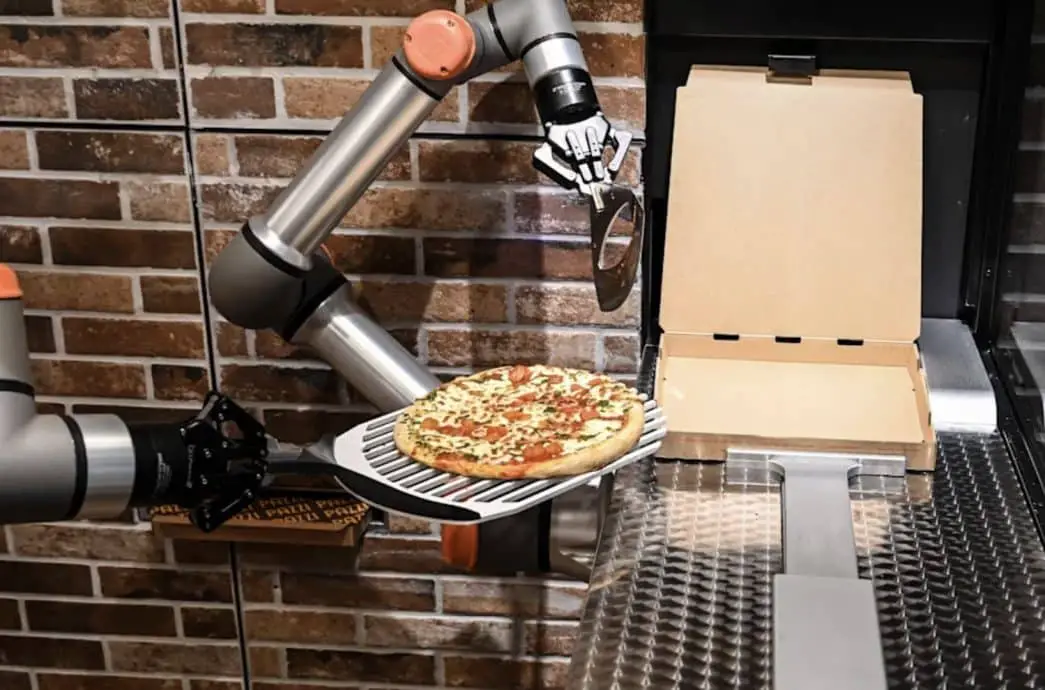
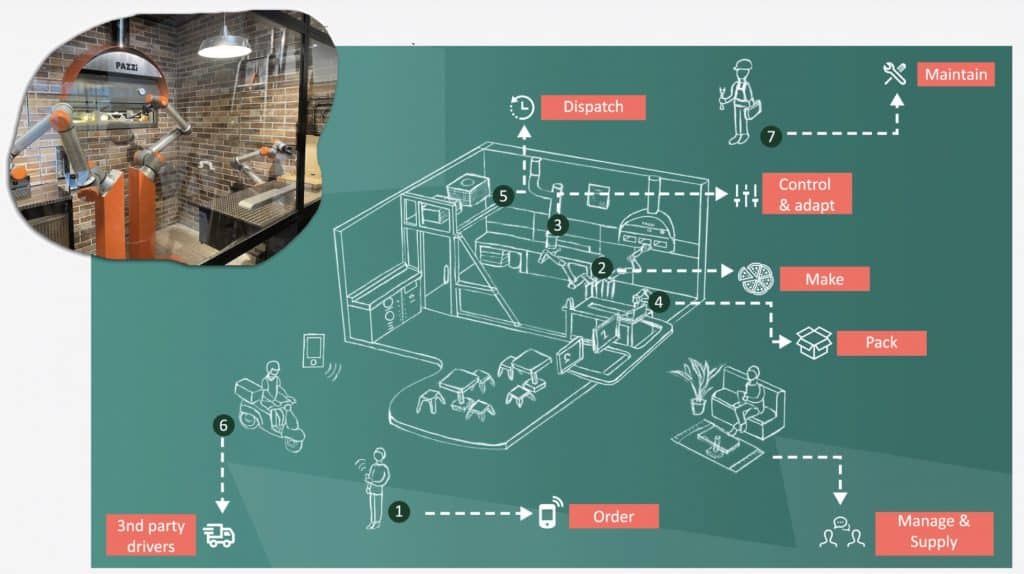
The Pazzi system operates through a coordinated sequence of robotic actions that transform raw ingredients into a finished, boxed pizza in approximately five minutes, with each individual pizza requiring about 45 seconds of active preparation before entering the oven. Three robotic arms work in concert behind a glass enclosure that gives customers a full view of the production process, turning pizza making into a theatrical experience that draws crowds and generates social media engagement. The first arm flattens fresh dough balls into rounds, a task that requires particular sophistication because, as Graffagnino emphasizes, "the dough is alive" and its properties change continuously as it ferments and ages throughout the day. Sauce is spread with measured precision, and up to 35 different toppings are placed according to each customer's order, with the system capable of personalizing ingredient quantities to individual preferences. AI-enabled smart kitchens represent a broader trend toward connected cooking environments, but Pazzi pushes the concept further by eliminating human intervention from the entire preparation-to-delivery workflow. The coordination of multiple robotic systems performing different tasks in sequence, while adapting in real time to the variable properties of fresh dough, represents one of the most complex automation challenges in the food service industry.
The baking phase uses integrated ovens that maintain precise temperature control, with the system managing up to six pizzas simultaneously at different stages of the cooking process. After baking, automated systems slice the finished pizza, place it in a recycled cardboard box, and deliver it to a marked cubby where the customer retrieves their order. Quality control is embedded throughout the process, with the system using sensors and computer vision to identify and correct imperfections in dough shape, topping distribution, and bake consistency. Computer vision applications in food robotics enable the real-time quality assessment that allows Pazzi to maintain the consistency that human workers cannot replicate across thousands of pizzas. Cloud-based monitoring connects each Pazzi unit to remote engineers who can watch operations through cameras and take control if necessary, ensuring continuity of service without requiring on-site technical staff. The ordering interface operates through touchscreen kiosks at the restaurant and through a web application, supporting both walk-in and click-and-collect orders that align with modern consumer expectations for flexible ordering.
The physical footprint of the system occupies approximately 120 square meters in its current configuration, though the company has publicly discussed plans to reduce this to approximately 25 square meters, which would dramatically expand the range of locations where a Pazzi unit could be installed. The entire system operates on Wi-Fi connectivity, with wired power supply providing the energy needed for robotic arms, ovens, and refrigeration units. Robotics and manufacturing principles adapted for food service applications underpin the mechanical design, with food-grade materials and hygiene-compliant surfaces throughout the system. The absence of human contact with food during preparation addresses growing consumer demand for hygienic food handling, a concern amplified by the COVID-19 pandemic that accelerated interest in contactless food service solutions.
The AI and Machine Learning Behind the Pizza
Beneath the visible robotic performance lies a sophisticated AI layer that manages the adaptive decision-making required to handle the inherent variability of fresh food ingredients. The dough, which forms the foundation of every pizza, changes its properties hour by hour as fermentation progresses, requiring the system to continuously adjust pressure, timing, and technique during the flattening process to achieve consistent results. Machine learning models trained on thousands of dough preparations enable the system to recognize and adapt to these variations without manual intervention or recipe adjustments by human operators. Machine learning from theory to practical application is demonstrated in Pazzi's approach, where algorithms translate the intuitive adjustments that an experienced pizzaiolo makes unconsciously into quantifiable parameters that a machine can execute reliably. Cloud technology enables the system to learn from every pizza it makes, building an increasingly sophisticated model of ingredient behavior that improves quality over time. The AI challenge of autonomous pizza making lies not in the mechanical execution of repetitive tasks but in the adaptive intelligence required to handle living, changing ingredients with the sensitivity that separates a good pizza from a great one.
The system's AI also manages inventory tracking, predictive maintenance scheduling, and operational optimization that ensure continuous service availability. Sensor data from each component feeds into predictive models that identify equipment issues before they cause downtime, contributing to the 96 to 97 percent uptime rate that Pazzi reports. The role of AI in boosting automation is evident in how Pazzi uses data from every operational cycle to optimize not just pizza quality but the efficiency and reliability of the entire production system. Order management algorithms balance incoming requests against production capacity, optimizing queue management and preparation sequencing to minimize customer wait times during peak periods. The integration of AI across both culinary and operational dimensions creates a system that is not merely automated but intelligent, capable of improving its own performance through continuous learning.
Pazzi in the Context of the Food Robotics Revolution
Pazzi operates within a rapidly growing food robotics ecosystem that is reshaping how restaurants, commercial kitchens, and food delivery services approach preparation, cooking, and service. The National Restaurant Association reports that more than 50 percent of restaurant owners expect automation to be a major operational investment by 2026, driven by labor shortages, rising wages, and consumer demand for speed and hygiene. Pazzi's approach of placing robots front and center as a visible spectacle differs from competitors like Picnic and xRobotics, which embed automation into more industrial-looking systems designed to operate behind the scenes. Robot-powered pizza concepts have explored various approaches to pizza automation, but Pazzi remains unique in achieving full end-to-end autonomy from dough to boxed delivery. The automated cooking systems market is projected to grow from USD 5.0 billion in 2025 to USD 34.1 billion by 2034, reflecting the enormous commercial opportunity that drives investment into systems like Pazzi. Pazzi's significance within the food robotics landscape lies not just in what it automates but in how completely it automates: no other commercial system has achieved the same level of end-to-end autonomy in fresh food preparation.
The competitive landscape for food robotics includes players operating across different segments of the restaurant experience, each addressing distinct aspects of the automation opportunity. Beastro by Kitchen Robotics offers a modular approach to kitchen automation that can prepare multiple cuisine types. Spyce's robotic kitchen pioneered automated grain bowl preparation in Boston before being acquired by Sweetgreen. Moley's masterchef robot takes a different approach by replicating human chef movements through articulated robotic hands that can execute complex recipes. Connected Robotics in Japan demonstrates how Asian markets are adopting cooking automation for culturally specific cuisine. Each of these competitors validates the commercial potential of food robotics while highlighting the diversity of approaches that the market supports. Miso Robotics' Flippy, which automates frying operations in fast-food environments, has partnered with major chains including multiple deployments announced in August 2025, demonstrating the scalability ambitions that characterize the sector's most successful players.
The Business Model and Franchise Expansion
Pazzi's commercial strategy has evolved from a single Parisian showcase into a global franchise model designed to scale autonomous pizza production into locations where traditional restaurants struggle to operate effectively. The franchise approach enables expansion without requiring Pazzi to fund and manage each location directly, instead providing master franchisees with exclusive regional rights and the technology platform, recipes, and operational support needed to operate autonomous pizzerias. Prices at the Paris location range from EUR 7 to EUR 14, positioning Pazzi in the affordable premium segment where quality ingredients and the novelty of robotic preparation justify a modest price premium over standard fast-food pizza. The minimized labor cost structure is central to the business case, as the elimination of kitchen staff, combined with 24/7 operational capability, creates unit economics that traditional pizza restaurants cannot match. AI in the hospitality industry is being reshaped by concepts like Pazzi that demonstrate how automation can simultaneously reduce costs and enhance the customer experience. Pazzi's franchise model transforms the business of pizza from a labor-intensive operation constrained by staffing challenges into a technology platform that can be deployed wherever demand exists, from busy train stations to underserved neighborhoods lacking quality food options.
The target locations for Pazzi expansion reveal a strategic vision that prioritizes high-traffic, underserved venues where traditional restaurant operations face particular challenges. Transit hubs, hospitals, university campuses, office complexes, and entertainment venues represent environments where demand for quality food is high but the staffing, space, and operational constraints make traditional restaurant formats difficult to sustain. The planned reduction of the system footprint from 120 square meters to approximately 25 square meters would enable installation in kiosk-format locations that currently serve only vending machines or pre-packaged food. Fully automated warehouses share operational parallels with Pazzi's approach, where compact, autonomous systems maximize throughput within minimal physical footprints. The expansion from Paris to Zurich represents the first step in international scaling, with the franchise model designed to support adaptation to local ingredient preferences, regulatory requirements, and cultural expectations across different markets.
Workforce Impact and the Human Element
The question of whether Pazzi replaces or transforms restaurant employment sits at the center of public debate about food robotics, and the company has addressed it directly through public communications that frame automation as evolution rather than elimination. Pazzi's position is that the restaurant industry's labor shortage is so severe that automation fills positions that would otherwise remain vacant rather than displacing willing workers, effectively channeling available human talent toward full-service restaurants where interpersonal skills and creative judgment remain essential. Impact of robotics on the workplace extends beyond simple job displacement to encompass the creation of new roles in robotics maintenance, software development, operations management, and quality control that require higher-skill profiles than the positions they replace. The company's franchise model generates additional employment in logistics coordination, ingredient sourcing, customer service, and regional management that supports each autonomous location. Whether robots will replace human jobs is a question that Pazzi addresses by highlighting that its technology creates a different category of employment rather than simply eliminating existing roles. Pazzi's workforce argument rests on the premise that automation in food service does not destroy jobs so much as redistribute them, shifting employment from repetitive kitchen tasks toward higher-skilled technical and creative positions.
The human element within Pazzi's operations remains significant despite the fully autonomous front-end production. Remote engineers monitor operations continuously, human technicians perform maintenance and restocking, and Thierry Graffagnino's culinary team continues to develop and refine recipes that the robots execute. The 3 percent of time when the system is offline for maintenance, cleaning, and ingredient restocking represents the irreducible human component that even the most advanced automation cannot eliminate entirely. Samsung Bot Chef and other consumer-facing food robotics concepts demonstrate a broader industry recognition that the future of cooking involves collaboration between human creativity and robotic execution rather than complete human replacement.
Quality, Consistency, and the Culinary Debate
The culinary community's response to Pazzi reflects broader tensions about whether automation can deliver food that satisfies the standards of quality, authenticity, and soul that define great cooking. Graffagnino himself acknowledges the tension, stating that a robot "can never replace the art of a real pizzaiolo" while simultaneously lending his championship-level expertise to ensuring that every robotic pizza meets exacting standards. The consistency advantage is measurable: unlike human workers whose output varies with fatigue, distraction, and mood, Pazzi produces every pizza to identical specifications with deviations measured in millimeters rather than inches. AI and recipe development represents a growing intersection of technology and culinary creativity where algorithms can suggest flavor combinations and optimize preparation techniques. The premium ingredient strategy, using proprietary flour blends, Cirio tomato sauce, and locally sourced toppings, addresses the common assumption that automated food systems cut corners on quality to maximize margin. The culinary debate around Pazzi ultimately comes down to whether consistency, speed, and accessibility can coexist with the quality and authenticity that pizza, one of the world's most beloved foods, demands.
Real-World Examples of Food Robotics Beyond Pazzi
Miso Robotics' Flippy platform, deployed across multiple fast-food chains following an August 2025 partnership with a major operator, demonstrates how AI-driven kitchen robots are scaling beyond novelty into mainstream commercial food service. Flippy automates frying operations using computer vision and thermal sensing to manage cooking times, flip items, and maintain food safety temperatures without human intervention. The measurable outcome includes consistent food quality, reduced oil waste, and faster service times during peak hours that improve customer throughput. The limitation is that Flippy addresses a single cooking function rather than the end-to-end autonomy that Pazzi achieves, requiring human workers to handle all other kitchen tasks. Source: Market Research Future food robotics analysis
TechMagic's expansion of its AI cooking robot "I-Robo 2" to eight additional Ippudo ramen stores in Japan in November 2025 illustrates how Asian food service markets are embracing cooking automation for culturally specific cuisine. The system automates ramen preparation processes while maintaining the consistency and speed that high-volume Japanese restaurant chains require. The measurable outcome is improved production throughput and reduced labor dependency during Japan's acute hospitality workforce shortage, where an aging population makes traditional kitchen staffing increasingly unsustainable. The limitation is the need for cuisine-specific customization that prevents a single robotic platform from serving as a universal kitchen automation solution. Source: OpenPR food robotics market data
ABB Robotics' introduction of "BurgerBots" in Los Gatos, California in April 2025 demonstrates how industrial robotics giants are entering the restaurant automation space with systems that bridge the gap between manufacturing precision and food service requirements. The concept restaurant uses articulated industrial robots adapted for food-grade environments to prepare burgers from start to finish. The measurable outcome is a proof-of-concept that validates the applicability of industrial robotics platforms to restaurant environments, potentially reducing the custom engineering costs that currently characterize food robotics development. The limitation is that adapting industrial systems for food service requires significant customization that challenges the economics of smaller-scale deployments. Source: Towards FnB food robotics analysis
Case Studies in Autonomous Food Service
Pazzi Paris and the Proof of Concept
Pazzi's first location in the Beaubourg district of Paris served as the critical proof of concept for fully autonomous pizza service, demonstrating that an end-to-end robotic system could operate commercially in a demanding urban environment. The problem was validating that robotic pizza production could achieve the quality, consistency, speed, and reliability needed for commercial food service while generating positive unit economics in a high-cost market like central Paris. The solution deployed three robotic arms behind a glass enclosure, supported by integrated ovens, washing systems, and cloud-based monitoring, with recipes developed by three-time World Pizza Champion Thierry Graffagnino. The measurable impact includes over 100,000 pizzas served, 96 to 97 percent uptime, 80-pizza-per-hour capacity, and customer satisfaction levels sufficient to win both the 2022 FoodTech Innovation Award and the 2025 World Catering Technology Award. The limitation is that the 120-square-meter footprint restricts deployment to locations with sufficient floor space, and the system still requires human intervention for restocking, maintenance, and the 3 percent of operational time that it cannot handle autonomously. The case validates that fully autonomous pizza production is commercially viable but highlights the engineering work still needed to optimize the system for broader deployment. Source: Pazzi official and industry reporting
The Franchise Model and Global Scaling
Pazzi's transition from a single Paris restaurant to a global franchise model represents the critical business evolution needed to transform a technology demonstration into a scalable commercial enterprise. The problem was that direct ownership of each location would limit expansion speed and require capital investment beyond what a startup could sustain, while regional food safety regulations, ingredient sourcing, and consumer preferences require local expertise that a centralized operation cannot provide. The solution adopted a master franchise model where regional partners receive exclusive territorial rights, the technology platform, training, supply chain frameworks, and ongoing operational support, while Pazzi retains control over the core robotic system, software, and quality standards. The measurable impact is the successful expansion from Paris to Zurich as the first international location, with additional franchise agreements in development across multiple regions. The limitation is that franchise model execution depends heavily on the quality of local partners, and the complexity of maintaining consistent robotic performance across diverse operating environments creates technical support challenges that scale with geographic expansion. The case illustrates how food robotics companies must develop business model innovations alongside technological innovations to achieve meaningful market impact. Source: Peak Magazine Singapore and industry coverage
Addressing the Restaurant Labor Crisis Through Automation
The restaurant industry's acute labor shortage provides the economic context within which Pazzi's value proposition is most compelling, addressing workforce challenges that threaten the operational viability of food service businesses worldwide. The problem was that food preparation and serving jobs face chronic vacancies due to low wages, physically demanding conditions, irregular hours, and high turnover rates, with manufacturers in 2024 grappling with over 615,000 unfilled positions in the U.S. alone. The solution offers a fully autonomous alternative that operates 24/7 without staffing constraints, providing consistent service quality regardless of labor market conditions while creating new technical employment in robotics maintenance and operations management. The measurable impact is demonstrated by Pazzi's ability to maintain full production capacity without kitchen staff, operating continuously with 96 to 97 percent uptime and requiring only periodic human intervention for maintenance and restocking. The limitation is that the capital cost of autonomous systems remains significant, and the technology currently addresses only a single cuisine category, limiting its applicability to the broader restaurant labor challenge. The ongoing debate centers on whether the emergence of food robotics will ultimately improve working conditions in the restaurant industry by redirecting human talent toward higher-value roles, or whether it will simply eliminate entry-level employment without creating accessible alternatives. Source: Food Processing Automation market analysis
Challenges and Limitations of Autonomous Pizza Robotics
Despite Pazzi's achievements, significant technical, commercial, and cultural challenges remain that will determine whether autonomous pizza making scales beyond novelty into mainstream food service infrastructure. The mechanical complexity of the system means that maintenance requires specialized technical expertise that is not widely available, creating dependence on Pazzi's engineering team and potential service disruption risks in remote franchise locations. Fresh ingredient handling presents ongoing challenges because biological materials like dough, vegetables, and cheeses behave unpredictably in ways that rigid automation systems must continuously learn to accommodate. End effectors in robotics designed for food handling must balance grip precision with gentleness to avoid damaging delicate toppings while maintaining the speed that commercial throughput demands. The current price range of EUR 7 to EUR 14 positions Pazzi competitively, but the capital investment required for each autonomous unit must be amortized over sufficient volume to achieve the returns that franchise investors expect. The path from Paris proof of concept to global food service platform requires solving not just technical challenges but commercial, regulatory, and cultural barriers that differ in every market Pazzi enters.
Consumer acceptance varies significantly across markets and demographics, with some segments enthusiastically embracing robotic food preparation while others express skepticism about the absence of human craft in their meal. Cultural attitudes toward food preparation are deeply rooted, and markets with strong artisanal food traditions may resist automation more strongly than those with established fast-food cultures. Automation versus AI is an important distinction in this context, as Pazzi combines both: repetitive mechanical automation for physical tasks and adaptive AI for the quality control and ingredient management decisions that require intelligence. Regulatory environments for autonomous food service are still developing in most jurisdictions, creating uncertainty about the requirements that autonomous restaurants must meet for food safety certification, liability, and consumer protection.
What the Future Holds for Pazzi and Food Robotics
The trajectory of Pazzi and the broader food robotics sector points toward a future where autonomous food preparation becomes a standard option alongside traditional restaurants, extending access to quality food in locations and at times that human-staffed operations cannot serve. Pazzi's stated goal of reducing its footprint to 25 square meters would enable deployment in kiosk formats that fit within transit stations, office lobbies, hospital corridors, and street corners where even small restaurants cannot operate. The integration of generative AI interfaces could enable natural-language ordering experiences that replace touchscreens with conversational interaction, making autonomous restaurants more accessible and engaging. AI in robotics and the next phase of technology suggests that the convergence of increasingly capable AI with more dexterous robotic hardware will expand the range of cuisines and dishes that autonomous systems can prepare. Robotics-as-a-Service pricing models could eliminate the upfront capital barrier that currently limits adoption, making autonomous food service accessible to small operators who cannot afford the full system investment. The future of Pazzi and food robotics is not a world without human chefs but a world where quality food is available whenever and wherever people need it, prepared with the precision of a machine and the expertise of a champion pizzaiolo.
The coming decade will determine whether Pazzi fulfills its ambition to become a global platform for autonomous food service or remains a compelling but geographically limited demonstration of what food robotics can achieve. The future of AI in business points toward increasing automation in food service as one of the most visible consumer-facing applications of AI and robotics technology. The organizations and entrepreneurs who succeed in this space will be those who understand that the technology is only half the equation; the other half is the culinary expertise, ingredient quality, and customer experience design that transforms a robotic system into a dining experience people choose to return to.
Key Insights
- The automated cooking systems market is projected to grow from USD 5.0 billion in 2025 to USD 34.1 billion by 2034, with Pazzi positioned as a pioneer in the fully autonomous restaurant segment.
- Pazzi produces up to 80 pizzas per hour with a 45-second preparation time, using three robotic arms that handle every step from dough flattening through boxing without human intervention.
- The system was developed over seven years by 28 engineers and features recipes from Thierry Graffagnino, three-time World Pizza Champion (2011-2013), who ensures culinary quality matches robotic precision.
- Over 100,000 pizzas served at the Paris location with 96 to 97 percent uptime, demonstrating commercial viability for autonomous food service at sustained volume.
- The global food robotics market is projected to grow from USD 2.81 billion in 2025 to USD 15.29 billion by 2034 at a 20.7 percent CAGR, reflecting accelerating commercial adoption across restaurant and food manufacturing sectors.
- More than 50 percent of restaurant owners expect automation to be a major operational investment by 2026, driven by chronic labor shortages and rising operational costs.
- Pazzi won both the 2022 FoodTech Innovation Award and the 2025 World Catering Technology Award, validating its position at the intersection of food quality and technological innovation.
| Dimension | Traditional Pizzeria | Pazzi Autonomous Pizzeria |
|---|---|---|
| Production Speed | 15-25 pizzas per hour per skilled worker during peak periods | Up to 80 pizzas per hour continuously, one every 45 seconds |
| Consistency | Varies with worker skill, fatigue, and shift conditions | Identical specifications on every pizza with millimeter-level precision |
| Operating Hours | Limited by staffing availability, typically 10-16 hours daily | 24/7 operation without staffing constraints |
| Labor Requirements | 3-8 kitchen staff per shift depending on volume | Zero kitchen staff; remote engineering monitoring and periodic maintenance |
| Food Safety | Dependent on individual worker hygiene practices and supervision | Zero human contact with food; automated hygiene and monitoring systems |
| Menu Flexibility | High; skilled workers can create custom items on demand | Currently limited to pizza with up to 35 toppings and quantity customization |
| Customer Experience | Personal interaction, ambiance, and craft visibility | Robotic spectacle, touchscreen ordering, and rapid pickup |
| Capital Investment | Lower initial investment; higher ongoing labor costs | Higher initial investment; significantly lower ongoing operational costs |
Frequently Asked Questions
Pazzi is the world's first fully autonomous pizza-making robot, located originally in Paris and expanding through a franchise model. The system uses three AI-controlled robotic arms to prepare, bake, slice, and box pizzas without any human contact with the food. It can produce up to 80 pizzas per hour and has served over 100,000 pizzas.
Pazzi makes pizza through a fully automated sequence where robotic arms flatten fresh dough, spread tomato sauce, place up to 35 different toppings, transfer the pizza to integrated ovens, then slice and box the finished product. The entire process takes approximately five minutes per pizza, with the system managing up to six pizzas simultaneously at different stages. Cloud-based AI adapts to dough variations in real time to maintain consistent quality.
Pazzi was co-founded by Sebastien Roverso and Cyrill Hamon, who led a team of 28 engineers through seven years of development to create the autonomous pizza-making system. The recipes were developed by Thierry Graffagnino, a three-time World Pizza Champion who won the title consecutively from 2011 to 2013. The company also received funding through venture capital and France's state development bank, Bpifrance.
Pazzi can produce up to 80 pizzas per hour, with each individual pizza requiring approximately 45 seconds of active preparation and about five minutes total from start to boxed delivery. The system can bake up to six pizzas simultaneously and operates with 96 to 97 percent uptime. Over 100,000 pizzas have been served at the original Paris location.
Pazzi pizzas are priced between EUR 7 and EUR 14 (approximately USD 8 to USD 16), positioning the offering in the affordable premium segment. The pricing reflects the use of quality ingredients including proprietary flour blends, Cirio Italian tomato sauce, and locally sourced toppings. The competitive pricing is enabled by the elimination of kitchen labor costs that represent a major expense in traditional pizza restaurants.
Pazzi's original location is in the Beaubourg district of Paris, near the Centre Pompidou at 42 Rue Rambuteau. The company has expanded to Zurich, Switzerland, and is pursuing global franchise partnerships that will bring autonomous pizzerias to additional markets. Target locations include transit hubs, hospitals, universities, and underserved neighborhoods.
Pazzi's recipes were developed by Thierry Graffagnino, a three-time World Pizza Champion with over 40 years of professional experience. The system uses premium ingredients including proprietary flour from Paul Dupuis Mills and Cirio Italian tomato sauce. The company won both the 2022 FoodTech Innovation Award and the 2025 World Catering Technology Award, recognizing its combination of technology and culinary quality.
Pazzi handles fresh, never-frozen dough that changes properties throughout the day as fermentation progresses. Machine learning models trained on thousands of preparations enable the system to adjust pressure, timing, and technique to accommodate these variations. This adaptive capability is one of the most technically challenging aspects of the system, as Graffagnino notes that "the dough is alive" and requires continuous adjustment.
Pazzi frames its role as filling positions that the restaurant industry cannot staff rather than displacing willing workers. The company creates new employment in robotics maintenance, software development, operations management, and regional franchise coordination. The chronic labor shortage in food service, with over 615,000 unfilled U.S. manufacturing positions in 2024 alone, provides context for the automation demand that Pazzi addresses.
Pazzi uses three articulated robotic arms, integrated ovens with precise temperature control, computer vision for quality assessment, cloud-based AI for adaptive dough handling and operational monitoring, and Wi-Fi-connected systems that enable remote engineering support. The system includes automated washing, ingredient handling, and boxing capabilities that create a complete autonomous production line.
Pazzi offers customization through its ordering interface, allowing customers to select from up to 35 different toppings and personalize ingredient quantities according to their preferences. The system identifies and corrects imperfections during preparation and can replace ingredients when necessary. Orders are placed through touchscreen kiosks or a web application that supports both in-store and click-and-collect options.
Pazzi has received the 2022 FoodTech Innovation Award and the 2025 World Catering Technology Award, recognizing its achievement in combining robotic automation with culinary quality. These awards reflect the company's success in demonstrating that autonomous food preparation can meet the quality standards expected by both industry judges and consumers.
The global food robotics market was valued at approximately USD 2.81 billion in 2025 and is projected to reach USD 15.29 billion by 2034, growing at a CAGR of 20.7 percent. The automated cooking systems segment specifically is projected to grow from USD 5.0 billion to USD 34.1 billion during the same period. Europe leads the market with approximately 35 percent share, driven by labor costs and food safety regulations.
Pazzi operates a franchise model where master franchisees receive exclusive regional rights to deploy autonomous pizzerias within their territories. Franchisees receive the technology platform, recipes, operational training, supply chain frameworks, and ongoing support. The model is designed for global scalability, with initial expansion from Paris to Zurich and additional markets in development.
The future of food robotics includes autonomous systems operating across multiple cuisine types, Robotics-as-a-Service pricing models, compact kiosk-format deployments, AI-driven menu personalization, and integration with delivery platforms. The market is projected to grow five to seven times its current size by 2034. The most significant trend is the shift from novelty to mainstream food service infrastructure driven by persistent labor shortages and consumer demand for convenience and quality.