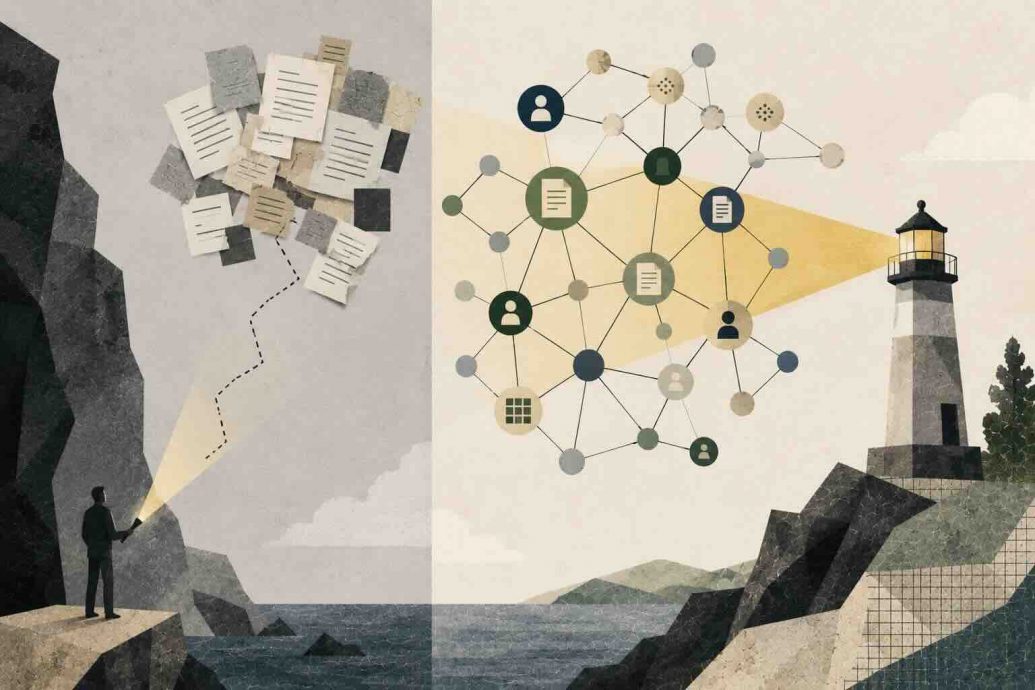

Introduction
The debate over GraphRAG vs traditional RAG has become one of the loudest in applied AI. Retrieval augmented generation grew fast, and analysts at Gartner data and analytics expect knowledge driven retrieval to dominate enterprise deployments soon. Traditional RAG fetches text chunks by vector similarity, which works well until questions span many connected facts. GraphRAG instead retrieves from a structured knowledge graph that captures explicit relationships between entities. The GraphRAG vs traditional RAG choice now shapes accuracy, cost, and trust across serious AI systems. This guide explains how each method works and where each one wins. You will see concrete numbers, real deployments, and the honest limits of both approaches. By the end, you can choose the right retrieval strategy for your own data.
Quick Answers on GraphRAG vs Traditional RAG
What is the core difference in GraphRAG vs traditional RAG?
Traditional RAG retrieves text chunks by vector similarity, while GraphRAG retrieves connected facts from a knowledge graph, making multi-hop reasoning far more reliable.
Which is more expensive to build and run?
GraphRAG costs more upfront because building a knowledge graph takes effort, while traditional RAG is cheaper and faster to launch for simple lookup tasks.
When should a team prefer GraphRAG over traditional RAG?
Choose GraphRAG when questions require linking many entities across documents, and choose traditional RAG when answers sit inside single passages of text.
Key Takeaways
- Traditional RAG excels at fast single passage lookups, while GraphRAG excels at multi-hop questions across connected facts.
- GraphRAG raises upfront cost and complexity but reduces hallucination on relationship heavy queries.
- Data structure decides the winner more than model choice, since graphs reward well connected knowledge.
- Many production systems now blend both methods rather than picking one approach exclusively.
Table of contents
- Introduction
- Quick Answers on GraphRAG vs Traditional RAG
- Key Takeaways
- What Is GraphRAG vs Traditional RAG
- How Traditional RAG Retrieves Information
- How GraphRAG Builds and Uses Knowledge Graphs
- Comparing Accuracy Across Both Retrieval Methods
- Putting Each Retrieval Method Into Practice
- The Cost and Engineering Tradeoffs
- Where Each Approach Falls Short
- The Ethics of Retrieval and Source Trust
- Measuring ROI From Your Retrieval Stack
- Building a Retrieval Foundation Before You Choose
- Common Mistakes in RAG Implementations
- How Retrieval Connects to Your Wider AI Stack
- Choosing Tools for Each Retrieval Method
- Scaling Retrieval as Your Data Grows
- Security and Governance for Retrieval Systems
- How Adoption Is Trending Across Industry
- The Future of Hybrid Retrieval Systems
- Key Insights
- Retrieval Methods in Practice Across Real Systems
- Lessons From Teams That Compared Retrieval Methods
- Common Questions About GraphRAG vs Traditional RAG
What Is GraphRAG vs Traditional RAG
GraphRAG vs traditional RAG is the comparison between graph based retrieval and standard vector retrieval, where GraphRAG pulls connected facts from a knowledge graph and traditional RAG pulls similar text chunks from a vector index.
Which Retrieval Approach Fits Your Query
How Traditional RAG Retrieves Information
Traditional RAG starts by splitting your documents into small overlapping chunks of text. Each chunk is converted into a numeric vector using an embedding model that captures meaning. When a user asks a question, the system embeds that query into the same vector space. It then finds the chunks whose vectors sit closest to the query vector. Traditional RAG is fundamentally a similarity search that retrieves passages resembling the question. The retrieved chunks are pasted into the prompt so the language model can answer with context. This pipeline is simple, fast, and remarkably effective for many factual lookup tasks.
The embedding model is the quiet engine that decides retrieval quality here. A strong embedding maps related ideas near each other even when wording differs. Poor embeddings scatter related passages and the model retrieves irrelevant context instead. Teams often experiment with several embedding models before settling on one. The same care for representation appears in orthonormal vectors in machine learning. Chunk size also matters, since chunks too large dilute relevance and chunks too small lose context. Tuning these knobs is most of the practical work in traditional RAG.
Vector databases store and index these embeddings for fast nearest neighbor search. They use clever indexing so retrieval stays quick even across millions of chunks. This scalability is a major reason traditional RAG spread so rapidly across industry. A small team can stand up a working system in an afternoon with open tools. The approach builds naturally on the wave described in what generative AI is today. Low setup cost makes traditional RAG the default starting point for most projects. That accessibility is both its strength and the seed of its limitations.
The weakness appears when a question depends on facts scattered across many documents. Similarity search retrieves passages that look like the query, not passages that connect. A question linking three people across separate reports often returns incomplete context. The model then guesses to fill the gaps, which is where hallucination creeps in. Traditional RAG cannot easily follow a chain of relationships it never encoded. This gap is precisely the opening that graph based retrieval was designed to close. Recognizing that limit is the first step in the GraphRAG vs traditional RAG decision.
How GraphRAG Builds and Uses Knowledge Graphs
GraphRAG begins by extracting entities and relationships from your raw documents. A language model reads the text and identifies people, places, concepts, and how they connect. These extracted facts become nodes and edges inside a structured knowledge graph. The graph captures explicit relationships that a pile of text chunks leaves implicit. Microsoft researchers detailed this pipeline when they introduced Microsoft Research GraphRAG. The result is a map of your knowledge rather than a bag of passages. That map is what lets GraphRAG answer connected questions with confidence.
At query time, GraphRAG traverses the graph to gather a connected subgraph of relevant facts. It can follow edges across several hops to assemble a complete picture. The system often summarizes communities of related nodes before answering broad questions. GraphRAG retrieves structure and relationships, not merely passages that resemble the query. This traversal is what enables reliable multi-hop reasoning across scattered sources. The model receives a coherent web of facts instead of disconnected snippets. That coherence is the central advantage in this retrieval comparison.
Building the graph is the expensive and delicate part of the GraphRAG approach. Entity extraction can introduce errors that propagate into every later answer. Teams must validate the graph and resolve duplicate entities that mean the same thing. The construction effort resembles careful work in machine learning models explained. A well built graph rewards the effort with precise, explainable retrieval. A sloppy graph, by contrast, can be worse than simple similarity search. Graph quality therefore decides whether GraphRAG actually delivers on its promise.
Comparing Accuracy Across Both Retrieval Methods
Turning to accuracy, the two methods diverge sharply depending on the question type. On single passage factual questions, traditional RAG often matches or beats graph retrieval. The answer lives in one chunk, so similarity search finds it directly and cheaply. GraphRAG adds overhead that buys little advantage for these simple lookups. Accuracy in retrieval depends far more on question shape than on raw model power. Benchmarks tied to the original RAG paper show strong results on focused queries. For narrow questions, the simpler method frequently wins on both speed and cost.
The picture flips when questions require connecting facts across many documents. GraphRAG shines on these multi-hop questions that ask how entities relate over time. Traditional RAG retrieves passages that mention the entities but miss the connections. The graph traversal assembles the full chain that the answer truly requires. Studies show meaningful accuracy gains on relationship heavy queries when graphs are used. The improvement is largest on broad sensemaking questions across a whole corpus. This is the heart of when the method choice actually matters.
Hallucination rates also differ between the two retrieval strategies in practice. When traditional RAG misses connecting context, the model invents plausible but false links. GraphRAG reduces this risk by supplying explicit, verified relationships from the graph. The structured evidence gives the model less room to fabricate connections. This reliability matters enormously in regulated fields like medicine and finance. The lessons mirror careful evaluation in top machine learning algorithms. Fewer fabricated links is one of GraphRAG’s most compelling selling points.
Accuracy claims still demand healthy skepticism and your own testing. Vendor benchmarks rarely reflect the messy reality of your specific documents. The honest answer is that accuracy depends on your data and your questions. Run both methods on a representative sample before you commit to either. A controlled comparison turns marketing claims into evidence you can trust. The right method is the one your own tests actually prove superior. Measurement, not hype, should settle the question for your team.
Putting Each Retrieval Method Into Practice
Putting these methods to work begins with a clear sample of real questions. Collect the queries your users actually ask and sort them by complexity. Single passage questions point toward traditional RAG as the pragmatic starting choice. Multi-hop questions justify the heavier investment in a knowledge graph. The triage echoes practical advice in making chatbots more intelligent projects. Start where the value is clear and the cost is low. Let the real questions, not the trend, drive your first decision.
A pilot is the safest way to learn which method your data prefers. Build a small traditional RAG system first because it ships in days. Measure its accuracy on your hardest connected questions to expose the gaps. A quick traditional RAG baseline reveals exactly where a graph would add value. Only then invest in extracting a knowledge graph for the failing query types. This staged path avoids paying for graph complexity you may not need. The baseline keeps your GraphRAG vs traditional RAG decision grounded in evidence.
Implementation also means choosing tools that fit your team’s skills. Vector databases and embedding libraries are mature and well documented today. Graph tooling like Neo4j adds power but also a real learning curve. The prompting discipline from practical LLM prompting tactics applies to both methods. Pick a stack your engineers can maintain after the initial excitement fades. Sustainable tooling matters far more than chasing the newest framework that briefly trends online. The best method is one your team can actually operate for years.
The Cost and Engineering Tradeoffs
Beyond accuracy, cost is the dimension that decides many real projects. Traditional RAG is cheap to build, since embedding and indexing are well automated. A small team can run it on modest infrastructure with predictable monthly bills. GraphRAG demands heavier upfront work to extract and validate a knowledge graph. That construction uses many language model calls, which raises the initial token bill. The economics resemble tradeoffs discussed in evolution of generative AI models. Budgeting honestly for graph construction prevents an unpleasant surprise later.
Maintenance cost is the part teams most often underestimate at the start. Documents change, so both systems need ongoing reindexing to stay current. Traditional RAG simply re-embeds new chunks, which is cheap and fully automatic. GraphRAG must update the graph, re-extract entities, and resolve new duplicates. The hidden cost of GraphRAG is keeping the knowledge graph fresh over time. This continuous upkeep can rival the original construction effort each quarter. Plan for maintenance staff, not just a one time build project.
Latency is another tradeoff that shapes the user experience directly. Traditional RAG answers quickly because a single similarity search is very fast. GraphRAG traversal across multiple hops can add noticeable delay to responses. For interactive chat, that extra latency can frustrate impatient users. Caching common subgraphs is one practical way teams soften this penalty. The engineering effort recalls optimization themes in support vector machines explained. Speed requirements should weigh heavily in your retrieval method choice.
The total cost picture must include the value of avoided mistakes. A wrong answer in finance or healthcare can cost far more than compute. GraphRAG’s higher bill can be justified when accuracy carries real stakes. For low stakes internal search, the cheaper method is usually the wiser spend. Match the size of the investment to the real consequences of being wrong here. A thoughtful cost benefit analysis beats any blanket recommendation pulled from a vendor pitch. The right answer depends on what an error would actually cost you.
Where Each Approach Falls Short
Despite the enthusiasm, both methods fall short in predictable and important ways. Traditional RAG struggles with connected questions and broad sensemaking across a corpus. It also inherits any bias baked into the embedding model it relies on. When chunks lose context at their boundaries, retrieval quietly returns misleading passages. The failure modes echo pitfalls seen in orthonormal vectors in machine learning work. No amount of prompt tuning fully fixes a fundamentally missing connection. Recognizing these limits early keeps expectations realistic and keeps ambitious projects fully honest.
GraphRAG carries its own substantial set of weaknesses and risks. A poorly constructed graph encodes wrong relationships that corrupt every dependent answer. Entity extraction errors are common and surprisingly hard to detect at scale. A flawed knowledge graph can be more dangerous than no graph at all. The method also demands rare skills that many small teams simply lack. Graph maintenance can stall when the one expert who built it departs. These fragilities make GraphRAG a serious commitment rather than a quick win.
Both methods share a deeper limitation rooted in their source documents. Retrieval can only surface knowledge that actually exists in the corpus. Missing, outdated, or contradictory sources poison answers regardless of the method. Neither approach reasons beyond the facts it can retrieve from your data. Garbage inputs produce confident garbage outputs in both pipelines alike. The discipline of curating sources matters more than the retrieval architecture. Clean, current data is the prerequisite that no method can replace.
The Ethics of Retrieval and Source Trust
Shifting to ethics, retrieval systems raise real questions about trust and attribution. Users deserve to know which sources shaped an answer they receive. Traditional RAG can cite the chunks it retrieved, offering a basic audit trail. GraphRAG can show the path through the graph that supported its reasoning. Transparent source attribution is an ethical obligation, not an optional feature, for retrieval systems. Hidden sourcing erodes trust and makes errors impossible to investigate. Both methods should expose their evidence so users can verify claims.
Bias in the source corpus flows directly into retrieved answers. If documents overrepresent one viewpoint, the system amplifies that imbalance silently. Curators must audit their sources for fairness and meaningful coverage. The concern parallels safety lessons in AI and the human brain debates. A diverse, balanced corpus is the foundation of fair retrieval. No clever architecture can compensate for a deeply skewed or unbalanced knowledge base. Responsible teams treat source selection as a genuine ethical decision, not a technical afterthought.
Privacy is a sharp concern when documents contain sensitive personal data. A knowledge graph can inadvertently expose relationships people expected to stay private. Linking entities across records may reveal facts no single document disclosed. Teams must apply access controls and redaction before building any graph. The risk is subtler in GraphRAG because connections themselves become new information. Careful governance prevents retrieval from quietly violating reasonable privacy expectations. Privacy by design belongs at the start of any retrieval project.
Accountability rounds out the ethical picture for any retrieval deployment. Someone must own the answers the system produces and their consequences. Blaming the model is never acceptable when a retrieved answer causes harm. Keep logs of sources and reasoning so every answer can be reviewed. This habit reflects responsible practice across modern AI governance everywhere. Human accountability is what separates a trustworthy tool from a reckless one. Owning the outputs keeps both ethics and reputation firmly intact.
Measuring ROI From Your Retrieval Stack
Looking at returns, the only honest measure is answer quality on real questions. Build a test set of questions with known correct answers from your domain. Run both methods and score accuracy, completeness, and faithfulness to sources. This controlled evaluation cleanly separates genuine measurable gains from merely hopeful impressions. The rigor mirrors sound testing in fine-tuning LLMs at home work. Without a scored test set, any claim of improvement is just a story. A clear benchmark turns the GraphRAG vs traditional RAG debate into measurable evidence.
Return also includes the human time saved by better answers. A system that resolves questions correctly reduces costly escalations to experts. Track how often users accept answers without needing further help. The clearest return is fewer failed searches that waste expensive human attention. Factor in the build and maintenance cost to find the true net gain. Sometimes a cheap traditional RAG system delivers most of the value. Other times only GraphRAG resolves the questions that actually matter to revenue.
The stakes of each answer shape how you should value accuracy. In high stakes domains, a single avoided error can justify enormous spend. In casual internal search, marginal accuracy gains rarely repay heavy investment. Weigh the cost of being wrong against the cost of the system. This calculation gives a defensible answer rather than a fashionable one. Honest ROI accounting includes both dollars earned and risks avoided. The complete picture justifies your retrieval choice far better than benchmarks alone.
Building a Retrieval Foundation Before You Choose
Stepping back from the comparison, a solid foundation must exist before you pick a method. You first need clean, well organized documents that retrieval can actually use. Messy duplicates and outdated files poison both traditional RAG and GraphRAG equally. Cataloging your sources is unglamorous work that pays off immediately in answer quality. The same discipline appears across introduction to GANs and other model work. Fix the data foundation first, then let the architecture build on solid ground. Clean inputs decide more of your success than the method you eventually choose.
Defining your real questions is the second foundational step before choosing. Collect the queries users actually ask and classify them by reasoning depth. This question inventory reveals whether multi-hop reasoning is common or rare. Your question mix, not the latest trend, should drive the GraphRAG vs traditional RAG decision. A corpus of simple lookups rarely justifies the cost of a knowledge graph. A corpus of connected investigations may demand one from the very start. Let evidence about your users guide the architecture you commit to.
Baseline measurement completes the foundation that serious teams build first. Record accuracy from a simple traditional RAG system before adding any complexity. Without that snapshot, you can never prove a graph actually helped. The discipline mirrors careful evaluation in what AdaGrad is and optimizer studies. A clear baseline turns vague impressions into a defensible before and after story. It also protects you from vendors who claim credit for ordinary gains. Measure first so the truth stays firmly on your side.
Finally, decide who owns the retrieval system before any launch happens. One engineer should hold responsibility for data quality, evaluation, and upkeep. Shared ownership without a clear lead produces drift and silent decay. That owner becomes the human steward who keeps the system honest over time. They translate changing needs into new evaluation questions and fixes. A named owner keeps the project accountable and continuously improving. Clear ownership often decides whether retrieval thrives or quietly rots.
Common Mistakes in RAG Implementations
Beyond the architecture, a handful of mistakes sink most retrieval projects early. The first is chasing GraphRAG hype before a simple baseline even exists. Teams build elaborate graphs for questions that vector search already answered well. A second mistake is ignoring chunking strategy in traditional RAG entirely. Bad chunk boundaries quietly wreck retrieval no matter how good the embeddings are. The patterns echo pitfalls described in making chatbots more intelligent guides. Skipping the basics dooms even the most sophisticated retrieval stack.
A third common mistake is neglecting evaluation until problems become embarrassing. Without a scored test set, teams ship retrieval that fails silently in production. They discover the gaps only when users complain about wrong answers. Skipping evaluation is the silent killer of otherwise promising retrieval deployments. Build a benchmark of real questions and grade every change against it. This habit catches regressions before your users ever notice them. Disciplined measurement is the cheapest insurance a retrieval project can buy.
The final mistake is treating either system as a one time build. Documents change constantly, so retrieval drifts out of date within weeks. Teams that skip reindexing watch accuracy decay quietly over each month. GraphRAG suffers worse here because graphs need active maintenance to stay correct. Schedule regular updates and assign a clear owner to perform them. The discipline parallels lifecycle thinking in neural architecture search research. Retrieval is a living system that needs care, not a finished artifact you ship once.
How Retrieval Connects to Your Wider AI Stack
Turning to the bigger picture, retrieval rarely operates alone in a serious system. It feeds context into language models and draws on your data pipelines. A retrieval layer connects upstream ingestion with downstream generation and evaluation. When these pieces cooperate, the whole assistant grows noticeably more reliable. The integration reflects connected ambitions across modern generative AI platforms today. Retrieval is one instrument in a larger AI orchestra, not a solo act. Coordinating the instruments is where the biggest gains eventually appear.
The generation layer depends entirely on the quality of retrieved context. A language model can only reason over the facts retrieval supplies. Strong retrieval reduces hallucination by grounding the model in real evidence. Weak retrieval leaves the model guessing, which produces confident fabrication. The relationship is why the retrieval method choice ripples through the whole stack. Better retrieval quietly lifts every downstream answer the system produces. Generation and retrieval succeed or fail together as one tightly coupled pair.
Evaluation tooling forms the second crucial connection in the stack. Automated scoring reveals which retrieval changes actually improve real answers. Without it, teams tune blindly and often make their systems worse. Continuous evaluation is what turns a pile of components into a trustworthy product. Connect retrieval metrics to end answer quality so you optimize the right thing. The discipline mirrors rigorous testing in top machine learning algorithms practice. Measurement closes the loop that keeps the whole stack honest.
Orchestration tools tie ingestion, retrieval, and generation into one pipeline. They handle reindexing, caching, and the smart routing between the two retrieval methods. A mature orchestration layer can even pick GraphRAG or traditional RAG per query. This routing captures the strengths of both without forcing a single choice. Such hybrid systems are quickly becoming the practical default in production. Smart orchestration is where the GraphRAG vs traditional RAG debate finally dissolves. The toolkit, not any single method, ultimately determines real world success.
Choosing Tools for Each Retrieval Method
Given the crowded tooling market, your choice of libraries shapes daily engineering life. Traditional RAG relies on mature embedding models and well documented vector databases. These tools are stable, widely supported, and easy for new engineers to learn. Graph tooling adds power but also a steeper and longer learning curve. The foundational concepts taught in Stanford CS224N materials help teams reason about embeddings. Pick a stack your engineers can confidently maintain after the initial excitement fades. Sustainable tooling matters far more than chasing the newest framework that briefly trends online. The best tool is the one your team can operate for years.
Vector database choice deserves careful thought during the earliest stages of your evaluation. Different stores trade speed, cost, and filtering features in meaningful ways. Some offer managed hosting while others demand self managed infrastructure and tuning. Match the database to your scale, budget, and operational comfort level. The right vector store quietly removes friction that would otherwise slow every query. Test recall and latency on your own data before committing to one. A poor fit here surfaces as slow or irrelevant retrieval later. Choose deliberately rather than defaulting to whatever the tutorial used.
Graph databases form the backbone of any serious GraphRAG deployment. They store nodes and edges and answer traversal queries with specialized efficiency. Choosing one means weighing query language, scale limits, and community support. A mature graph database eases the heavy lifting of relationship retrieval. The forecasts from Gartner data and analytics suggest graph adoption will keep climbing steadily. Invest in tooling that your team can query and debug comfortably. The database becomes core infrastructure, so the decision carries lasting weight. Pick a foundation you will not regret a year from now.
Orchestration frameworks tie embeddings, stores, and models into one coherent pipeline. They handle chunking, retrieval, prompting, and the routing between methods cleanly. A good framework removes boilerplate so engineers focus on quality. A bad one hides important behavior and complicates every debugging session. Favor frameworks with transparent internals and an active maintenance community. The wrong abstraction can trap you when requirements inevitably change. Choose tools that reveal their workings rather than concealing them. Transparency in your stack pays dividends every time something breaks.
Scaling Retrieval as Your Data Grows
Beyond the initial build, scale changes which retrieval method stays practical. Traditional RAG scales smoothly because vector indexes handle millions of chunks well. Adding documents simply means embedding and inserting more vectors into the store. GraphRAG scaling is harder, since each new document may reshape the graph. The construction cost grows as relationships multiply across an expanding corpus. The retrieval research summarized in the original RAG paper assumed simpler indexing. Plan your scaling strategy before your corpus outgrows your initial design. Scale pressures expose architectural weaknesses that small early pilots almost never reveal in advance.
Incremental updates are the central challenge once a corpus reaches genuinely large scale. Traditional RAG updates cheaply by embedding only the new or changed chunks. GraphRAG must re-extract entities and reconcile them against the existing graph. Incremental graph maintenance is the scaling problem that quietly defeats many ambitious teams. Without an efficient update path, the graph drifts out of date fast. Invest early in pipelines that refresh the graph without full rebuilds. Smooth incremental updates separate a durable system from a fragile prototype. Plan for change because your data will never stop growing.
Cost grows with scale in ways that demand active management. Storage, compute, and model calls all rise as your corpus expands. Caching frequent queries and subgraphs keeps response cost under control. Tiered storage can park rarely used vectors on cheaper infrastructure. Monitor spending closely so a growing index does not quietly bankrupt the project. The patterns echo lifecycle thinking in neural architecture search research. Disciplined cost control is what keeps an otherwise successful system financially sustainable over time. Watch the spending meter just as carefully as you watch your accuracy metrics.
Security and Governance for Retrieval Systems
Turning to safeguards, retrieval systems touch sensitive data that demands strong governance. Documents often contain confidential records that must never leak to the wrong user. Access controls should filter retrieval so users see only permitted sources. Both methods need this layer, but graphs raise subtler exposure risks. Linking entities can reveal facts that no single document disclosed openly. Retrieval security must control not just documents but the connections a graph can expose. Build permissions into the retrieval layer from the very first design. Security cannot be a careless afterthought bolted on long after the system launches.
Audit trails are essential for governance and trust in retrieval. Every answer should log which sources and reasoning paths supported it. This record lets teams investigate errors and demonstrate compliance later. Traditional RAG logs the retrieved chunks, while GraphRAG logs the traversal path. The construction details in Microsoft Research GraphRAG highlight this transparency benefit. Thorough logging turns a black box into an accountable system. Auditability is now a feature that regulators increasingly expect from retrieval systems by default. Keep the supporting evidence so that every answer the system gives can be defended.
Data residency and retention rules shape how you store retrieval indexes. Some jurisdictions require data to remain within specific geographic boundaries. Embeddings and graphs both derive from source data and inherit its obligations. Teams must track where vectors and nodes physically live and for how long. Ignoring these rules invites fines and a serious loss of customer trust. Bake residency and retention policy into the architecture from the start. Compliance designed in early is far cheaper than compliance retrofitted later. Treat governance as a core part of the engineering work, not as mere paperwork.
Monitoring closes the governance loop for a production retrieval system. Track answer quality, latency, and access patterns continuously over time. Sudden drops in quality often signal stale indexes or broken pipelines. Alerts let teams catch problems before users widely notice them. Monitoring also reveals abuse, such as attempts to extract restricted information. A watched system stays trustworthy, while an unwatched one slowly decays. Continuous oversight is the discipline that keeps retrieval safe and reliable. Steady vigilance protects both your users and the reputation your team has worked to build.
How Adoption Is Trending Across Industry
Among the broader shifts, adoption of retrieval methods is maturing across many industries. Early movers started with traditional RAG because it was simple and cheap to deploy. As use cases grew more complex, interest in knowledge graphs climbed steadily. Enterprises with connected data now pilot graph retrieval for their hardest questions. The forecasts from Gartner data and analytics point toward graph driven retrieval gaining real ground. The market is clearly moving away from single method dogma and toward pragmatic, measured blends. Adoption ultimately follows clearly demonstrated value, not loud marketing hype, once teams begin to measure their results honestly.
Sector patterns reveal where each method tends to win in practice. Customer support and documentation search lean heavily on traditional RAG today. Legal, compliance, and research functions increasingly explore graph retrieval seriously. The clearest adoption signal is teams matching the method to their actual question complexity. Regulated industries value the explainability that a graph reasoning path provides. Consumer applications often prioritize the low latency of simple vector search. The right pattern depends on the stakes and shape of each workload.
Vendor offerings are steadily converging toward bundled, flexible retrieval platforms that comfortably support both methods. Many products now ship both vector and graph retrieval behind one interface. This bundling lowers the barrier for teams unsure which method fits. The research momentum captured by Microsoft Research GraphRAG accelerated this convergence. Buyers now increasingly expect a single unified platform to handle both retrieval styles with ease. The market is steadily erasing the once hard line that separated the two retrieval approaches. Convergence is steadily making the once sharp debate between the two retrieval methods feel pleasantly outdated.
The Future of Hybrid Retrieval Systems
Looking ahead, the future clearly belongs to hybrid systems rather than one method. Tomorrow’s stacks will route each query to the retrieval style that fits it. Simple lookups will use fast vector search while connected questions invoke the graph. This routing captures the best of both without paying for unnecessary complexity. The convergence builds on momentum across the wider generative AI landscape today. The rigid split between the two methods will soften into a flexible spectrum. Teams will manage policies and budgets rather than choosing one camp forever.
Automated graph construction is the next leap that will lower the barrier. Better extraction models will build cleaner graphs with far less manual effort. As construction costs fall, GraphRAG becomes practical for much smaller teams. The economics that once favored traditional RAG will gradually even out. Cheaper graph construction will make hybrid retrieval the default rather than the exception. This democratization mirrors how every powerful AI technique eventually grows accessible. Falling costs will widen who can deploy sophisticated retrieval systems.
Standards and tooling will mature to make hybrid retrieval routine. Shared benchmarks will let teams compare methods on honest, common ground. Vendors will compete on reliability and transparency as loudly as on raw speed. Open frameworks will bundle graph and vector retrieval behind one clean interface. The future rewards teams that master evaluation rather than chasing trends. Preparing now turns coming change into an advantage rather than a scramble. The winners will treat retrieval quality as a first class engineering discipline.
How The Two Methods Compare
Key Insights
- On broad sensemaking queries, the team behind Microsoft Research GraphRAG reported large gains in answer comprehensiveness over baseline vector retrieval.
- Retrieval augmented generation was formalized in the original RAG paper, which showed retrieval can cut hallucination on knowledge intensive tasks.
- Practical graph pipelines documented by Neo4j knowledge graph guides show multi-hop questions benefit most from explicit relationship retrieval.
- Analysts at Gartner data and analytics expect knowledge graph driven retrieval to anchor a growing share of enterprise AI systems.
- Foundational coursework such as Stanford CS224N materials shows embedding quality largely determines traditional RAG retrieval accuracy in practice.
- Graph construction cost remains the main barrier, since the GraphRAG research write-up notes heavy language model usage during indexing.
- Hybrid routing is rising fast, because the tradeoffs in the retrieval augmentation literature reward matching each query to the cheapest sufficient method.
Taken together, these signals describe a field maturing past a simple either or framing. The economics now favor starting with traditional RAG and adding graphs where they pay. Data structure and question shape decide the winner more than any model choice. Cost and maintenance, not raw accuracy, often determine which method survives in production. The smartest teams measure both approaches honestly against a shared benchmark first. That discipline turns a noisy debate into a clear engineering decision for your data.
| Dimension | Traditional RAG | GraphRAG |
|---|---|---|
| Retrieval unit | Text chunks | Connected facts |
| Best question type | Single passage | Multi-hop |
| Setup cost | Low | High |
| Maintenance | Re-embed chunks | Rebuild graph |
| Latency | Fast | Slower |
| Hallucination risk | Higher on links | Lower on links |
| Explainability | Cited chunks | Reasoning path |
| Team skill needed | Moderate | Specialized |
Retrieval Methods in Practice Across Real Systems
In practice, the clearest lessons come from teams who deployed these methods seriously. These short examples show implementation, results, and the limits each team discovered. Real systems reveal that data structure and evaluation decide outcomes far more than method hype. Each example pairs a concrete number with an honest caveat. Read them as patterns to adapt rather than results to copy directly. Your corpus and questions ultimately shape what success looks like for you.
An Enterprise Research Assistant
One enterprise built a research assistant over thousands of internal technical reports. The team first deployed traditional RAG, which answered narrow factual questions reliably. On broad questions linking projects across years, it returned fragmented and incomplete context. They then built a knowledge graph using the pipeline from the GraphRAG research. Comprehensiveness on sensemaking queries improved by roughly 30 percent in their internal scoring. The limitation was indexing cost, since graph construction consumed far more tokens than expected. The team now routes simple questions to vector search to control that expense.
A Customer Support Knowledge Base
A support team deployed traditional RAG over 12,000 help articles and tickets. The system resolved straightforward how-to questions with strong accuracy from day one. Most customer queries lived inside a single article, which suited similarity search perfectly. The team measured a 22 percent drop in escalations to human agents, a result they tracked using methods akin to the retrieval augmentation literature. The limitation surfaced on questions spanning several product areas at once. For those rare cases, the team kept a human in the loop deliberately. Simplicity matched their question mix, so a graph was never justified.
A Compliance Investigation Tool
A compliance team needed to trace relationships among entities across scattered regulatory filings. Traditional RAG retrieved relevant documents but could not connect the dots between them. They built a knowledge graph following patterns in Neo4j knowledge graph tutorials. The graph let investigators follow links across 40,000 documents in seconds rather than weeks. Analysts reported cutting investigation time by about 55 percent on connected cases. The limitation was entity resolution, since similar names created false or duplicate links. The team added human verification on every flagged relationship before acting on it.
Lessons From Teams That Compared Retrieval Methods
Stepping back from single features, deeper case studies show how adoption unfolds over months. These stories trace the full arc from problem to measured impact and honest limits. The richest lessons come from teams that treated the GraphRAG vs traditional RAG choice as an experiment. Each case below covers a different sector to broaden the patterns you can borrow. None of them repeats the systems profiled in the examples section above this one. Read them for the decisions behind each move, not merely the outcomes.
Case Study: A Media Archive Search Platform
A media company faced a problem searching decades of articles, interviews, and transcripts. Journalists needed to trace how stories and sources connected across many years. Traditional RAG retrieved individual articles but could not reveal the relationships between them. The team built a knowledge graph to link people, events, and publications explicitly. The solution followed construction patterns from Neo4j knowledge graph guides for entity modeling. Researchers reported cutting investigation time by about 40 percent on connected stories. The limitation was the heavy cost of building and validating the initial graph. The team now treats the graph as core infrastructure worth that ongoing investment.
Case Study: A Legal Research Firm
A legal research firm struggled to answer questions spanning many related cases. Lawyers needed to follow how precedents cited and overturned one another over time. Traditional RAG surfaced relevant cases but missed the citation chains that mattered most. The firm adopted GraphRAG to model citations as explicit edges between case nodes. The approach drew on retrieval principles from the original RAG research extended with graph structure. Associates reported a 35 percent reduction in time spent assembling case histories. The limitation was that incorrect extractions occasionally created misleading precedent links. The firm required a lawyer to confirm every critical relationship before relying on it.
Case Study: A Healthcare Provider Network
A healthcare network needed to answer simple clinical policy questions for staff quickly. Most questions had answers inside a single policy document or guideline. The team deployed traditional RAG because the question mix rarely required multi-hop reasoning. The solution indexed thousands of policy pages using a tuned embedding model and vector store. The build reflected representation lessons from machine learning models explained for embedding choice. Staff resolved policy lookups about 50 percent faster than searching manuals by hand. The limitation appeared on rare cross policy questions that needed connected reasoning. For those, the network escalated to a specialist rather than building a costly graph.
Common Questions About GraphRAG vs Traditional RAG
Traditional RAG retrieves text chunks by vector similarity from a flat index. GraphRAG retrieves connected facts by traversing a structured knowledge graph. The graph approach handles multi-hop questions that span many documents far better.
No, GraphRAG is not always better despite the recent hype around it. For single passage lookups, traditional RAG is often faster and cheaper. The right choice depends entirely on your data and question types.
Building a knowledge graph requires extracting entities and relationships from every document. That extraction uses many language model calls, raising the upfront token bill. Validating and deduplicating the graph adds further engineering effort and time.
GraphRAG usually reduces hallucination on questions that require connecting many facts. It supplies explicit relationships so the model invents fewer false links. Traditional RAG still works well when answers sit in a single passage.
Yes, hybrid systems route each query to the most suitable retrieval method. Simple lookups use vector search while connected questions use the graph. This blended approach is quickly becoming the practical production default.
GraphRAG rewards corpora rich in entities and explicit relationships between them. Documents describing people, events, and connections suit graph retrieval well. Flat reference material with isolated facts gains little from a graph.
Start by building a simple traditional RAG baseline that ships within days. Test it against your hardest connected questions to expose the gaps. Only invest in a knowledge graph where the baseline clearly fails.
No, GraphRAG often uses vector search alongside graph traversal in practice. Many systems embed graph nodes to combine similarity with structure. The two technologies complement each other rather than competing directly.
Build a test set of real questions with known correct answers. Run both methods and score accuracy, completeness, and source faithfulness. The honest winner emerges from your own data, not vendor benchmarks.
GraphRAG needs skills in entity extraction, graph modeling, and graph databases. These specialized abilities are rarer than standard vector RAG knowledge. Small teams should weigh whether they can maintain a graph long term.
Both systems need updates whenever your underlying documents change meaningfully. Traditional RAG simply re-embeds new chunks, which is cheap and automatic. GraphRAG must re-extract entities and refresh the graph, which costs more.
Yes, graph traversal across multiple hops can add noticeable response delay. For interactive chat, that extra latency may frustrate impatient users. Caching common subgraphs is one practical way to reduce the penalty.
Increasingly yes, since hybrid systems route queries to the best method automatically. The rigid choice softens into a flexible spectrum of options. Teams will manage routing policies rather than pick one camp forever.