
Introduction
The global restaurant industry faces a labor crisis that shows no signs of easing, with 89% of restaurant owners reporting rising staff expenses in 2025. Four MIT mechanical engineering students saw this problem coming years before the rest of the industry caught on. They built Spyce, a restaurant where robots handle every step of meal preparation from raw ingredients to finished bowl. The concept was not a gimmick or a tech demo designed to attract venture capital attention alone. It was a genuine attempt to solve a fundamental problem in how affordable, nutritious food reaches everyday consumers. Spyce proved that a robotic kitchen could cook complex meals in under three minutes at price points well below competing fast-casual restaurants. The company’s journey from a college dorm idea to a $186 million acquisition reveals both the promise and the pain of automating one of the world’s oldest professions. That story now continues under Wonder, the food platform that plans to install the technology across more than one hundred kitchens by the end of this decade.
Key Questions On Spyce Robotic Kitchen
What is the Spyce Infinite Kitchen?
The Spyce Infinite Kitchen is a fully automated robotic restaurant system that uses conveyor belts and mechanical woks to prepare made-to-order meals without human chefs, serving up to 500 bowls per hour.
Who owns Spyce technology now?
Wonder, the food platform founded by Marc Lore, acquired Spyce from Sweetgreen in November 2025 for $186.4 million and plans to deploy the Infinite Kitchen across its restaurant network starting in 2026.
How much does a robotic kitchen save on labor?
Sweetgreen’s Infinite Kitchen locations delivered approximately 700 basis points in labor savings and nearly 100 basis points in cost-of-goods improvement compared to traditional restaurants of similar volume.
Key Takeaways
- The fully automated restaurant market is projected to reach $6.7 billion by 2033, with robotic kitchens expected to appear in fast-casual chains, university cafeterias, and airport food courts first.
- Spyce was founded by four MIT graduates who built the world’s first fully robotic restaurant kitchen, opening in Boston in 2018 with meals priced at $7.50 and prepared in under three minutes.
- Sweetgreen acquired Spyce for $70 million in 2021 and later sold it to Wonder for $186.4 million in 2025, validating the commercial potential of kitchen automation technology.
- Infinite Kitchen locations consistently deliver 7 percentage points in labor savings while maintaining 90% positive customer satisfaction ratings for food quality and freshness.
Table of contents
- Introduction
- Key Questions On Spyce Robotic Kitchen
- Key Takeaways
- The Robotic Kitchen That Changed Fast-Casual Dining
- How a College Dorm Craving Launched the World’s First Robotic Kitchen
- What Makes the Spyce Kitchen Different from Traditional Restaurants
- The Engineering Behind Automated Wok-Based Cooking
- From MIT Lab to Downtown Boston
- Why Michelin-Starred Chef Daniel Boulud Backed a Robot
- How the Infinite Kitchen Prepares Hundreds of Meals Every Hour
- The Role of Human Workers Inside a Robotic Restaurant
- Sweetgreen’s Strategic Bet on Kitchen Automation
- How the Infinite Kitchen Cuts Labor Costs and Boosts Margins
- Customer Experience Inside an Automated Dining Concept
- Real Challenges of Scaling Robotic Kitchen Technology
- Why Wonder Paid $186 Million for Spyce Technology
- How Food Robotics Is Reshaping the Fast-Casual Industry
- Ethical Questions Around Replacing Kitchen Staff with Machines
- Comparing Spyce to Other Robotic Restaurant Concepts
- What Went Wrong with Spyce’s Original Boston Locations
- The Business Case for Automation in Rising-Cost Restaurants
- Where Robotic Kitchen Technology Is Headed Next
- How Consumers Actually Feel About Robot-Prepared Food
- Lessons Other Industries Can Learn from the Spyce Experiment
- Key Insights
- Real-World Examples
- Case Studies
- Frequently Asked Questions On Spyce Robotic Kitchens
The Robotic Kitchen That Changed Fast-Casual Dining
Spyce is a robotic kitchen system originally developed by four MIT mechanical engineering graduates that automates meal preparation from ingredient dispensing through cooking and plating. The technology uses inductively heated woks mounted on conveyor belts to cook complex bowls and salads without human intervention in the cooking process. Now owned by Wonder after a $186.4 million acquisition from Sweetgreen, the system operates under the brand name Infinite Kitchen and can prepare up to 500 meals per hour.
Robotic Kitchen ROI Calculator
Model the financial impact of deploying an Infinite Kitchen system in your restaurant. Adjust the inputs to see how automation affects your bottom line.
Your Restaurant Inputs
Projected Impact
Traditional Margin
Automated Margin
What This Means
Adjust the sliders above to generate your personalized analysis.
How a College Dorm Craving Launched the World’s First Robotic Kitchen
Michael Farid, Kale Rogers, Luke Schlueter, and Brady Knight were MIT students who shared a common frustration with expensive takeout food. They were mechanical engineering majors and water polo teammates who regularly spent more than ten dollars on basic lunch and dinner orders. Being robotics enthusiasts, they began sketching plans for a machine that could cook tasty, nutritious meals at a fraction of the cost. Their early prototypes were rough and experimental, built in campus labs with limited budgets and borrowed equipment. The idea was simple but ambitious in scope: remove the most expensive variable in food service, which is human labor in the kitchen. That single insight would eventually attract Michelin-starred chefs, millions in venture capital, and the attention of major restaurant chains across the country.
The founding team spent more than two years refining their prototype before anyone outside MIT took serious notice of their work. They iterated on dozens of recipes, testing how different ingredients responded to automated stirring, heating, and portioning mechanisms. The wok-based cooking system they developed could handle everything from grain bowls to stir-fried vegetables with consistent temperature control. Each version of the prototype brought them closer to a machine that could operate reliably in a commercial restaurant environment. The students understood that technical innovation alone would not be enough to succeed in the notoriously difficult restaurant business. They needed culinary credibility, which led them on an unlikely path to one of the world’s most celebrated chefs.
Spyce was formally incorporated in 2015 in Somerville, Massachusetts, with a mission that blended engineering precision and culinary ambition into one package. The founders positioned their company not as a robotics startup that happened to serve food but as a restaurant concept powered by automation. This distinction mattered because it kept the focus on food quality rather than technological novelty as the primary selling point. Early investors included Khosla Ventures, a firm known for backing companies that challenge entrenched industries with radical approaches to cost and efficiency. The founding team’s approach to food robotics in the industry set a template that many subsequent startups would attempt to follow. Their $21 million Series A funding round in 2018 demonstrated that institutional investors saw real commercial potential in robotic food preparation.
What Makes the Spyce Kitchen Different from Traditional Restaurants
Traditional fast-casual restaurants rely on teams of line cooks who prepare each order by hand using conventional kitchen equipment and personal judgment. Spyce replaced that entire process with a row of inductively heated woks positioned beneath a conveyor belt that automatically delivers precise ingredient portions. The robots measure, mix, and cook each dish according to exact specifications programmed by professional chefs into the system’s software. This approach eliminates the variability that comes from different cooks interpreting the same recipe in slightly different ways across shifts. The result is a meal that tastes identical whether it is the first bowl of the day or the three hundredth one prepared that evening. Consistency at this level is something most restaurant chains spend millions trying to achieve through training programs and quality audits alone.
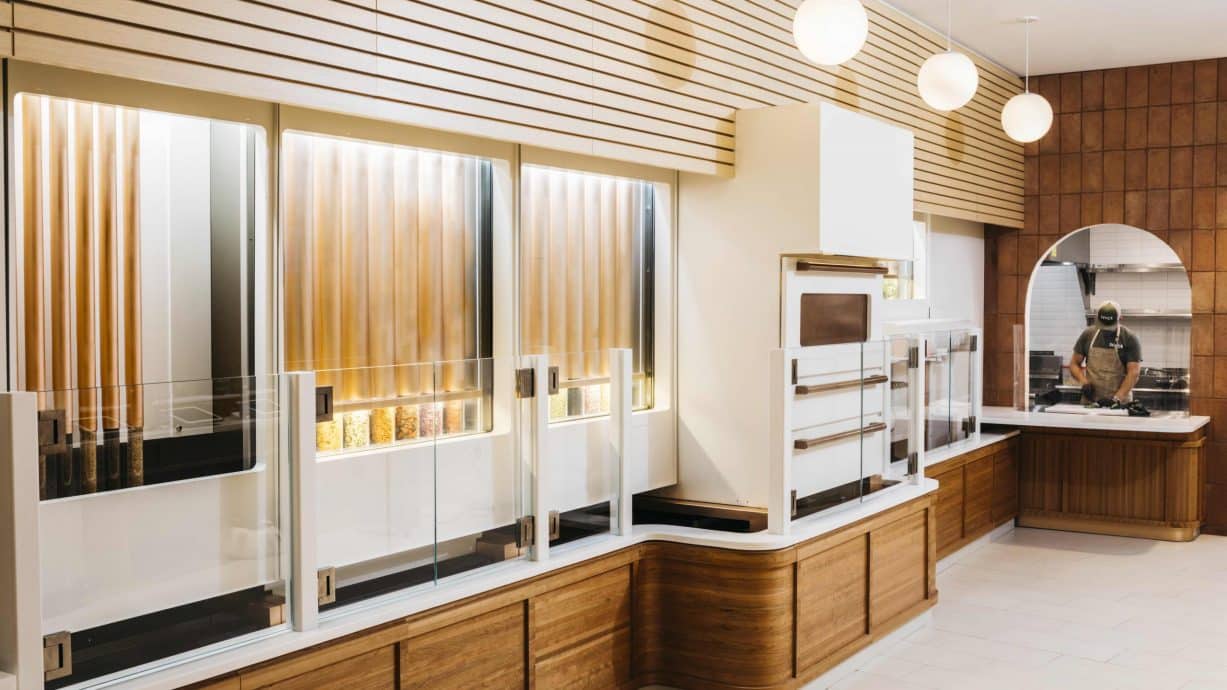
The transparent design of the Spyce kitchen was an intentional choice that turned meal preparation into a form of live entertainment for customers. Diners could watch their food travel along the conveyor system and drop into rotating woks that stirred and heated each ingredient combination precisely. This visibility built trust with customers who might otherwise feel uneasy about eating food prepared entirely by machines without human oversight. The concept of AI-enabled smart kitchens had existed in theory for years, but Spyce was among the first to make it a tangible consumer experience. The entertainment factor also generated significant social media attention, turning every meal into a potential viral moment for the brand.
The Engineering Behind Automated Wok-Based Cooking
The core of the Spyce system revolves around a series of cylindrical woks that rotate on mechanical axes to stir, heat, and portion food automatically. Each wok is heated using electromagnetic induction, which provides instant and precise temperature control far beyond what gas or electric burners can deliver. Induction heating eliminates open flames from the kitchen entirely, which reduces fire risk and creates a safer working environment for the few human employees present. The woks can reach cooking temperatures within seconds and maintain exact heat levels throughout the entire preparation cycle without fluctuation. Sensors embedded in each cooking station monitor temperature, rotation speed, and ingredient weight to ensure every bowl meets programmed specifications. This level of thermal precision would be nearly impossible for even the most skilled human chef to replicate consistently across hundreds of consecutive orders.
The ingredient dispensing system operates on a gravity-fed conveyor mechanism that releases exact portions from individual containers mounted above the cooking line. Each container holds a different ingredient, from grains and proteins to sauces and fresh vegetables, and dispenses them in a programmed sequence. The portioning accuracy means that food waste drops dramatically compared to traditional kitchens where cooks estimate quantities by eye and experience. The engineering principles behind this system share similarities with automated warehouse operations that use conveyor systems for sorting and packaging in industrial settings. Material flow engineering adapted from manufacturing gave Spyce an advantage in designing reliable, high-throughput food preparation systems.
The cleaning cycle represents another engineering achievement that most observers overlook when evaluating the Spyce system and its operational capabilities. After each bowl is prepared, the woks automatically flush themselves with water and sanitizing solution before accepting the next order. This self-cleaning mechanism runs continuously throughout service without requiring any manual intervention from staff members on the floor. The automated sanitation process ensures that allergen cross-contamination risks drop significantly compared to kitchens where cleaning depends on human diligence between orders. Health inspectors who visited early Spyce locations reportedly noted the exceptional cleanliness standards maintained by the robotic system throughout service hours. The entire cooking and cleaning cycle completes in approximately three minutes, allowing each wok station to process roughly twenty orders per hour.
From MIT Lab to Downtown Boston
Moving from a campus prototype to a commercial restaurant required the Spyce team to solve problems that no academic lab could simulate. They needed to find a location, navigate health department regulations, build a kitchen that met commercial building codes, and hire staff for customer-facing roles. The team chose Downtown Crossing in Boston for their first restaurant, a high-traffic area surrounded by office workers and college students who matched their target demographic perfectly. Opening day on May 3, 2018, marked the first time paying customers could order from a fully robotic kitchen in a permanent restaurant setting anywhere in the world. The response was immediate and overwhelming, with long lines forming as curious diners waited to watch robots cook their lunch in real time.
The restaurant served bowls priced at $7.50, which was significantly cheaper than comparable offerings at nearby fast-casual competitors charging ten to fifteen dollars for similar meals. This pricing was possible because the robotic kitchen eliminated the need for a full brigade of line cooks working multiple shifts every day. The founding team hired human employees for front-of-house roles, including greeting customers, applying finishing touches like dressings and garnishes, and maintaining the dining area. The model demonstrated that AI in robotics applications could deliver tangible consumer benefits rather than serving purely as a back-end efficiency tool hidden from public view. Spyce became proof that automation could make quality food more accessible rather than simply making restaurant operations more profitable.
Why Michelin-Starred Chef Daniel Boulud Backed a Robot
Daniel Boulud is one of the most respected chefs in the world, with multiple Michelin stars and restaurants spanning New York, London, and beyond. When Michael Farid cold-emailed him about the Spyce concept, most people would have expected the message to go unanswered or dismissed entirely. Farid guessed Boulud’s email address and sent a pitch that was equal parts audacious and sincere in its vision for robotic cooking. Two weeks later, Boulud visited the MIT campus to see the prototype in action and was genuinely impressed by what the machine could produce. He accepted the role of Culinary Director and made a personal financial investment in the company, lending his name and reputation to a venture that could easily have damaged his standing among traditional culinary peers. Boulud’s endorsement transformed Spyce from a student engineering project into a credible restaurant concept overnight.
Boulud’s involvement went far beyond lending his name to press releases and marketing materials distributed to potential investors. He connected the Spyce team with Sam Benson, a talented chef who had worked at Café Boulud and understood both fine dining standards and practical kitchen operations. Benson became Spyce’s Executive Chef, responsible for developing the actual recipes that the robotic system would prepare for paying customers daily. His expertise ensured that the food quality matched or exceeded what customers expected from traditional fast-casual restaurants in the same price range. The collaboration between engineering precision and culinary artistry became the defining characteristic of the Spyce brand identity.
The celebrity chef endorsement also attracted additional culinary investors who recognized the potential of marrying robotics with serious food preparation expertise. Thomas Keller, Jerome Bocuse, and Gavin Kaysen all invested in Spyce alongside Boulud, creating a culinary advisory board with extraordinary combined experience and reputation. These chefs understood that automation did not have to mean a sacrifice in food quality if the recipes were developed by people who genuinely cared about taste and presentation. Their involvement helped Spyce raise $21 million in Series A funding led by Collaborative Fund and Maveron, with continued support from Khosla Ventures. The fundraise signaled that Spyce had crossed a critical threshold from interesting experiment to investable business with genuine scaling potential ahead of it.
How the Infinite Kitchen Prepares Hundreds of Meals Every Hour
The second generation of Spyce’s technology launched in November 2020 under the name Infinite Kitchen, representing a major leap forward in throughput and versatility. This upgraded system could prepare up to 350 meals per hour in its initial configuration, a figure that later improved to roughly 500 meals per hour under Sweetgreen’s operational management. The Infinite Kitchen replaced the individual wok stations of the original design with a continuous conveyor belt system that moved bowls past ingredient dispensers in a customized sequence. Each customer’s order triggered a unique dispensing pattern, allowing for extensive menu customization without slowing down the overall production line at all.
The ordering process begins when a customer places their selection through a self-service kiosk, the mobile app, or directly with a human host at the restaurant entrance. The system immediately queues the order and assigns it to the next available bowl position on the conveyor belt moving through the kitchen. As the bowl travels along the track, automated dispensers release the correct ingredients in the exact quantities specified by the recipe and any customer modifications requested. The process resembles an automotive assembly line adapted for food preparation, with each station adding a specific component to the final product moving through.
After the ingredients are dispensed and cooked, the completed bowl arrives at a finishing station where a human team member adds final touches that require manual dexterity and presentation judgment. These finishing elements include items like whipped ricotta, fresh herbs, dressings, and delicate garnishes that benefit from a personal touch rather than mechanical dispensing mechanisms. The combination of robotic precision in cooking and human artistry in presentation creates a hybrid model that delivers both consistency and visual appeal simultaneously. This approach to robotic kitchen concepts in Japan and elsewhere has shown that the most successful automated food systems blend machine efficiency with human creativity rather than eliminating people entirely.
The entire process from order placement to a finished bowl in the customer’s hands takes approximately three minutes under normal operating conditions. This speed exceeds what most traditional fast-casual kitchens can achieve during peak lunch hours when orders stack up and human fatigue begins to affect performance. The system’s ability to maintain consistent speed regardless of order volume represents one of its strongest competitive advantages over conventional kitchen operations. Quality does not degrade as the day progresses because the machines do not experience the physical and mental fatigue that affects human line cooks during long, demanding shifts.
The Role of Human Workers Inside a Robotic Restaurant
Despite the fully automated kitchen, Spyce and its Infinite Kitchen successor always maintained a significant human workforce in every restaurant location they operated. Human employees handle customer greeting, order assistance, finishing and garnishing bowls, dining area maintenance, and ingredient preparation in the commissary kitchen. The commissary team preps all raw ingredients before they are loaded into the automated dispensing system, which means fresh vegetables are washed, proteins are marinated, and sauces are prepared by skilled workers each day. These roles require culinary knowledge and food handling certification that robots are not currently equipped to replicate reliably.
The human element extends beyond operational necessity into the realm of brand experience and customer relationship management at every level. Sweetgreen introduced a “host” position at its Infinite Kitchen locations specifically to create a more personalized connection between team members and guests entering the restaurant. This role did not exist in traditional Sweetgreen locations and represents a deliberate effort to add warmth and hospitality to an environment dominated by machines and screens. The approach acknowledges that the concerns about robots replacing human jobs are valid and require proactive solutions rather than dismissive reassurance from corporate leadership.
Team member turnover at Infinite Kitchen locations has been measurably lower than at traditional Sweetgreen restaurants, suggesting that employees prefer working alongside automation. Workers in automated locations spend less time performing physically demanding, repetitive tasks like assembling hundreds of salads by hand during peak hours. They instead focus on customer-facing activities, quality checks, and creative plating work that provides more job satisfaction than repetitive manual labor. The reduction in physically exhausting work may explain why staffing retention improves in environments where robots handle the most grueling parts of restaurant operations.
Sweetgreen’s Strategic Bet on Kitchen Automation
Sweetgreen acquired Spyce in August 2021 for approximately $70 million, a move that signaled the salad chain’s belief that automation would define the future of fast-casual dining. The acquisition came just months before Sweetgreen filed for its initial public offering, and ownership of proprietary robotic kitchen technology made the company significantly more attractive to public market investors seeking differentiation. Rising labor costs had been squeezing profit margins across the entire restaurant industry, and Spyce’s technology offered a structural solution rather than a temporary cost management tactic. The deal positioned Sweetgreen as a technology company that happened to sell salads rather than a restaurant chain experimenting with gadgets.
Integration took nearly two years before the first Sweetgreen Infinite Kitchen opened in Naperville, Illinois, in May 2023. The delay reflected the complexity of adapting Spyce’s technology from a standalone restaurant concept to a scalable system compatible with Sweetgreen’s existing supply chain and menu architecture. The Naperville location delivered restaurant-level margins of 26% in its first full month of operation, outperforming most new Sweetgreen locations from day one of business. This early financial performance validated the investment thesis and set the stage for an aggressive rollout plan that would eventually target half of all new Sweetgreen openings. Understanding the difference between automation versus AI helped Sweetgreen communicate clearly to investors that the Infinite Kitchen was a mechanical automation system enhanced by software intelligence.
How the Infinite Kitchen Cuts Labor Costs and Boosts Margins
The financial case for the Infinite Kitchen rests on documented labor savings that compound as the system scales across more locations nationwide. Sweetgreen reported that Infinite Kitchen restaurants consistently deliver approximately 700 basis points in labor savings compared to traditional locations of similar age and volume. They also generate nearly 100 basis points in cost-of-goods-sold improvement through more precise ingredient portioning that reduces waste across every shift. These savings translate directly to improved restaurant-level margins, with a Hingham, Massachusetts, location achieving 30% margins in its first full month of operation.
The system operates with roughly half the staff required to run a traditional Sweetgreen restaurant, which dramatically reduces the impact of rising minimum wages on operating costs. California’s fast-food minimum wage increase to $20 per hour in 2024 made the financial argument for automation even more compelling for chains operating in high-cost states. The Infinite Kitchen’s ability to maintain throughput without adding workers during peak periods means that labor costs remain relatively fixed regardless of sales volume fluctuations. This decoupling of labor costs from revenue is a structural advantage that traditional restaurants simply cannot replicate without fundamentally changing their operating model.
The return on capital for each Infinite Kitchen installation has been accretive from the earliest deployments, despite estimated upfront costs of $200,000 to $300,000 per location. Sweetgreen’s CFO noted that incremental flow-through at Infinite Kitchen locations runs approximately 70% compared to 40% for traditional sites, meaning each additional dollar of revenue generates significantly more profit. The Willis Tower location in Chicago, retrofitted with an Infinite Kitchen in late 2024, was described as being on pace to set operational records for the entire chain. These performance metrics have attracted attention from investors and competitors who see kitchen automation as the most promising path to sustainable profitability in fast-casual dining.
Customer Experience Inside an Automated Dining Concept
A January 2025 survey conducted by Sweetgreen found that 90% of customers at Infinite Kitchen locations expressed positive overall experiences, including satisfaction with food quality and ingredient freshness. The visual spectacle of watching bowls travel along a conveyor belt while ingredients drop precisely into place has become a distinctive brand experience that differentiates these locations from ordinary restaurants. Customers frequently photograph and share the process on social media platforms, generating organic marketing exposure that traditional restaurants must pay significant advertising budgets to achieve.
The ordering process itself has been streamlined to minimize friction between the decision to eat and the moment food arrives in the customer’s hands. Self-service kiosks, a mobile app, and the human host position offer three distinct ordering channels that accommodate different customer preferences and comfort levels with technology. Digital ordering through the app allows customers to customize their bowls extensively and schedule pickup times, which reduces wait times inside the restaurant during peak lunch hours. The combination of speed, customization, and entertainment creates a dining experience that appeals particularly to younger consumers who value efficiency and novelty.
Order accuracy at Infinite Kitchen locations approaches near-perfect levels because the automated dispensing system eliminates the human errors that plague traditional make lines. Incorrect toppings, wrong portion sizes, and missing ingredients are among the most common complaints in fast-casual dining, and robotic precision addresses all three problems simultaneously. The consistency also benefits customers with dietary restrictions or allergies who depend on accurate ingredient information and proper food handling to avoid health complications. The impact of robotics impacting the workplace extends well beyond efficiency metrics to encompass genuine improvements in the quality of service that end consumers receive daily.
Real Challenges of Scaling Robotic Kitchen Technology
The upfront capital investment required for each Infinite Kitchen installation represents a significant barrier for any restaurant chain considering automation at scale across its portfolio. Estimated costs of $200,000 to $300,000 per unit create a substantial financial commitment, particularly for companies like Sweetgreen that reported a net loss of $29 million in Q1 2025 alone. The payback period of twelve to twenty-four months requires patience from investors and operators who are accustomed to faster returns in the restaurant industry cycle. Smaller chains and independent restaurants face even greater challenges because they lack the volume and capital access needed to justify such expensive technology deployments.
Menu flexibility remains a persistent limitation that constrains the types of food that robotic kitchens can prepare compared to traditional kitchen setups. The Infinite Kitchen was originally designed for bowls and salads, which are inherently suitable for conveyor-based assembly but represent only a narrow slice of the total restaurant menu landscape. Expanding into hot foods, fried items, and more complex preparations like woks, ovens, and fryers requires substantial additional engineering that has not yet been proven at commercial scale anywhere. Wonder has stated its intention to extend the technology beyond bowls into other cuisines, but this ambition has not been validated in live restaurant operations yet.
Equipment reliability in high-volume, high-heat environments poses engineering challenges that are fundamentally different from those encountered in cleaner industrial automation settings. Restaurant kitchens are harsh environments where moisture, grease, food particles, and constant use create conditions that accelerate mechanical wear on moving parts and electronic sensors. A single equipment failure during the lunch rush can disrupt service for an entire restaurant because the automated system has no manual backup mode that staff can switch to immediately. The challenge of maintaining robotic systems in food robotics environments requires specialized technicians who combine mechanical, electrical, and food safety expertise in ways that traditional restaurant maintenance staff do not possess.
The lack of U.S. patents protecting core aspects of Spyce’s wok-based cooking system has been cited as a contributing factor in the company’s decision to shut down its original Boston locations. An independent inventor in Taiwan has claimed to hold patents on the fundamental stir-frying automation mechanism that Spyce’s system relies upon, raising questions about intellectual property protection for robotic kitchen innovations in general. Patent disputes in emerging technology sectors can create uncertainty that slows investment and complicates licensing arrangements between companies operating in overlapping technical spaces. This vulnerability highlights why technology companies in the food automation space must invest heavily in intellectual property strategy alongside engineering development.
Why Wonder Paid $186 Million for Spyce Technology
Wonder, the food platform founded by Marc Lore, acquired Spyce from Sweetgreen in November 2025 for $186.4 million, paying $100 million in cash and $86.4 million in Wonder stock. The price represented a significant premium over the $70 million Sweetgreen originally paid for Spyce just four years earlier, reflecting the proven commercial performance of the Infinite Kitchen system across more than twenty locations. Wonder’s vision extends far beyond salad bowls to encompass a multi-concept restaurant platform where robotic kitchens could prepare dishes from dozens of different cuisine types in a single compact facility. The acquisition included 38 Spyce engineers and all four original co-founders who would transition to building Wonder’s automated food preparation infrastructure.
Wonder operates over eighty locations across the United States using a model where customers can order from multiple restaurant concepts on a single ticket. The company partners with celebrity chefs including Bobby Flay, José Andrés, Nancy Silverton, and Marcus Samuelsson to offer diverse menus under one roof. Adding Spyce’s robotic kitchen technology gives Wonder the ability to automate meal preparation across these varied concepts while maintaining the consistency and speed that each brand demands. The company has stated plans to open an Infinite Kitchen inside one of its Manhattan locations in 2026 and install the technology in fifty to one hundred kitchens by 2027.
The acquisition positions Wonder as the only food platform that owns both delivery infrastructure and robotic kitchen technology, creating a vertically integrated model with no direct competitor. Wonder’s previous purchases of Grubhub for $650 million and Blue Apron for $103 million already established its control over delivery logistics and meal kit operations. Adding Spyce’s manufacturing capabilities completes a technology stack that spans from recipe development through automated cooking to last-mile delivery without relying on any external partners. This vertical integration strategy mirrors approaches used in other industries where companies like Amazon have demonstrated the competitive advantages of controlling every step in the value chain.
How Food Robotics Is Reshaping the Fast-Casual Industry
The fully automated restaurant market is projected to reach $6.7 billion by 2033, driven by deployment across fast-casual chains, university cafeterias, airport food courts, and eventually fine-dining establishments. The smart restaurant robot industry as a whole is expected to exceed $10 billion by 2030, covering applications from cooking and assembly to delivery and table service in commercial settings. These projections reflect a fundamental shift in how the restaurant industry approaches labor, quality, and scalability challenges that have intensified since the pandemic exposed vulnerabilities in traditional staffing models.
Spyce’s journey helped establish the viability of kitchen automation in fast-casual dining and inspired a wave of competitors developing their own robotic food preparation systems. Flippy, the burger-flipping robot developed by Miso Robotics, has raised $125 million and deployed in thirteen quick-service locations as of early 2025 for repetitive tasks like grilling and frying. PizzaBot and P-Robo handle pizza assembly and pasta preparation respectively, while BellaBot has become a common sight delivering food directly to tables in restaurants across the country. The landscape of robot-powered pizza restaurants and similar concepts continues to expand as costs decrease and the technology matures enough for mainstream commercial deployment.
Ethical Questions Around Replacing Kitchen Staff with Machines
The conversation about robotic kitchens cannot avoid the reality that automation directly reduces the number of cooking positions available in an industry that employs millions of workers across the country. Sweetgreen’s own data shows that Infinite Kitchen locations operate with roughly half the staff required at traditional restaurants, which means each new automated location eliminates several full-time cooking positions. The restaurant industry has historically served as an entry point for workers without college degrees, immigrants, and young people seeking their first employment experience. Reducing these opportunities has consequences that extend beyond individual job losses to affect entire communities where restaurant work forms a significant portion of the local employment base.
Proponents of kitchen automation argue that the technology creates new, higher-skilled positions that offer better working conditions and pay than traditional line cook roles in the industry. Roles in robotics maintenance, software management, commissary operations, and customer experience design require different skills but offer more sustainable career paths than physically demanding kitchen work. The shift mirrors what happened in manufacturing when automation replaced assembly line jobs with technician and programming positions that required additional training but provided better compensation. Companies investing in the transition to Samsung’s Bot Chef system and similar technologies have a responsibility to invest equally in retraining programs for displaced workers.
The ethical dimension becomes more complex when considering that the workers most affected by kitchen automation are disproportionately from marginalized communities with fewer alternative employment options. Restaurant kitchen jobs have historically been accessible to people regardless of educational background, language proficiency, or immigration status, and these workers cannot easily transition to the technical roles that automation creates. Any responsible approach to kitchen automation must include workforce transition programs, educational partnerships, and community investment commitments that address the human cost of technological progress directly. The industry cannot simply celebrate efficiency gains while ignoring the social impact on the people who built the food service workforce that automation is designed to replace.
Comparing Spyce to Other Robotic Restaurant Concepts
Spyce’s Infinite Kitchen is not the only robotic restaurant system operating in the market, and understanding how it compares to competitors reveals important differences in approach and capability. Creator, a San Francisco-based burger restaurant, built a fully automated system that assembled and cooked gourmet hamburgers using robotic arms and gravity-fed ingredient chutes in a format visually similar to Spyce’s conveyor approach. Miso Robotics took a different path by developing Flippy, a modular robotic arm that retrofits into existing kitchen setups to handle specific tasks like frying and grilling without requiring a complete kitchen redesign. Each approach offers distinct advantages depending on the restaurant format, menu complexity, and capital investment tolerance of the operator.
The key advantage of Spyce’s system over competitors lies in its end-to-end integration of the entire meal preparation process from ingredient dispensing through cooking to cleaning. Flippy and similar modular systems automate individual tasks within a traditional kitchen but still require human workers to manage the overall workflow and handle all non-automated steps between cooking stations. Spyce’s approach eliminates the need for anyone to stand over the cooking line at all, which delivers greater labor savings but also requires a larger upfront investment and more complex maintenance infrastructure. The concepts behind robotic café operations demonstrate that there are multiple viable models for integrating automation into food service at different scales and investment levels.
The modular approach championed by companies like Miso Robotics may ultimately reach more restaurants because it does not require operators to rebuild their entire kitchen around a new system. A restaurant owner can add a Flippy unit to handle frying for a few thousand dollars per month rather than investing hundreds of thousands in a complete Infinite Kitchen installation that transforms the entire operation. This accessibility difference means that modular robotics may spread more rapidly across independent restaurants and smaller chains while integrated systems like the Infinite Kitchen remain concentrated in well-capitalized brands with aggressive automation strategies.
What Went Wrong with Spyce’s Original Boston Locations
Spyce closed its original Downtown Crossing restaurant in Boston in October 2021, just months after Sweetgreen completed the acquisition of the company for $70 million. The closure was framed as a strategic decision to allow the engineering team to focus entirely on developing the Infinite Kitchen technology for deployment across Sweetgreen’s existing restaurant network. The original Spyce restaurant had served as a proof of concept and testing ground, but its standalone format was not part of Sweetgreen’s vision for how the technology should scale into the broader market.
The underlying challenges went deeper than simple strategic redirection and reflected fundamental difficulties in operating a standalone robotic restaurant as an independent business. The original Spyce format required specialized maintenance for its robotic systems that created operating costs not faced by traditional restaurants with conventional kitchen equipment. Patent vulnerabilities related to the core stir-frying mechanism created intellectual property uncertainty that complicated the company’s ability to attract continued independent funding and expansion capital. The transition from standalone restaurant brand to embedded technology platform within Sweetgreen represented an acknowledgment that Spyce’s greatest value lay in its engineering rather than its ability to operate consumer-facing restaurants independently and profitably.
The Business Case for Automation in Rising-Cost Restaurants
Restaurant operators across the United States face a convergence of cost pressures that make the financial argument for kitchen automation stronger with each passing year. Labor costs continue to rise as minimum wage increases take effect in states across the country, with California’s fast-food minimum wage reaching $20 per hour in 2024 alone. Food costs remain volatile due to supply chain disruptions, climate-related agricultural challenges, and geopolitical factors that affect ingredient prices unpredictably from month to month. These pressures squeeze already thin restaurant margins, which typically range between three and nine percent for most operators in the fast-casual segment nationwide.
The Infinite Kitchen’s demonstrated ability to deliver 700 basis points in labor savings represents a structural advantage that compounds as wage inflation continues to accelerate across the industry. A traditional restaurant spending 30% of revenue on labor could reduce that figure to approximately 23% with an Infinite Kitchen installation, freeing resources for food quality improvements, marketing, or profitability enhancement. The 100 basis points in cost-of-goods improvement from precise portioning adds further margin protection against ingredient price volatility that operators cannot control through any other operational mechanism available today. These savings make the $200,000 to $300,000 upfront investment recoverable within twelve to twenty-four months at locations with sufficient volume.
The most compelling element of the business case is that automation provides a permanent structural advantage rather than a one-time cost reduction that competitors can easily replicate. Training programs, process improvements, and management initiatives can temporarily improve efficiency, but these gains erode as employee turnover, which averages over 70% annually in the restaurant industry, continuously resets institutional knowledge. A robotic kitchen retains every process improvement permanently and never requires retraining when a new employee joins the team. The permanence of automated efficiency gains creates a widening competitive gap between restaurants that adopt the technology early and those that continue relying exclusively on human labor.
Where Robotic Kitchen Technology Is Headed Next
Wonder’s acquisition of Spyce signals the beginning of a new chapter where robotic kitchen technology expands beyond bowls and salads into a much wider range of cuisine types and restaurant formats. The company has explicitly stated its intention to develop automated systems for fryers, ovens, woks, beverages, and other cooking methods that would allow a single compact kitchen to prepare meals from multiple restaurant concepts simultaneously. This ambition represents a significant engineering challenge because each cooking method involves different temperature profiles, timing requirements, and ingredient handling characteristics that demand specialized robotic solutions. Success in this expansion would transform Wonder from a food delivery platform into something closer to an automated food manufacturing company.
The broader industry trajectory points toward robotic kitchens appearing first in high-volume, standardized environments where the technology’s strengths in consistency and speed deliver the greatest operational impact quickly. University cafeterias, airport food courts, corporate dining facilities, and hospital kitchens are all environments where large volumes of meals must be prepared quickly with consistent quality and strict food safety compliance. These institutional settings often struggle with the same labor challenges facing commercial restaurants but have even less flexibility in pricing to absorb rising costs. The market for automated food preparation in institutional settings alone could represent several billion dollars in annual opportunity.
Younger consumers who have grown up with technology-mediated experiences in every aspect of their lives represent the demographic most likely to embrace robotic restaurant concepts without hesitation. Research consistently shows that Gen Z and millennial diners prioritize speed, transparency, and novelty in their dining choices, all areas where automated kitchens excel compared to traditional restaurant operations. As this demographic becomes the dominant spending cohort in the restaurant industry, their comfort with technology-driven dining experiences will accelerate adoption of robotic kitchen systems across all restaurant formats. The question is no longer whether robotic kitchens will become mainstream but how quickly the transition will occur and which companies will lead the transformation of this global industry.
How Consumers Actually Feel About Robot-Prepared Food
Consumer acceptance of robotic food preparation has evolved significantly from initial skepticism to growing enthusiasm as more people experience automated restaurants firsthand and share their reactions publicly. Sweetgreen’s survey data showing 90% positive customer experiences at Infinite Kitchen locations suggests that most diners care more about food quality, speed, and accuracy than whether a human or machine assembled their meal during the process. The visual transparency of the system, where customers watch their bowl being built in real time, addresses the trust gap that many consumers feel when they cannot see how their food is being prepared behind closed kitchen doors.
Skeptics remain among consumer groups who associate handmade food with authenticity, care, and cultural tradition that robotic systems cannot replicate regardless of their technical sophistication. Fine dining establishments are unlikely to adopt robotic kitchens because their value proposition depends on the artistry, creativity, and human judgment of individual chefs whose reputations attract customers willing to pay premium prices. The sweet spot for robotic kitchen adoption lies in the fast-casual segment where customers prioritize value, speed, and consistency over the craftsmanship narrative that defines higher-end dining experiences. The most successful automated restaurant concepts will be those that complement rather than compete with the human elements of dining that consumers continue to value deeply in their overall experience.
Lessons Other Industries Can Learn from the Spyce Experiment
The Spyce story offers a masterclass in how startups can navigate the gap between technical innovation and commercial viability in industries resistant to change. The founders understood early that technological novelty alone would not sustain a business in an industry where taste, trust, and affordability determine success or failure within months. Recruiting Daniel Boulud as a culinary advisor demonstrated the importance of securing credibility from established industry figures who can validate an outsider’s approach to skeptical customers and investors. The lesson applies broadly to any technology company attempting to disrupt a traditional industry where expertise and reputation carry enormous weight.
The transition from standalone restaurant to technology platform embedded within Sweetgreen, and then sold to Wonder, illustrates the strategic flexibility required when a startup’s original business model encounters unexpected limitations in the marketplace. Spyce’s value was always in its engineering rather than its ability to manage individual restaurant locations, and the company’s leadership recognized this reality before burning through capital trying to scale an unsustainable standalone model. This willingness to pivot from operator to technology provider allowed the founding team to maximize the value of their innovation while finding partners better equipped to handle consumer-facing operations at large scale.
The most enduring lesson from Spyce is that automation succeeds not when it eliminates humans entirely but when it redefines the relationship between people and machines in ways that benefit both workers and customers simultaneously. The Infinite Kitchen does not run without people, and the restaurants that use it are not devoid of human warmth, creativity, or hospitality in their daily operations. The technology handles repetitive, physically demanding tasks that cause burnout and turnover while freeing people to focus on work that requires empathy, judgment, and creative expression that no machine can replicate yet. This human-machine partnership model offers a template for automation across industries far beyond food service, from healthcare to manufacturing to retail.
Key Insights
- Incremental flow-through at Infinite Kitchen locations runs approximately 70% compared to 40% for traditional sites, meaning each additional revenue dollar generates nearly twice the profit at automated locations versus conventional restaurants.
- The Infinite Kitchen’s ability to prepare up to 500 bowls per hour exceeds the combined output of traditional front and digital make lines by approximately 50%, demonstrating that automation can dramatically outpace human throughput in standardized food preparation tasks.
- Sweetgreen’s Infinite Kitchen locations deliver approximately 700 basis points in labor savings and nearly 100 basis points in cost-of-goods improvement, proving that kitchen automation generates measurable and sustained financial benefits at scale.
- The fully automated restaurant market is expected to grow to $6.7 billion by 2033, with early adoption concentrated in fast-casual chains, university cafeterias, and airport food courts where volume and standardization favor robotic systems.
- Restaurant operators report that 89% face rising staff expenses in 2025, creating economic pressure that makes the business case for kitchen automation increasingly difficult to ignore across all segments of the industry.
- The smart restaurant robot industry overall is projected to exceed $10 billion by 2030, covering kitchen robots, delivery bots, and AI-powered administrative systems that transform both front-of-house and back-of-house operations.
- Wonder plans to install Infinite Kitchen technology in 50 to 100 kitchens by 2027, extending the system beyond bowls into fryers, ovens, woks, and beverages across multiple cuisine types within its growing restaurant platform.
| Dimension | Traditional Restaurant Kitchen | Spyce Infinite Kitchen | Impact Assessment |
|---|---|---|---|
| Transparency | Kitchen hidden from diners; preparation not visible | Fully visible conveyor system; customers watch meal assembly | Builds consumer trust; generates social media engagement |
| Worker Participation | Full human staffing across all cooking positions | Approximately 50% fewer staff; humans handle finishing and hospitality | Reduces headcount but creates new host and technician roles |
| Consumer Trust | Built through brand reputation and word-of-mouth over time | Built through visible preparation process and consistent quality metrics | Automated transparency can accelerate trust-building with new customers |
| Decision Making | Relies on individual cook judgment; varies by skill and experience level | Algorithmically controlled; recipes executed identically every time | Eliminates variability but removes individual chef creativity from cooking |
| Misinformation Risk | Menu accuracy depends on staff training and communication quality | Near-perfect order accuracy through automated dispensing and tracking systems | Reduces complaints from incorrect orders and allergen-related incidents |
| Service Delivery | Speed varies with volume, staffing levels, and individual cook performance | Consistent three-minute preparation time regardless of order volume or time of day | Eliminates peak-hour slowdowns that frustrate customers at traditional restaurants |
| Accountability | Quality depends on management oversight and individual employee diligence | System-level monitoring with sensors tracking temperature, weight, and timing | Creates data trail for quality assurance that human-run kitchens cannot match |
| Cost Structure | Labor costs 25-35% of revenue; highly sensitive to minimum wage increases | Labor costs reduced by approximately 700 basis points; decoupled from wage inflation | Provides structural cost advantage that compounds over time as wages continue rising |
Real-World Examples
Sweetgreen Naperville, Illinois – First Infinite Kitchen Deployment
Sweetgreen opened its first Infinite Kitchen in Naperville, Illinois, in May 2023, marking the commercial debut of Spyce’s technology within a major restaurant chain’s operations. The location achieved restaurant-level margins of 26% in its first full month, exceeding the performance of most new Sweetgreen openings in the chain’s history. The automated make line could produce 400 to 500 bowls per hour, approximately 50% more than traditional front and digital lines combined at comparable locations. Customer feedback was overwhelmingly positive, with diners praising speed, cleanliness, and the novelty of watching robotic food preparation in real time. The Naperville location required about one-third fewer workers to operate compared to a traditional Sweetgreen restaurant of similar size and volume. Critics noted that the system’s menu was limited to bowls and salads, restricting its applicability to restaurant concepts with broader and more complex menu offerings. Source: Restaurant Business Online
Sweetgreen Willis Tower, Chicago – High-Volume Urban Retrofit
The Willis Tower location in Chicago was retrofitted with an Infinite Kitchen system in Q4 2024, testing whether the technology could be installed in an existing high-volume urban restaurant without significant disruption to ongoing operations. The retrofitted location was described by Sweetgreen’s CEO as being on pace to set operational records for the entire chain, demonstrating that automation delivers even greater benefits in high-traffic urban environments. Digital sales lines at the location comped approximately 15%, suggesting that the automated system attracted additional customer traffic beyond what the location had previously captured. The retrofit cost and timeline were not publicly disclosed, but company officials noted that the modular design of the Infinite Kitchen allowed for installation in existing spaces without complete kitchen demolition. The success of the Willis Tower conversion influenced Sweetgreen’s decision to accelerate retrofits at other high-performing urban locations across its portfolio. The limitation is that retrofitting involves downtime and construction that temporarily reduces revenue at locations that are already performing well. Source: QSR Magazine
Sweetgreen Hingham, Massachusetts – Margin Leadership
The Hingham, Massachusetts, Infinite Kitchen location achieved a 30% restaurant-level margin in its first full month of operation, the highest recorded among all Infinite Kitchen deployments to date. This performance exceeded the 26% margin achieved by the original Naperville location, suggesting that operational learnings from earlier deployments were being successfully incorporated into newer installations. The location’s suburban setting demonstrated that the Infinite Kitchen format works effectively outside dense urban centers where labor costs and real estate pressures are somewhat different. A January 2025 customer survey found that 90% of diners at Infinite Kitchen locations rated food quality and freshness positively. The strong margin performance supported Sweetgreen’s projection of an 800-basis-point margin advantage for Infinite Kitchens over traditional locations as the system matures. The limitation remains that these are early-stage results from a small sample size that may not hold as the system deploys to less favorable locations with different customer demographics. Source: QSR Magazine
Case Studies
Spyce’s Original Boston Restaurant – Proof of Concept and Its Limits
Spyce opened its first restaurant in Downtown Crossing, Boston, in May 2018, becoming the world’s first permanent restaurant featuring a fully robotic kitchen preparing meals for paying customers. The problem the founders set out to solve was straightforward: college students and urban workers needed access to nutritious, tasty meals at prices below $10 without sacrificing food quality or preparation speed. The solution combined inductively heated mechanical woks with automated ingredient dispensing to cook complex bowls in under three minutes at $7.50 per serving. The concept attracted enormous media attention and validated customer interest in robotic food preparation at a time when most people considered the idea purely theoretical or futuristic.
The measurable impact was significant in proving that consumers would embrace robot-prepared food when the quality, price, and experience met their expectations consistently throughout daily operations. The restaurant served as a living laboratory that generated the operational data and engineering insights necessary to develop the second-generation Infinite Kitchen system launched in 2020. The limitation that ultimately constrained Spyce’s independent growth was the absence of U.S. patents protecting the core stir-frying automation mechanism, which created intellectual property vulnerability that complicated fundraising and expansion planning. The restaurant closed in October 2021 after Sweetgreen’s acquisition, with the company acknowledging that its engineering value exceeded its viability as a standalone restaurant operator in a competitive Boston market. Source: The Robot Report
Sweetgreen’s Infinite Kitchen Rollout – From Pilot to Portfolio Strategy
Sweetgreen faced a strategic challenge common to growing fast-casual chains: scaling operations while managing rising labor costs that were eroding restaurant-level margins across the entire portfolio nationwide. The company’s 2021 acquisition of Spyce for $70 million provided access to robotic kitchen technology that could fundamentally restructure its cost model at a time when wages were rising and worker shortages were intensifying across the country. The solution was to integrate Spyce’s technology into a new restaurant format called the Infinite Kitchen, launching the first location in Naperville, Illinois, in May 2023 after nearly two years of integration work.
By the end of 2024, Sweetgreen operated twelve Infinite Kitchen locations delivering 700 basis points in labor savings and improved cost-of-goods performance at every deployment. The company projected plans to reach 33 Infinite Kitchen locations by end of 2025, dedicating half of all new development to the automated format going forward. The controversy emerged when Sweetgreen’s same-store sales declined 9.5% in Q3 2025, raising questions about whether automation investment was distracting management from addressing fundamental demand challenges across the broader business. The decision to sell Spyce to Wonder for $186 million in November 2025 suggested that the technology’s value was more fully realized as a standalone platform than as an embedded capability within a single restaurant chain. Source: Restaurant Dive
Wonder’s Acquisition – Building a Tech-Driven Food Platform
Wonder, the food platform founded by Marc Lore, recognized that its multi-concept restaurant model could achieve transformative efficiency gains by owning robotic kitchen technology rather than relying exclusively on human-operated kitchens across its growing network. The problem was that operating multiple restaurant concepts from a single kitchen location required extraordinary coordination, consistency, and speed that human staffing alone struggled to deliver reliably at the scale Wonder envisioned. The $186.4 million acquisition of Spyce in November 2025 gave Wonder ownership of both the Infinite Kitchen hardware and the engineering team that developed it, including all four original MIT co-founders.
The planned impact is substantial, with Wonder targeting an Infinite Kitchen deployment in a Manhattan location in 2026 and installations in fifty to one hundred kitchens by 2027 across its expanding restaurant network. The acquisition completed Wonder’s vertical integration strategy alongside its previous purchases of Grubhub and Blue Apron, creating the only food platform that controls delivery logistics, meal kit operations, and robotic food manufacturing simultaneously. The limitation and controversy center on whether a system designed primarily for bowl and salad assembly can be successfully adapted for the diverse range of cuisines that Wonder’s multi-concept model requires, from Bobby Flay burgers to José Andrés Mediterranean dishes, without sacrificing the quality that celebrity chef partnerships demand. Source: Food On Demand
Frequently Asked Questions On Spyce Robotic Kitchens
The Infinite Kitchen uses a conveyor belt system that moves bowls past automated ingredient dispensers, which release precise portions into each bowl according to the customer’s order. Inductively heated cooking stations then bring ingredients to exact temperatures with precision that exceeds manual cooking capabilities. The system completes an entire meal from order to finished bowl in approximately three minutes. A human team member adds final garnishes and finishing touches before the bowl reaches the customer.
Four MIT mechanical engineering graduates founded Spyce in 2015: Michael Farid, Kale Rogers, Luke Schlueter, and Brady Knight. The first Spyce restaurant opened in Downtown Crossing, Boston, on May 3, 2018, serving bowls at $7.50 each. Michelin-starred Chef Daniel Boulud served as Culinary Director and personally invested in the company after seeing the prototype. The founding team raised $21 million in Series A funding from Collaborative Fund, Maveron, and Khosla Ventures.
Sweetgreen sold Spyce to Wonder for $186.4 million in November 2025 after experiencing declining same-store sales and mounting net losses that pressured the company’s financial position. The sale generated cash and strategic equity that Sweetgreen could redirect toward its core restaurant operations and growth initiatives. Sweetgreen retained a license to continue using the Infinite Kitchen technology in its own restaurants through a supply agreement with Wonder. The original $70 million acquisition price grew to $186 million in value, validating the technology investment.
The Infinite Kitchen does not eliminate humans from the restaurant entirely, though it does reduce the total number of workers needed by approximately half compared to traditional locations. Human employees handle customer greeting, order assistance, ingredient preparation in commissary kitchens, and finishing touches on completed bowls. Sweetgreen created a new “host” position specifically for Infinite Kitchen locations to provide personalized customer interaction that machines cannot deliver. Worker turnover at automated locations is measurably lower than at traditional Sweetgreen restaurants.
Industry estimates place the cost of each Infinite Kitchen installation between $200,000 and $300,000, though exact figures have not been publicly confirmed by Sweetgreen or Wonder. The investment typically pays back within twelve to twenty-four months through labor savings and improved cost-of-goods performance. Sweetgreen reported that costs are declining as the company achieves economies of scale with each new deployment across its restaurant network. The modular design allows for flexibility in layout and configuration based on each location’s specific spatial constraints.
The current Infinite Kitchen system is optimized for bowls, salads, and grain-based dishes that can be assembled on a conveyor belt with automated ingredient dispensing. Sweetgreen expanded the system to handle warm foods and protein plates in addition to its core cold salad offerings. Wonder has announced plans to extend the technology to fryers, ovens, woks, and beverage preparation across multiple cuisine types. The system’s expansion into more complex cooking methods has not yet been proven at commercial scale.
A January 2025 customer survey found that 90% of diners at Infinite Kitchen locations rated food quality and ingredient freshness positively. Order accuracy approaches near-perfect levels because automated dispensing eliminates the human errors that cause incorrect toppings, wrong portions, and missing ingredients. Recipes are developed by professional chefs and executed identically every time without variation between shifts, locations, or individual cooks. The consistency advantage grows most apparent during high-volume peak periods when human-operated kitchens typically experience quality declines due to fatigue.
Spyce closed its Downtown Crossing location in Boston in October 2021, shortly after Sweetgreen completed the acquisition of the company. The closure was described as a strategic decision to focus the engineering team entirely on developing technology for Sweetgreen’s restaurant network. Underlying challenges included patent vulnerabilities related to the core stir-frying mechanism and the difficulty of operating a standalone robotic restaurant profitably. The technology continued under the Infinite Kitchen brand within Sweetgreen’s locations nationwide.
Complete integrated systems like the Infinite Kitchen remain primarily accessible to well-capitalized chains due to the $200,000 to $300,000 installation cost per location. Independent restaurants can access modular robotic solutions like Flippy, which handles specific tasks like frying and grilling for lower monthly costs. The restaurant automation market continues to develop more affordable options as technology costs decline with increased manufacturing scale. Companies like Miso Robotics offer subscription-based pricing models that reduce the upfront capital burden for smaller operators.
Sweetgreen reported that Infinite Kitchen locations deliver approximately 700 basis points in labor savings and nearly 100 basis points in cost-of-goods improvement. The Hingham, Massachusetts, location achieved 30% restaurant-level margins in its first month, compared to typical new-store margins around 20%. Incremental flow-through at automated locations runs approximately 70% versus 40% at traditional sites, meaning additional revenue generates nearly twice the profit. These margin improvements compound as wage inflation continues to rise across the restaurant industry.
Equipment reliability in harsh kitchen environments poses significant engineering challenges that differ from cleaner industrial automation applications. Menu flexibility remains limited, with current systems optimized for bowls and salads rather than the full range of cuisine types most restaurants require. Upfront capital costs create financial barriers for smaller operators, and the lack of manual backup systems means equipment failures can shut down service entirely. Intellectual property disputes around core cooking mechanisms create legal uncertainty for companies operating in overlapping technical domains.
Industry projections suggest the fully automated restaurant market will reach $6.7 billion by 2033, indicating strong growth but not yet universal adoption. The technology is most likely to spread first through large chains with standardized menus and high volumes that maximize return on investment. Independent and smaller restaurants will adopt modular solutions that automate specific tasks rather than full kitchen replacement systems. Consumer acceptance data showing 90% positive experiences at existing locations suggests that demand-side resistance is unlikely to slow adoption significantly.
Wonder intends to extend the Infinite Kitchen beyond bowls and salads into fryers, ovens, woks, and beverages to support its multi-concept restaurant platform. The company plans to deploy the technology in a Manhattan location in 2026 and install it in fifty to one hundred kitchens by 2027. Wonder’s model allows customers to order from multiple restaurant concepts on a single ticket, and automated kitchens could prepare diverse meals simultaneously in one compact facility. The goal is to eventually operate over one hundred restaurants across every cuisine type from a small kitchen footprint.
Automated kitchens reduce food safety risks by eliminating human handling during the cooking process and executing self-cleaning cycles between every order automatically. Sensor-based monitoring tracks temperature, cooking time, and ingredient weights continuously, creating a data trail for food safety compliance documentation. Cross-contamination risks decrease because the system follows programmed protocols rather than relying on individual worker diligence during busy service periods. Health inspectors at early Spyce locations noted exceptional cleanliness standards maintained consistently throughout all operating hours.
Precise ingredient portioning through automated dispensing significantly reduces food waste compared to traditional kitchens where cooks estimate quantities by eye. Induction cooking uses energy more efficiently than gas burners, converting a higher percentage of electrical energy directly into heat for cooking. Reduced food waste and energy consumption create a smaller environmental footprint per meal served compared to conventional restaurant kitchen operations. The full lifecycle environmental impact, including manufacturing and disposing of robotic equipment, has not yet been comprehensively studied.